

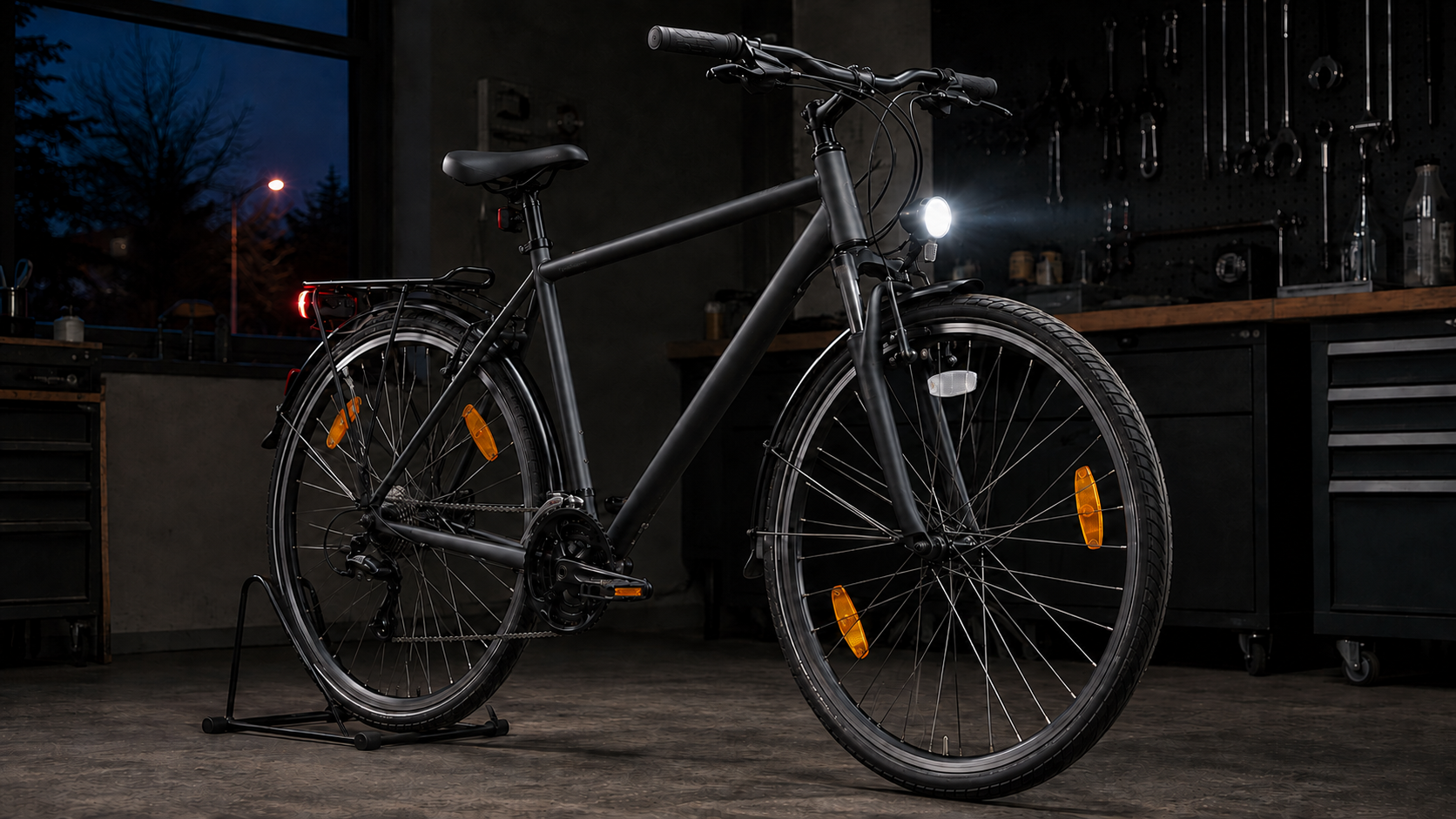
A bright jacket and a powerful battery do not replace required bicycle lighting. For bicycles and standard pedelecs, Section 67 of the German Road Traffic Licensing Regulations (StVZO) specifies which lights and reflectors must be present. Removable lights are permitted, but in dusk, darkness, or otherwise poor visibility, they must be mounted and ready for use. Before riding, therefore, it is not enough to simply “turn on the lights”; take a quick walk around the entire bicycle.
Bicycle lighting: What is part of the basic equipment?
Section 67 of the German Road Traffic Licensing Regulations (StVZO) distinguishes between active lights and passive reflectors. The white headlight at the front and the red rear light at the back emit light actively. Reflectors return incident light and remain important even when a battery is empty. Together, the required components form the lighting equipment.
- at the front, one or two headlights with white light,
- at the front, at least one white reflector,
- at the rear, at least one red rear light,
- at the rear, a red, non-triangular Category Z reflector,
- yellow reflectors facing forward and backward on each pedal,
- Side reflectors on both wheels in a permitted configuration.
Additional permitted lights can improve visibility. However, they do not replace any missing required component. A reflective backpack or high-visibility vest is also only an addition.
White at the front, red at the back
The headlight shines white toward the front, while the rear light shines red toward the back. Flashing headlights and flashing rear lights are not permitted on bicycles under Section 67. Steady light makes it easier for other road users to judge direction and distance.
A removable set may be carried during the day. As soon as dusk, darkness, or poor visibility makes it necessary, it must be mounted. Simply having it in your backpack is not sufficient then. Before a longer ride, check that the mounts are secure, that the battery and backup power are sufficient, and that the lights can be mounted without tools.
Correctly aiming the headlight is a separate issue: it should make the road visible without dazzling oncoming traffic. This article focuses on the required equipment; the angle and cutoff line are checked separately.
The white front reflector
In addition to the headlight, a white reflector is also required at the front. It may be integrated into the headlight if the approved component has this function. Whether this is the case cannot be determined solely by looking at a white surface. Product labeling and the manufacturer's documentation provide the answer.
For a separate reflector, check that it is aligned vertically, clean, and not obscured by cables, a basket, or luggage. A small, dull, or heavily scratched surface may perform its function less effectively and should be inspected.
Red rear light and category Z rear reflector
At the rear, a red taillight and a red category Z reflector are required equipment. Here too, an approved component can combine several functions. An arbitrary red plastic part is not proof of an approved rear reflector.

Panniers, rain covers, and luggage on the rear rack can restrict visibility. After loading, check from a few meters away and at the height of following traffic whether the light and reflectors are clearly visible. A trailer is subject to additional requirements that are not fulfilled by the towing bicycle’s rear light alone.
Pedal reflectors are often overlooked
Each pedal needs yellow reflectors that are visible from the front and rear. These surfaces are sometimes missing on sporty clipless pedals or very small platform pedals. For a bicycle used on public roads, you should therefore check when buying the pedals whether the required reflectivity is present or can be retrofitted with a designated, approved system.
Dirt quickly builds up on pedals. A soft cloth is usually sufficient for a visual inspection. If a reflector is broken or missing after contact with a curb or bike rack, it should be replaced before the next ride in the dark.
Side visibility of the wheels
For each wheel, § 67 requires side marking. Permitted options include continuous white reflective rings on tires or rims, fully white-reflective spokes or spoke sleeves, or at least two yellow spoke reflectors positioned 180 degrees apart. Not every decorative reflective film meets the technical requirements.
A single yellow spoke reflector per wheel is not enough. Therefore, when changing a wheel or fitting new tires, it is not only the size that is checked, but also whether the selected reflective solution remains complete. White reflective rings must not be rendered practically ineffective by rim stickers, dirt, or unfavorable installation.
How do I recognize approved lighting?
The design of certain lighting equipment must be officially approved in accordance with § 22a StVZO. In retail, this is often indicated by a test mark on the lamp or reflector, such as a wavy line with the letter K and a number. A CE marking alone does not answer the question of design approval under road traffic law.
When buying, specifically look for a light approved for bicycles in Germany. The product description, packaging, and component should be checked against one another. Statements such as “extremely bright,” “outdoor lamp,” or “USB light” are not a substitute for approval.
Dynamo, battery, or e-bike battery?
The StVZO permits different energy sources, provided that the lights and power supply are compatible and fulfill the required function. A hub dynamo is independent of the charge level of a carried lamp battery. Rechargeable-battery and battery-powered lights are flexible, but require a reliable charging routine.
For permanently connected e-bike lighting, the system voltage, connection, and approval from the drive manufacturer must be taken into account. Unauthorized wiring may affect the electronics or warranty terms. If the light flickers, an error message appears, or a cable is damaged, do not improvise; consult a specialist workshop or the manufacturer's documentation.
The 60-second pre-ride check
- Switch on the front light: Check the white steady light and white reflector.
- Check the rear: The red steady light and Z-shaped reflector must be clean and visible.
- Rotate the pedals: Check the yellow reflectors at the front and rear of both pedals.
- Check the wheels: Side reflectors on the front and rear wheels must be complete.
- Check the mounts: Lights must not twist or come loose on uneven surfaces.
- Check your luggage: Panniers, baskets, and clothing must not obscure the equipment.
- Estimate the energy: Choose the charge level to match the planned riding time and reserve.
Common misconceptions
- “I don’t need any bicycle lighting during the day”: Removable lights may be removed during the day, but must be fitted when visibility conditions require them. The other required equipment remains relevant.
- “Flashing makes me more visible”: Flashing front and rear lights are not permitted on bicycles.
- “Reflective clothing replaces the reflectors”: It supplements them but does not replace the required equipment.
- “A bright light is automatically permitted”: Brightness alone says nothing about type approval or light distribution.
- “The battery was fully charged in the morning”: Cold temperatures, age, and lighting duration can reduce the reserve. Check that it is actually working immediately.
Frequently asked questions
Does the battery-powered light always have to be mounted?
Removable lights may be removed during the day. At dusk, in the dark, or whenever visibility conditions require lighting, they must be attached and operational.
Are LED lights permitted, and is there a fixed lux limit?
LED technology is permitted if the light is type-approved and complies with the requirements of § 67 StVZO. The section does not specify a blanket lux limit for purchasing a standard bicycle headlight. What matters is the approved dipped beam, correct adjustment, and ensuring that other road users are not dazzled; a high lux figure alone does not prove compliance.
May I use a flashing auxiliary light on my helmet?
This article covers the required equipment on a bicycle. Flashing headlights and rear lights are not permitted on bicycles. Accessories worn on the body are not a substitute for bicycle lighting; with additional equipment, other road users must not be dazzled, confused, or endangered.
Does a pedelec need the same reflectors?
Under traffic law, a standard pedelec up to 25 km/h is generally treated like a bicycle. S-pedelecs are subject to different vehicle regulations. Before modifying permanently connected lighting, the specific vehicle and manufacturer documentation is decisive.
What should I do if a light fails while I am riding?
You must not continue riding in the dark without effective lighting. Find a safe place, replace the battery or light, or arrange collection or a suitable way to continue your journey. Holding a phone flashlight is not a safe substitute.
A compliant lighting system is not seasonal equipment. Regularly checking the lights, reflectors, mounts, and power supply together helps identify minor failures before riding in the dark and makes it easier for other road users to recognize you from all directions.
Share:
Bicycle tire direction of rotation: how to correctly read the arrows for the front and rear wheels
Right of way from the right when cycling: distinguishing intersections, curbs, and dirt roads