

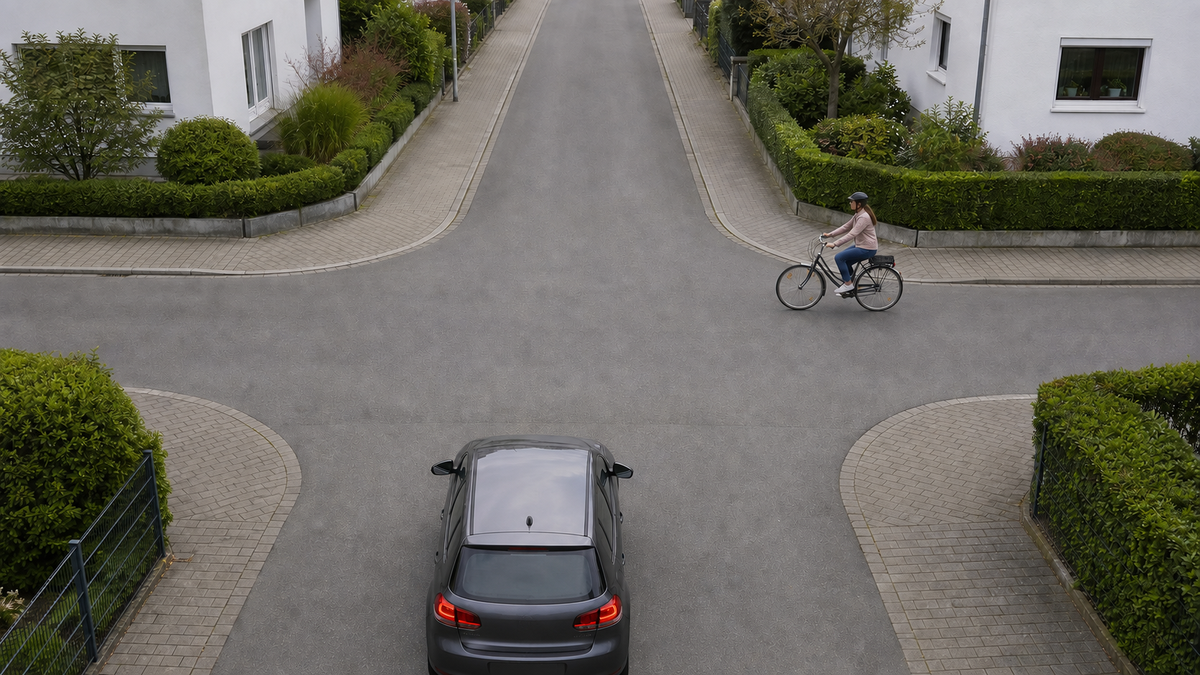
“Priority to the right” also applies to bicycles when roads meet at an intersection or junction and neither traffic lights nor priority signs specify otherwise. The rule does not depend on which vehicle is larger. Nevertheless, not every opening on the right has priority: a field or forest path, a property exit, a lowered curb, and an exit from a traffic-calmed area are treated differently.
Priority to the right on a bicycle: the basic rule
Section 8 (1) of the German Road Traffic Regulations (StVO) states that at intersections and junctions, the person coming from the right has priority. The rule applies when traffic signs or traffic lights do not specifically regulate priority. A bicycle, pedelec, car, and motorcycle are initially vehicles with the same priority relationships.
Anyone who must wait reduces their speed in good time and shows through their riding or driving behavior that they are observing the right of way. At an intersection with limited visibility, you may cautiously edge forward until the road is visible. “Edging forward” does not mean quickly rolling into the path of traffic, but gaining visibility step by step without endangering or significantly obstructing traffic with priority.
Check traffic lights and signs first
A functioning traffic light takes precedence over the basic rule. Without traffic lights, check Sign 205 “Give way,” Sign 206 “Stop. Give way,” Sign 301 “Priority,” and Sign 306 “Priority road.” A priority road that bends can also indicate a route through supplementary signs that does not correspond to the road’s apparent straight-line layout.
Road markings alone should not be overinterpreted. A stop line may indicate an existing obligation to wait, but it does not always establish the priority rule itself. Shark teeth markings clarify certain obligations to wait. What matters is the interaction between traffic lights, signs, markings, and the road layout.
Field and forest paths are a statutory exception
Anyone coming from a field or forest path onto another road cannot invoke “priority to the right.” This exception is set out directly in Section 8 of the StVO. An unpaved surface is an indication, but not a definitive criterion. A narrow paved connection can also be a field path, while an ordinary road may be unpaved.
When in doubt, ride defensively and seek eye contact. The legal classification may depend on the specific circumstances, including the path’s construction, function, signage, and local context. A bicycle navigation device cannot reliably determine this priority question.

Lowered curb and property exit
Section 10 of the StVO applies when someone enters the carriageway from a property, a pedestrian zone, a traffic-calmed area, another part of the road, or via a lowered curb. The person entering must rule out any danger to other road users. Being “on the right” does not provide normal priority in this situation.
This is particularly important for cyclists at driveway exits, gas stations, parking lots, and intersecting sidewalk or cycle-path access points. A surface that appears flush may nevertheless be separated by a lowered curb. Conversely, not every shallow edge is automatically a lowered curb within the meaning of Section 10. When the layout is unclear, enter defensively.
Exiting a traffic-calmed area
At the end of a traffic-calmed area, priority to the right does not simply apply. Anyone entering another road from there is subject to Section 10 and must rule out any danger to others. This also applies when the exit visually resembles an equal-status side street.
The obligation to wait does not end at some blanket distance beyond the sign that can be measured without considering the physical layout. The specific exit maneuver is decisive. Rolling forward slowly, checking both directions, and entering only when the way is clear is the reliable approach.
A cycle street does not automatically have priority
A cycle street grants cyclists special usage rights, but it does not automatically give them priority at every junction. If there are no signs granting priority or structural arrangements specifying it, priority to the right may also apply there. Cyclists should therefore reassess every intersection on a cycle street.
A cycle street with priority may be routed differently by signs or design. This cannot be inferred from red asphalt or a bicycle symbol alone. The existing traffic regulation is more important than the expectation that you may continue along a “main route” without stopping.
Two-way cycling on a one-way street: cyclists from the right count
If a bicycle is legally traveling against the one-way direction on a street open to two-way bicycle traffic, the general priority rule still applies. The StVO’s explanation of permitting bicycle traffic in the opposite direction expressly clarifies that the principle of “priority to the right” remains unaffected. Other road users must not overlook the cyclist simply because they do not expect a car from that direction.
Nevertheless, cyclists should not rely on eye contact that has not yet been established. Building lines, parked vehicles, and narrow junctions can obstruct the view. Being ready to brake protects your own priority without giving it up.
Four typical situations
Residential area without signs
Two ordinary roads cross, and no traffic light or priority sign is visible. The bicycle coming from the right generally has priority. Both sides travel slowly enough to assess the situation.
Bicycle coming from a supermarket parking lot
The exit from the property falls under Section 10. Even if the bicycle is coming from the right from the perspective of traffic on the road, it must rule out any danger and wait.
Paved agricultural road joins the road
The paved surface alone does not prove that it is an equal-status road. If it is functionally a field or forest path, the exception under Section 8 applies. If the classification is unclear, do not insist on an assumption.
Cycle street crosses a side street
The cycle-street sign regulates usage, not automatically every priority situation. If there are no other regulations, priority to the right may apply. Assess the intersection individually.
The three-level check
- Regulation: Fully identify traffic lights, priority signs, and supplementary signs.
- Origin: Is it an ordinary road, or an exit from a property, field path, pedestrian zone, traffic-calmed area, or via a curb?
- Visibility: Choose a speed that allows you to stop despite parked vehicles, hedges, and walls.
Only once all three levels have been clarified does “priority to the right” provide a reliable basis for a decision. The rule is no substitute for Section 1 of the StVO: Even with priority, no one may knowingly cause an avoidable accident.
Frequently asked questions about priority to the right
Does a bicycle coming from the right have priority over a car?
Yes. At an equal-status intersection without any other regulation, priority to the right applies regardless of the type of vehicle. However, an exit governed by Section 10 or a field or forest path is not a normal equal-status situation.
Do cyclists always have priority on cycle paths?
No. A cycle path alone does not provide blanket priority. What matters is the traffic light, traffic signs, the route of the road with priority, and the specific junction. Anyone entering from a property, via a lowered curb, or from a traffic-calmed area must observe the additional rules under Section 10 of the StVO.
Does priority to the right apply in a 30 km/h zone?
Often yes, if no traffic light or priority sign specifies otherwise. However, the zone sign alone does not answer every individual intersection; existing signs remain decisive.
Do I always have priority on a cycle street?
No. A cycle street can be given priority, but it does not have priority automatically. Without a special regulation, priority to the right may apply.
Is a lowered curb treated like a normal junction?
Anyone entering the carriageway via a lowered curb must rule out any danger to others under Section 10. The normal priority-to-the-right rule does not grant priority there.
As of September 5, 2026. If signage or the road layout is unclear: reduce your speed and assess the entire junction.
Share:
Bicycle tire direction of rotation: how to correctly read the arrows for the front and rear wheels
Cycling past a bus and bus stop: When you have to wait