

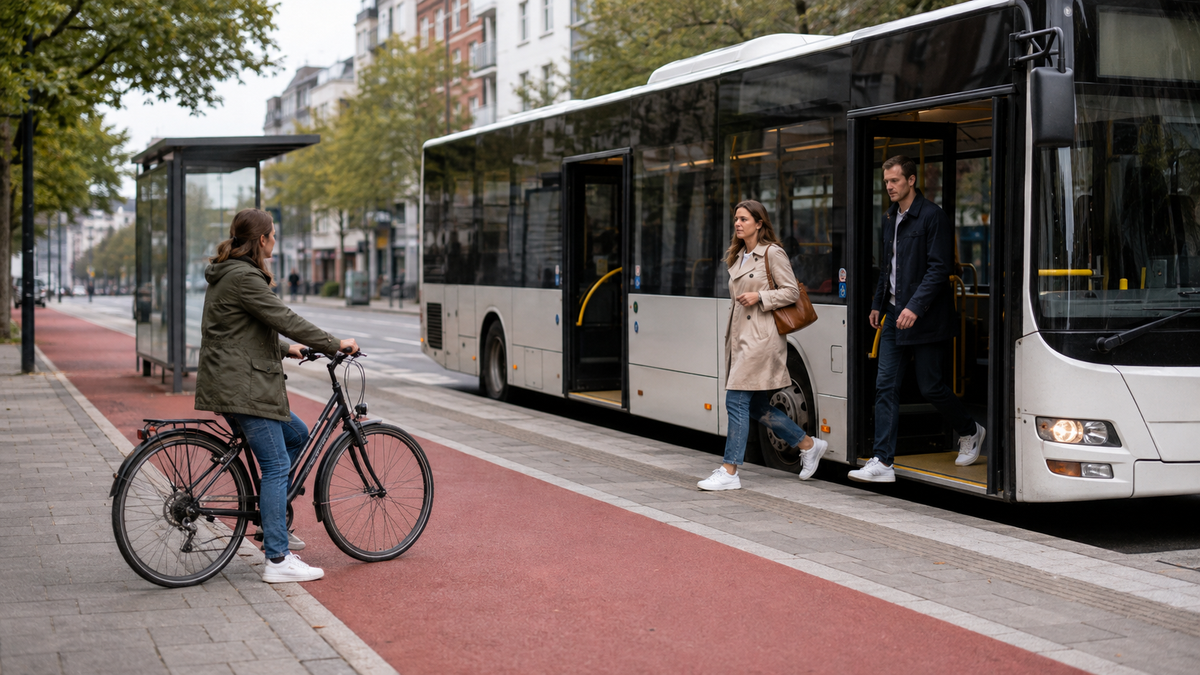
A scheduled bus stops on the right, people get off, and the cycle path runs directly past the bus stop: in this situation, it is not enough to look only at your own lane. The special rules around public transport apply to cyclists just as they do to other road users. What matters is the bus's status, whether its hazard warning lights are on, and whether passengers are entering the carriageway or cycle path.
Passing a bus by bicycle: the short version
Section 20 of the German Road Traffic Regulations (StVO) requires particular caution around scheduled buses, trams, and marked school buses. If a vehicle stops at a bus stop, it may only be passed with caution. If passengers want to get on or off and must cross the path of travel to do so, they may be passed on the right only at walking speed and without endangering or impeding them. If this is not possible, the bicycle must wait.
These rules do not apply only once someone is already standing in front of the front wheel. Open doors, waiting people, children, or an obscured area behind the bus are clear reasons to reduce speed early and be ready to brake.
Three situations, three different rules
The bus is stopped without its hazard warning lights on
A stationary scheduled bus, tram, or marked school bus must be passed with caution. “With caution” is not an invitation to maintain the previous speed. Watch the area beside the road, adjust the distance, and expect passengers to appear suddenly. The specific speed depends on visibility, available space, and the number of people present.
Passengers are getting on or off
If passengers cross the path of travel, only walking speed is permitted on the right. No one may be endangered or impeded. This may be relevant on a cycle lane, a physically separated cycle path, or the carriageway. If the path is blocked by passengers getting off, stop. Ringing your bell does not give you right of way and may prompt people to make an unpredictable movement.
The bus has its hazard warning lights on
If a scheduled or school bus with its hazard warning lights on is approaching a bus stop, it must not be overtaken. If the bus then remains stopped with its hazard warning lights on, it may only be passed at walking speed; passengers must not be endangered or impeded. Walking speed also applies to oncoming traffic on the same carriageway. Where carriageways are physically separated, the specific road layout must be assessed.
Why the cycle path does not automatically provide a clear passage
Many bus stops are located between the roadway and the cycle path. In that case, passengers inevitably have to cross the cycling area. A colored marking or bicycle symbol does not change the fact that boarding and alighting passengers must be protected. Anyone riding must recognize the conflict and adjust their speed accordingly.
At other bus stops, the cycle path runs behind a waiting area. People may also enter the cycle path there without recognizing it as a traffic area. Advertising elements, trees, shelters, and the bus itself can obstruct the view. A clear line on the map therefore says little about the actual visibility.

At a so-called bus bulb stop, the bus stops on the roadway, while cyclists are directed either behind the waiting area or together with other traffic, depending on the layout. The markings on site determine where you may ride. Passenger safety remains essential regardless of the design.
A safe sequence before the bus stop
- Spot hazards early: Look out for the bus stop sign, the bus, hazard warning lights, and waiting passengers.
- Reduce your speed: Do not wait until you reach the rear bumper to brake. Leave enough distance to see the doors and the area alongside the bus.
- Watch the door side: If doors are opening or people are moving toward the bus, expect them to cross.
- Check the route: Does your lane pass between the bus and the waiting area, behind the shelter, or along the roadway?
- Wait if in doubt: Walking speed is permitted only if no one is endangered or obstructed. If there is insufficient space or visibility for this, the bicycle must remain stationary.
- Set off calmly: Continue only once doors are closed, crossings are complete, and the route ahead is clearly unobstructed.
Walking speed depends on the situation
Section 20 of the German Road Traffic Regulations does not specify a fixed kilometer-per-hour value. In practice, walking speed means a pace comparable to walking that allows you to stop at any time. A fast pass-by on the grounds that the bicycle is narrow does not meet this requirement.
An e-bike provides assistance even at low speed. This is helpful at a bus stop but requires carefully controlled acceleration. A high assistance mode can cause an unexpected surge. Anyone who feels unsure should choose a lower assistance level and keep one finger ready on the brake, without making abrupt manoeuvres in front of passengers.
When the bus wants to set off again
Scheduled buses and clearly marked school buses must be allowed to leave designated stops. Other road users must wait if necessary. This does not relieve the bus driver of the general duty of care, but it is no reason to quickly ride into a gap that is becoming narrower.
If the bus signals left and the bicycle is still behind it, the situation should be assessed early. Keeping a sufficient distance prevents entering the blind spot beside the bus. If the bicycle is already alongside the vehicle, eye contact and defensive riding are more important than accelerating spontaneously.
Particular risks for children and groups
Children may step out from between waiting adults or suddenly change direction after getting off. This is why it is important to pay attention to more than just the hazard warning lights on school buses. Even when the hazard warning lights are not active, speed and distance must be adjusted to the group that is clearly present.
In a group of cyclists, the decision is not blindly taken over from the person in front. A bus may open its doors after the first cyclist has passed. Each person reassesses the situation and keeps enough distance to ensure that stopping does not cause a collision within the group.
Typical mistakes
- “The cycle path is mine”: The marked area does not remove the need to protect passengers boarding or leaving the bus.
- Quickly passing the door: An open door is an immediate signal that people may cross.
- Insisting with the bell: This can startle people and is no substitute for walking speed or waiting.
- Overlooking the hazard warning lights: They change the rules for overtaking as soon as the bus approaches.
- Cutting in front of a departing bus: The scheduled bus should be able to leave the stop; the gap beside it can disappear quickly.
What helps when the route is unclear
Construction sites, faded markings, or a crowded bus stop can make the intended route unclear. In that case, do not improvise between the bus and the curb. The safe position is one with a clear view of the doors and people, even if this requires a brief stop. Moving onto the sidewalk is not a general solution, as it is not intended for cycling without explicit permission.
If dangerous situations occur regularly, the location can be reported to the responsible municipality or traffic authority with the exact location, direction of travel, and an objective description. Photos should be taken only from a safe position and, where possible, should not show identifiable people.
Frequently asked questions
May I pass a stationary bus on the left?
Passing on the left may be assessed differently depending on the road, markings, oncoming traffic, and hazard lights, both legally and practically. When approaching a regular or school bus displaying hazard warning lights, overtaking is prohibited. When passing a stationary bus, particular caution and the local traffic arrangements remain decisive. An unclear or narrow situation should not be forced.
Do I have to wait if nobody is getting off?
Not automatically in every situation. However, you may pass a stationary bus only with caution. As soon as passengers want to cross the roadway, you must travel at walking speed and must not endanger or obstruct them. If visibility or distance is insufficient, waiting is the correct course of action.
Does the rule also apply to e-bikes?
For a standard pedelec up to 25 km/h, the bicycle rules apply. Other vehicle classes may be subject to additional regulations. Regardless of the drive system, Section 20 protects passengers.
May I pass a tram in the same way?
Section 20 also applies to trams. Where passengers cross the road between the stop and the vehicle, you may pass on the right only at walking speed and without endangering or obstructing anyone; if necessary, you must wait.
The sound decision at a bus stop is simple: brake early, check the hazard lights and doors, let passengers pass first, and continue slowly only when the situation is clear and easy to see. Losing half a minute is better than a conflict in a space shared by buses, cyclists, and pedestrians.
Share:
Bicycle tire direction of rotation: how to correctly read the arrows for the front and rear wheels
Right of way from the right when cycling: distinguishing intersections, curbs, and dirt roads