

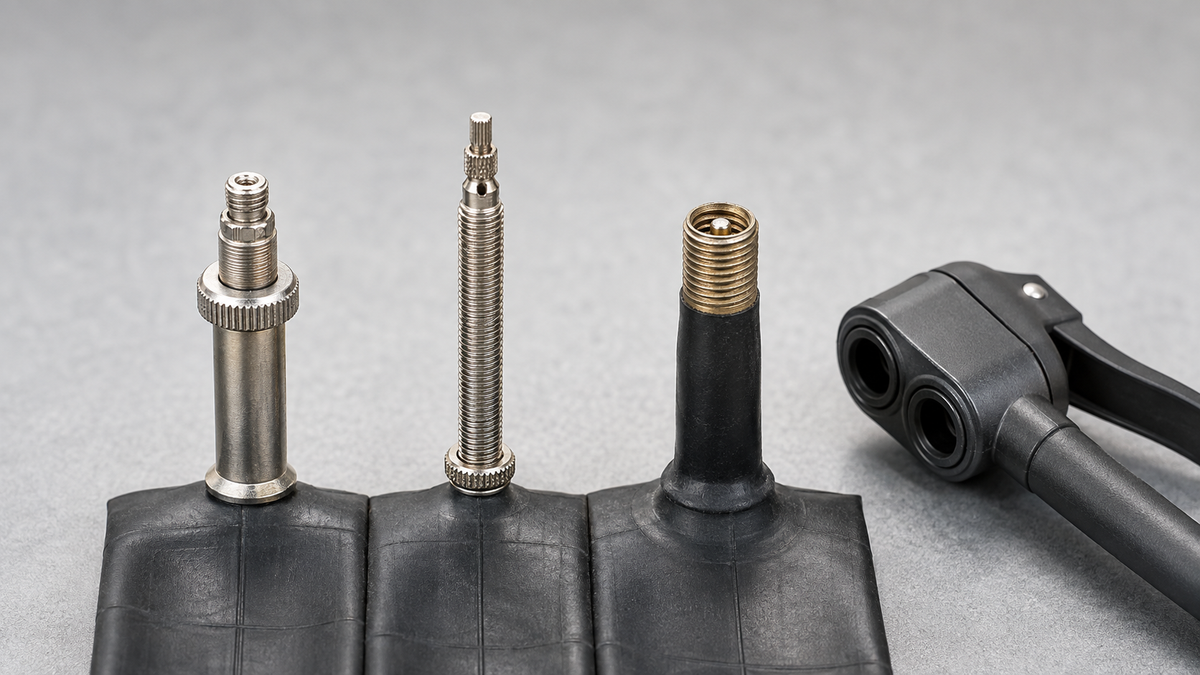
Dunlop, Sclaverand, and Schrader valves differ in more than just their names. They require the appropriate pump head, must fit the hole in the rim, and are operated differently before inflation. When buying a new tube, you should therefore check the tire size, valve type, and valve length together. A matching diameter alone is not enough.
The three common bicycle valves compared
| Valve | Common abbreviations | Shaft diameter | Before inflating |
|---|---|---|---|
| Dunlop valve | DV, Dunlop valve | approximately 8 mm | Position the appropriate pump head; the valve insert normally remains closed when installed |
| Sclaverand valve | SV, Presta, French valve | approximately 6 mm | Loosen the small knurled nut at the top and briefly tap the valve |
| Schrader valve | AV, Schrader | approximately 8 mm | Remove the valve cap; the pump head actuates the central pin |
These dimensions are a guide based on Schwalbe's technical specifications. The specific component remains decisive. The valve hole, rim shape, rim tape, tube, and pump must be compatible as a system.
Dunlop valve: easily replaceable insert
The Dunlop valve is found on many classic city and everyday bicycles. Its valve stem typically uses a rim hole of approximately 8 mm. The insert can be removed after loosening the union nut. This allows air to escape quickly when the insert is open or removed.
When inflating, use a pump head for Dunlop/Sclaverand valves or select the corresponding insert on a multi-valve pump. Position the head straight. Pulling it sideways puts strain on the valve stem and can damage the tube at the transition. Once finished, the insert and nut should be seated correctly, but do not overtighten plastic or metal parts with pliers.
Sclaverand valve: narrow shaft, additional operating lever
The Sclaverand valve is also known as a Presta or French valve. According to Schwalbe, it has a shaft diameter of approximately 6 mm, making it suitable for narrow rim holes. Before inflating, loosen the small knurled nut at the tip by a few turns. Briefly pressing the tip shows whether the valve moves freely. Then place the pump head on straight.
The thin tip must not be bent by force. After inflating, close the knurled nut with your fingers and replace the protective cap. Deep rims require the inner tube to have sufficient valve length; a tip that is too short is difficult to seal and puts strain on the pump head.
A Presta valve should not be placed unprotected in a significantly larger rim hole. Schwalbe points out that the valve stem may break off there. If a designated reducer or suitable rim solution is to be used, the rim and inner tube manufacturers must approve the combination. Improvised washers are not a reliable repair.
Schrader valve: wider stem and central valve pin
The Schrader valve, also called an AV valve or car valve, usually has a stem about 8 mm wide. A spring-loaded pin sits in the center and is opened by the appropriate pump head. Many floor pumps have a separate opening or an adjustable insert for this purpose.
The fact that this valve is also widely used on motor vehicles does not mean that every inflation device is suitable for every bicycle tire. The permissible pressure is stated on the tire or in the manufacturer’s documentation. A fast-inflating device without a finely adjustable gauge can quickly overinflate a small bicycle tire. A bicycle pump with an easy-to-read pressure gauge provides more control.
How to identify the valve type you have
- Remove the cap: Do not judge only by the shape of the cap; it may have been replaced.
- Look at the stem: Presta valves are significantly narrower. Dunlop and Schrader valves use the wider diameter.
- Check the valve tip: Presta valves have a small removable knurled nut, Schrader valves have a central pin, and Dunlop valves have a removable insert beneath a union nut.
- Do not measure the rim hole while the tire is pressurized: For selecting an inner tube, the existing marking is usually sufficient; if in doubt, deflate the tire or ask a bike shop.
Some manufacturers use additional names. “French” usually means Presta, “Blitz valve” usually means a modern Dunlop version, and “Schrader” means the car valve. The abbreviation on the inner tube packaging or product page is therefore helpful.

The right tube needs more than the right valve
A size marking is shown on the tire sidewall, often in ETRTO format, such as the width and rim seat diameter. The new tube must cover this size range. The valve type and valve length must also be selected. With a high rim, a valve that is too short is difficult to reach with the pump head; a very long valve is not automatically technically problematic, but may be subjected to greater lateral loads.
On e-bikes, the motor, chain guard, hub gears, or heavy tires can make removal more difficult. Before changing the wheel, therefore follow the instructions from the bicycle and drive-system manufacturer, as well as the specified torque values. Replacing a valve alone is not a reason to loosen cables or torque arms without a plan.
Assign the pump head correctly
Many pumps have two openings: the narrow one for Sclaverand/Dunlop and the wide one for Schrader. Other heads are converted by turning a rubber insert around. The pump markings are decisive. Push the head on as far as the intended stop and then lock it with the lever; on some models, the order is reversed.
If air can be heard escaping next to the valve, do not bend it further. Release the pump head, check the seal and adjustment, and attach it straight again. A hissing connection may be caused by the wrong head, a worn seal, or a Sclaverand valve that has not been opened.
Tighten the valve nut using your fingers only
A rim nut holds the valve in position while pumping, but does not seal the tube against the rim. Schwalbe recommends tightening it by hand only. Pliers can apply excessive force. If the nut is extremely tight, the valve cannot give way when the tire moves, and the tube may be damaged at the valve base.
If the valve is at an angle after a few rides, this is a warning sign: the tire and tube may have shifted on the rim. Do not simply tighten the nut further. Release the air, check the cause and tire pressure, and align the tire correctly. If the valve base is torn, replace the tube.
Inflate step by step
- Check the tire sidewall for the permitted pressure range and damage.
- Position the valve vertically and remove the cap.
- For a Presta valve, loosen the tip and tap it briefly; prepare other types according to the pump instructions.
- Fit the correct pump head without pulling it sideways and lock it in place.
- Pump slowly, watch the pressure gauge, and check the tire intermittently for even seating.
- Pull the pump head straight off, close the Presta valve tip again, and fit the cap.
- Check the pressure again after a short wait if a slow leak is suspected.
When to stop pumping
- The valve stem is noticeably crooked or moves inside the inner tube.
- There is a crack, bulge, or visible inner tube emerging at the valve base.
- The tire bead lifts away from the rim at one point.
- The rim tape or valve hole has sharp edges.
- The indicated pressure rises unusually quickly without the tire becoming firmer.
In these cases, release air in a controlled manner and check the installation. Do not force a damaged inner tube, a rim with a sharp hole, or an unsuitable valve diameter to fit by applying more pressure.
Frequently asked questions
Can I inflate every valve with the same pump?
Only if the pump head is explicitly suitable for the respective type or can be correctly switched over. The shape alone does not guarantee a seal.
Can I switch from a Dunlop valve to a Schrader valve?
Both often use a rim hole of approximately 8 mm, but the inner tube size, rim, rim tape, and approvals must still be compatible. Do not select the new inner tube based solely on the valve abbreviation.
Can I use a Presta valve in an AV rim?
Without a solution specifically designed for this purpose, the larger hole poses a risk of damaging the narrow valve stem. The manufacturer’s specifications or a workshop should confirm compatibility.
Why does the tire briefly lose air when removing the pump?
A brief noise may come from the pump hose. If the tire pressure then drops noticeably, check the valve, pump head, and seal. Soapy water can indicate a leak when the wheel is removed or safely parked; keep electrical components dry.
For your next inner tube order, a brief note is enough: ETRTO tire size, valve abbreviation, and required valve length. This avoids the most common incorrect purchases and makes it immediately clear which pump head opening is needed on the road.
Share:
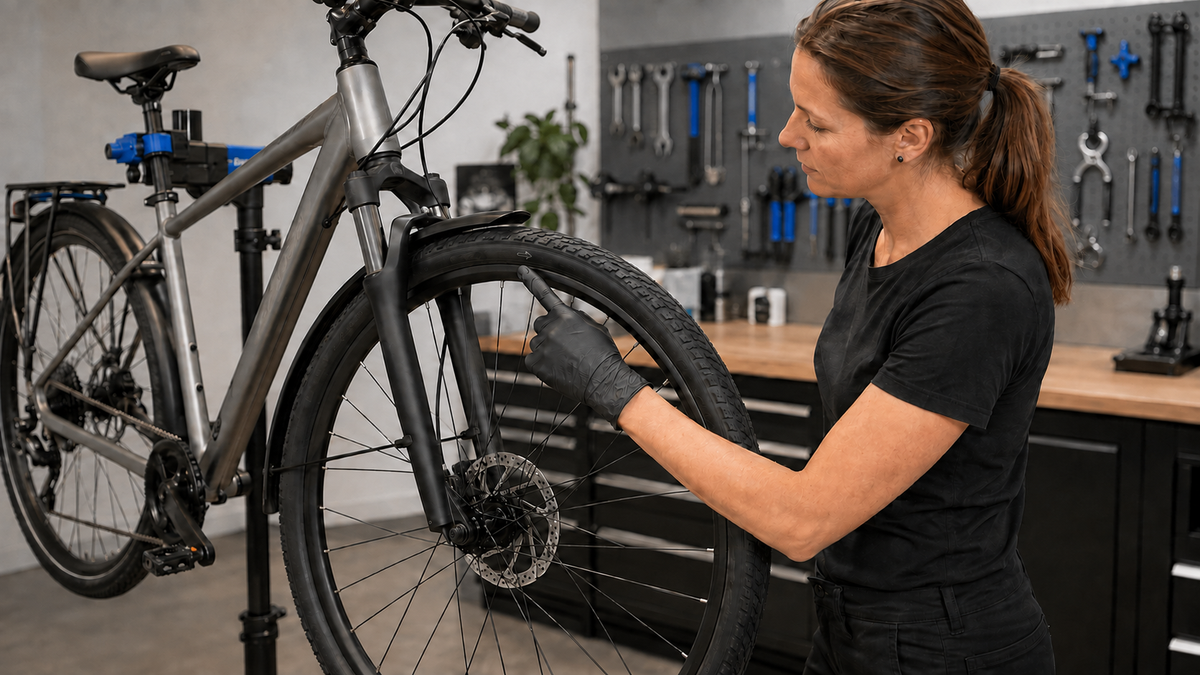
Bicycle tire direction of rotation: how to correctly read the arrows for the front and rear wheels
Right of way from the right when cycling: distinguishing intersections, curbs, and dirt roads