

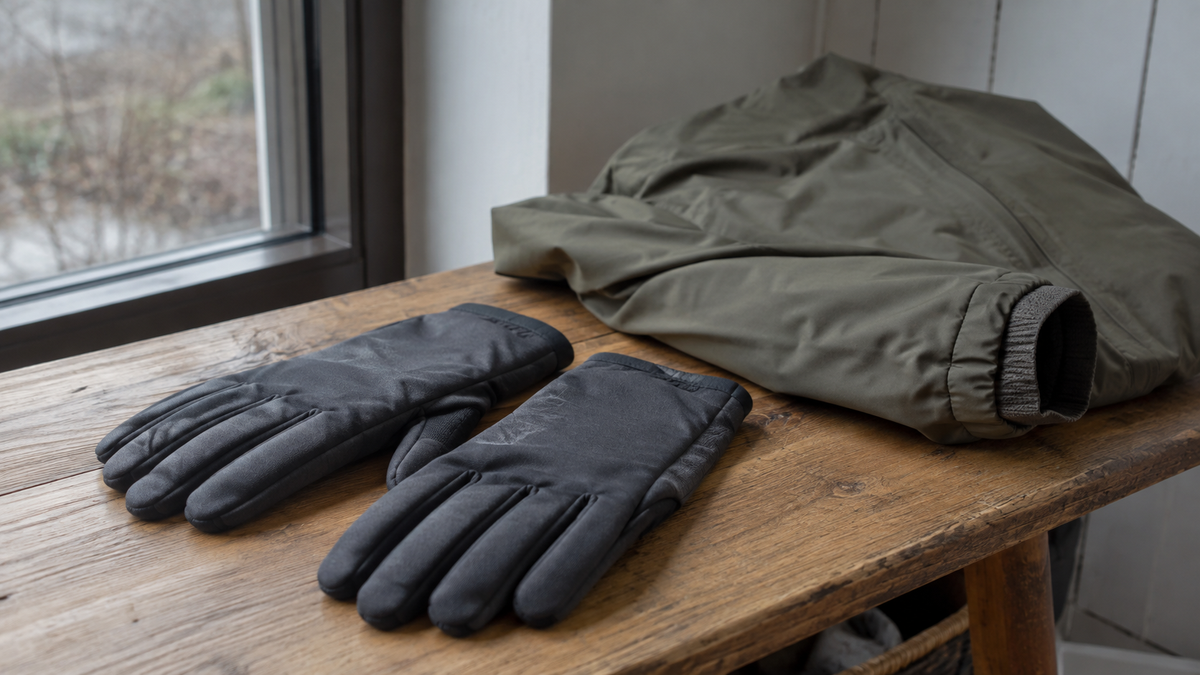
Winter cycling gloves need to do more than feel warm in the store. You need a secure grip and must be able to reliably reach the brakes, gears, and other controls. So do not simply choose the thickest pair. Consider the weather, ride duration, and fit together—then test the controls on your own bike.
Start with your route, not just the temperature
Note when and for how long you are normally out: in the morning on your way to work, in the evening on the way back, or for several hours on a tour. Will you encounter rain and exposed, windy sections? Can you dry a wet pair at your destination? These questions produce a more useful shopping list than the word “winter” on the packaging.
The GripGrab glove guide distinguishes between weather conditions and riding style. Our practical conclusion: A short, brisk training ride and a longer everyday journey are not automatically the same use case. Before buying, note exactly what your current pair fails to provide: too much wind, moisture, unsuitable finger length, or difficult operation.
Read wind protection and protection from moisture separately
Windproof, water-repellent, and waterproof are not interchangeable terms. An illustrative example from a manufacturer is the GripGrab Windster 2: It is described as windproof, but according to the product questions, it does not have a waterproof membrane. The manufacturer explicitly distinguishes protection in light rain from protection during prolonged or heavy rain.
This is not a general recommendation for this model and does not make any statement about Cyseekin accessories. Read the specific description for each pair you select. Ask if it only says “weather-resistant.” For regular rides in the rain, specifically look for stated protection against moisture and a suitable combination with your jacket sleeves, rather than treating a coating as unlimited protection from rain.
Try them on with your own jacket
Use the size chart for the respective model as a starting point. Try on both gloves and wear your usual winter jacket. You should be able to spread and bend your fingers without the seams pulling uncomfortably. At the same time, excess material should not dangle beyond your fingertips or form large folds when gripping.
Fasten the cuff as you intend to wear it while riding. Reach forward into your usual handlebar position and rotate your hand. Does the transition between sleeve and glove remain covered? Can you operate the fastening with your other hand already wearing a glove? These small everyday actions reveal more about the fit than holding an open hand in front of a mirror.
The control check on a stationary bicycle
The ADFC emphasizes for winter accessories that gear and brake levers must remain operable while wearing gloves. Our fitting test derived from this starts with the bicycle standing securely, with motor assistance switched off. It is initially about reachability and grip, not emergency braking or technical adjustment.
Check your usual hand position. Can you reach the brake levers without trapping any material? Can you reach the gear shifter or twist shifter, bell, and control buttons? Do not feel for several buttons at once. With a derailleur gear system, the grip and reach test is sufficient while stationary; check the actual gear change later during the appropriate riding test instead of forcing the gears to shift while at a standstill.
| Check | How to test it | When you should keep looking |
|---|---|---|
| Finger length | Open and bend your hand and wrap it around the grip | Strong tension at the seams or bothersome material ends |
| Palm | Grip the handlebar in your usual riding position | The inner material shifts or forms large folds |
| Brake levers | Reach both levers in a controlled manner while stationary | Adjusting your grip or trapped fabric interferes with operation |
| Gears and buttons | Reach each control individually and deliberately | You press neighboring buttons or cannot find a secure grip |
| Cuff | Reach forward into the riding position while wearing a jacket | The sleeve slips back or the cuff interferes with movement |
| Putting them on and taking them off | Handle both gloves with the cuffs closed | The lining shifts or the fastening is difficult to grip |
The table is a decision aid, not a certification test. If the pair passes the stationary test, follow up with a short, controlled test ride on a dry, flat, traffic-free surface. As soon as operating the controls feels unsafe, stop the test. Restricted brake operation is not an adjustment issue you should try to solve in traffic.
Finger gloves, mittens, or lobster gloves?
A standard mitten groups the fingers together. The ADFC advises against using one for cycling because shifting and braking are more difficult with it. As alternative designs, it mentions lobster gloves with some fingers grouped together.
A lobster glove is still not automatically practical with your handlebars. Its finger configuration must suit the fingers you use to operate the levers and shifter. Try it using the same routine as for a five-finger glove. If you cannot reliably perform the necessary movements, that design is ruled out—regardless of how warmly it is advertised.
Liner gloves only as a compatible combination
Thin liner gloves can provide an additional layer. GripGrab points out in its guide that the outer glove must provide enough room for this. Therefore, do not buy the two items independently and assume they will fit together. Try on the planned combination in full.
Repeat the grip and control check with both layers. When taking them off, also check whether the lining stays in place. If the combination feels tight, stiff, or unwieldy, adding more material is not a useful improvement for you. The same applies to additional liners whose space requirements you have not taken into account beforehand.

How to interpret temperature ratings as a selection aid
A manufacturer’s stated temperature range is not a personal guarantee. GripGrab itself explains that the Windster 2 may not be warm enough for everyone in sub-zero temperatures. You should therefore not compare figures from different brands as if they were identical test results without considering each brand’s own explanation.
Our suggestion for your first rides: Choose a short, familiar route with an easy way to return, then note the weather, duration, moisture, and how the controls feel. This allows you to check whether they are suitable for your everyday use. If you can no longer brake or shift reliably, stop safely and do not continue riding under these conditions. This is about equipment and ease of use, not a medical assessment of cold hands.
Consider care and the return journey before buying, too
Care instructions can even vary within a brand: for the Windster 2, GripGrab specifies machine washing at 30 °C, while the Primavera 2 Merino requires hand washing. For both, tumble-drying and wringing are prohibited. These are model-specific examples; follow the current label on your pair.
Plan a suitable place for drying them in your daily routine, and do not put gloves away damp until your next ride. If you have no suitable option at work, carrying a dry spare pair can be practical. Also test any advertised touchscreen function on your device while stationary. On its own, it says nothing about safe braking or shifting.
Frequently asked questions about winter cycling gloves
Which gloves are guaranteed to keep me warm while riding an e-bike?
No such guarantee can be derived from a product category. Choose based on the weather, duration, fit, and ease of use. Information for other riders or a temperature range does not replace your own careful suitability test.
Should I always buy winter gloves one size larger?
No. The size chart and cut of the specific model are decisive. If you wear liner gloves, you need room for both layers, but no irritating folds or overly long fingertips. Try on the complete combination.
Are windproof gloves sufficient in the rain?
Not automatically. Check the information on moisture protection. In the Windster 2 example mentioned, the manufacturer distinguishes light rain from prolonged wet conditions and explicitly describes the model as not waterproof.
Can I wear ordinary mittens while cycling?
The ADFC does not recommend them because they restrict lever operation. Choose a design that allows you to control your bike reliably. Even a specialized lobster glove must be compatible with your controls.
Conclusion: The right pair passes the control check
Good winter gloves suit your actual journey and let your hands do their job. Compare weather protection, try them on with your jacket and, if applicable, liner gloves, and check all controls. Warmth is important—but reliable braking and shifting remain essential.
As of September 7, 2026. Manufacturer specifications apply only to the models named. The fitting procedure and table are editorial suggestions, not product tests or temperature guarantees.
Share:
Cleaning and drying a bicycle bag: Protect the material and fasteners
Choose a frame bag: Check the size using the template and a test pack.