

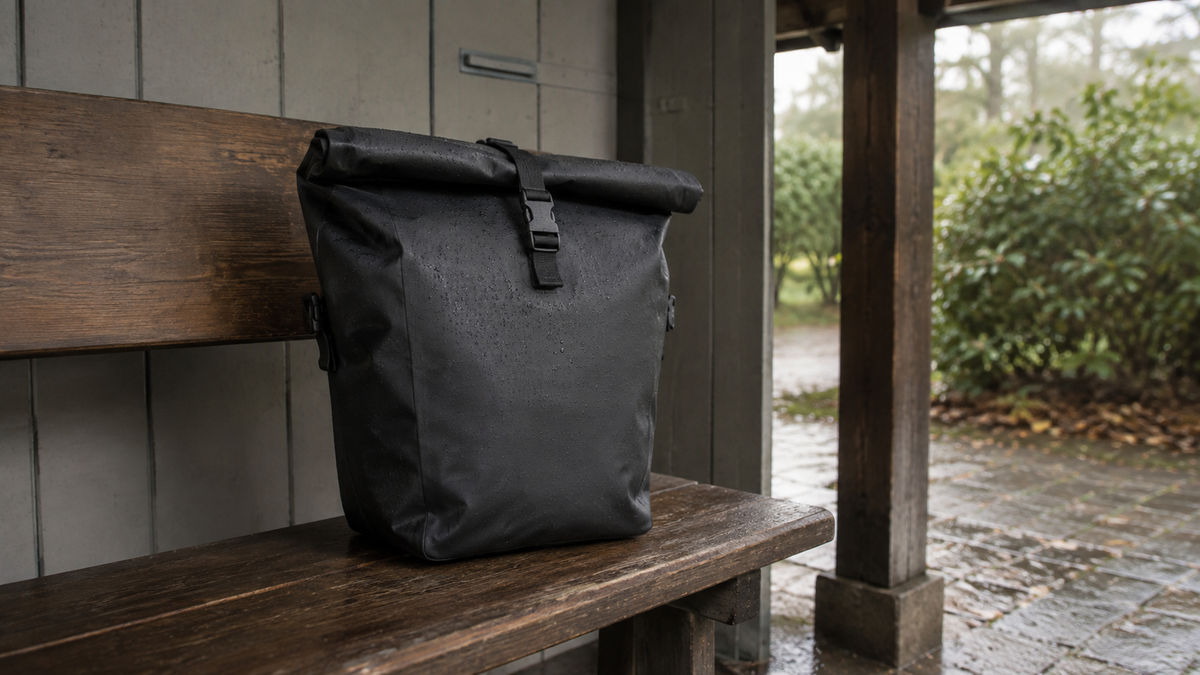
The product page says “waterproof,” while the data sheet lists IP64. What does that mean for the commute or a longer bike ride? The decisive factors are what type of exposure to water the bag is designed to withstand and what condition it must be in to do so. Suitable material alone does not make a bag correctly closed.
Therefore, check three things together: the protection rating of the specific model, the instructions for closing it, and the scope of coverage for the main and outer compartments. For example, a closed buckle does not automatically show that a roll-top closure has been rolled sufficiently.
IP64 means protection against splashing water, not submersion
ORTLIEB describes IP64 for the Office-Bag as dust-tight and protected against splashing water from all directions. Here, the first digit concerns dust and the second water. This does not constitute approval for submersion. For this model, the manufacturer explicitly points out that water can enter through the closure when the bag is fully submerged.
| Specification or observation | What it indicates | What this does not mean |
|---|---|---|
| IP64 on the specific product | Dust-tight and protected against splashing water from all directions | No blanket suitability for submersion or a pressurized water jet |
| Waterproof material | A property of the described fabric or its coating | Not, on its own, proof of the seams, openings, and all compartments |
| High hydrostatic head | A specification of the water pressure the tested material withstands | No corresponding diving depth for the entire bag |
| Water beads off the outside | A visible condition of the surface at that moment | Not a complete watertightness test of the entire item of luggage |
Do not therefore treat IP64 as a blanket promise for every situation involving water. If you need a bag for anything other than rain and splashing, you must check the specific requirements carefully. A bicycle bag does not become a diving container simply because its outer material looks like a tarp.
Material, seams, and opening work together
In its waterproofness statement, ORTLIEB distinguishes between materials, connections, and types of closure. It also explains there that the hydrostatic head describes a material test, not the protective performance of every part of a filled bag. So read on if a product description only cites an impressive fabric rating.
Our suggestion for comparing products in the store: Open the bag and mentally trace the path from the outside to the contents. Where do the materials meet? Which opening is rolled, covered, or closed with a zipper? Is there a cable pass-through? Ask about the protection rating for this construction rather than inferring its water resistance from its appearance.
Close the roll-top closure according to the instructions
The number of rolls required depends on the model. For the Office-Bag, ORTLIEB specifies three to four rolls followed by downward tensioning to achieve IP64. This is a specific manufacturer requirement for this bag. It cannot be applied to another piece of luggage with a similar closure without checking first.
As a second example, VAUDE specifies at least three folds for its Drybag 3 Liter. This dry bag is also intended for use as an organizer. In each case, the appropriate product instructions are decisive—not a universal rule such as “one fold is enough” or “every roll-top bag requires exactly the same steps.”

- Check the closing instructions for the model and version.
- Pack the bag so that the upper area needed for this remains clear.
- Check that no item of clothing or other object is caught in the opening.
- Close, roll, and secure the edge in the prescribed order.
- After repacking later, check the entire closure again.
That is why the packing test should already be part of the purchase decision. If your usual shopping only fits while the bag remains open, its usable storage capacity is too small for this purpose. Take your typical items with you for a packing test or recreate their shape at home. Additional height is usable only if enough space remains for the required closure area.
View the main compartment and exterior pockets separately
An externally attached pocket is not automatically protected to the same degree as the main compartment. Look for a clear description of each compartment where sensitive items are to be stored. An open mesh pocket, a zippered pocket, and a separately rolled-up pouch are different constructions. Without specific information, you should not assume they offer the same level of protection.
Also check access during a rain shower. Do you have to open the entire main compartment to reach the key, or is there another suitable place to store it? Our organizational suggestion: Sort items by accessibility and sensitivity. Frequently needed things should remain accessible without unnecessarily exposing the entire contents.
A suitable separate protective bag can provide an additional layer for documents or electronics. However, it has its own instructions and must also be closed correctly. It does not repair a damaged outer bag and is not a reason to exceed unverified usage limits for the equipment as a whole.
Inspect before riding; do not certify it with a garden hose
Before use, check for visible damage, dirty closure areas, and complete closure. Follow the manufacturer’s care instructions. A self-conducted diving or pressurized-water test does not prove compliance with a standard and may place stress on the equipment beyond its intended use. Keep valuable contents out of such experiments.
If moisture has appeared inside, first document the circumstances: the weather, type of transport, packing condition, and how the bag was closed. Also check whether wet items had already been packed. If the cause remains unclear, we suggest providing this information, together with photos, to the manufacturer. This allows for more targeted follow-up than the blanket statement “not waterproof.”
Frequently asked questions about waterproof bicycle bags
Does water-repellent mean the same as waterproof?
Do not treat the terms as equivalent evidence. “Water-repellent” alone specifies neither a particular protection rating nor its conditions. Ask what applies to the complete bag and the intended use.
Is IP64 sufficient for a bike ride in the rain?
IP64 describes protection against splashing water from all directions. Whether the specific model is suitable for your trip also depends on the manufacturer’s specifications, its intact condition, and proper closure. This does not guarantee protection for any length of time or against any water pressure.
How many times do I need to roll up the roll-top closure?
As often and in the manner specified in your bag’s instructions. For the Office Bag mentioned, this means rolling it three to four times and securing it downward. Other models may have different requirements.
Can a bag be waterproof without a specified IP rating?
The absence of a number alone does not prove that a bag is not watertight. Without further information, however, its protective performance is more difficult to assess. Have the construction, closing method, and usage limits explained specifically instead of assigning an IP rating yourself.
Ultimately, selection depends on a clear statement about the entire bag in the correct usage condition. Assess the protection rating, closure, and individual compartments together. The packing test is passed only when your usual luggage fits inside and the bag closes according to the instructions.
Information as of: September 7, 2026. The product examples explain the manufacturer’s specifications; they are not an independent laboratory test or a blanket recommendation for every weather condition or use.
Share:
Choose winter cycling gloves: check warmth and usability
Choose a frame bag: Check the size using the template and a test pack.