

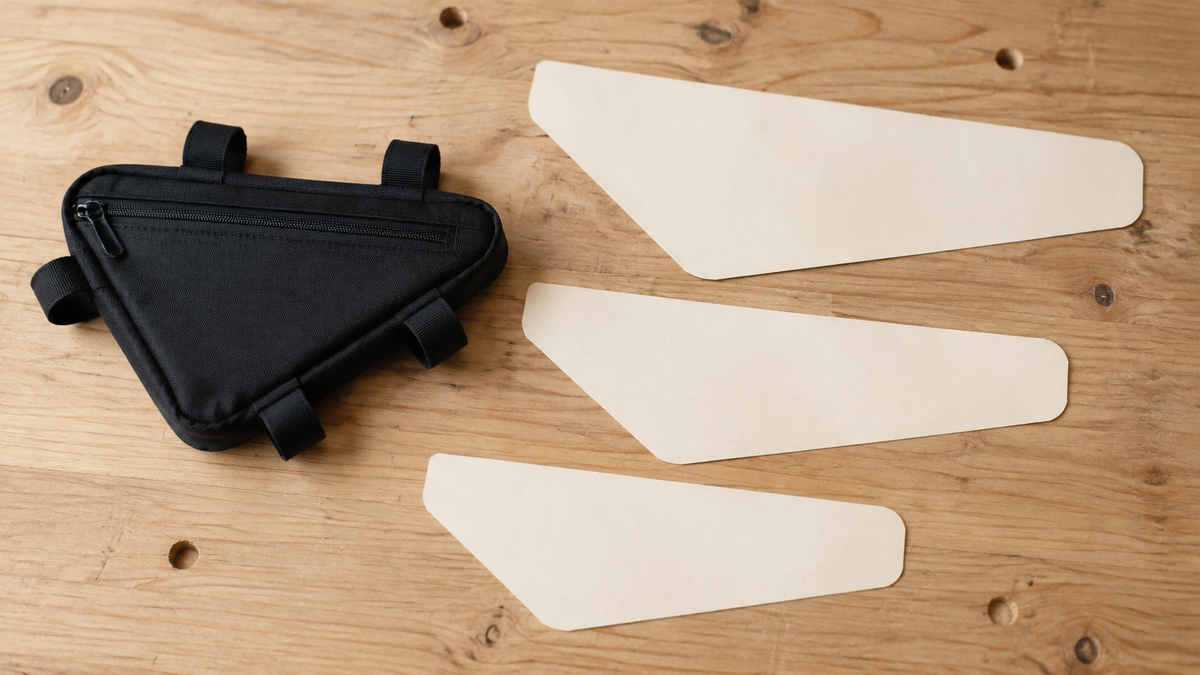
A four-liter frame bag may fit one bicycle well but collide with the water bottle or your knees on another. What matters is not just storage capacity, but the frame shape and the position of the mounting points. Applying a template before buying can help you rule out unsuitable sizes early.
However, the paper test is only the beginning. It shows the side profile, not the width of the filled bag or the actual hold of the straps. For a reliable choice, also check bottle clearance, inspect the mounting points, and test-pack the intended contents.
Consider the available frame, not just the frame size
The bicycle’s size designation is not a bag size. Compare the inner frame area and the tube shape of your specific bike. A top tube may slope steeply, a bottle may protrude far into the space, or a shock absorber may occupy the intended area. On an e-bike, the battery housing and access points may also take up part of the space.
If there is no conventional frame triangle, a triangle bag designed for one is not automatically a suitable choice. This applies, for example, to some step-through bikes. In that case, look for a bag shape designed for the available mounting position. Do not stretch universal straps across missing tube sections, battery covers, or a folding hinge just to attach an unsuitable shape.
Use the manufacturer’s dimensions and the template together
For its Backcountry Frame Pack, Apidura recommends choosing the size based on the actual frame geometry rather than the desired capacity. The manufacturer provides dimensions, a sizing tool, and printable templates for this purpose. The product page for the ORTLIEB Frame-Pack also links to a template. Always select the template for the specific bag variant.
- Compare the bag’s model and size with the name of the template.
- Print the template at its original size; do not automatically fit it to the paper size.
- Measure a known dimension again so that an accidentally reduced printout is detected.
- Assemble multi-page templates according to the markings.
- Trace the outline with the bike safely parked and also consider the intended strap positions.
The ORTLIEB template for the 4-liter version, for example, consists of three parts that are joined according to the letters. The exact contour is more helpful than an arbitrary rectangle of the same length. Do not press or fold an oversized template to make it fit, as this would conceal precisely the conflict that the test is meant to reveal.
Our practical suggestion: Photograph every possible size from the side on the same bike and note any unresolved conflicts. This lets you compare two bags without relying only on memory. The template is an aid for selecting a bag; remove it before moving or riding, and do not attach it as temporary equipment.

Check the fit in five points
| Check | Question for your own bike | Implication for your choice |
|---|---|---|
| Side profile | Does the bag fit in the intended space without forced deformation? | If there are conflicts, consider a different shape or size |
| Mounting | Do all the intended straps reach suitable sections of tubing? | Do not improvise where mounting points are missing |
| Water bottle | Can it be removed and put back in place? | Consider the removal path in addition to the space it occupies |
| Width | Do your knees and legs remain clear even when the bag is packed? | Test with real contents, not just by holding the empty bag in place |
| Access points | Do the zipper, battery lock, and other necessary components remain accessible? | Try out everyday handling before making your final decision |
Mark not only obstacles but also the things that need to remain usable. A bottle may fit under the bag and still not be removable from its cage. Apidura expressly points out that clearance depends on the frame, bag, and bottle sizes. A product photo showing two bottles is therefore not proof that the same setup will work on your own bike.
The packed width is often the decisive second test
From the side, a bag may look narrow even though it can bulge significantly when packed. The ORTLIEB Frame-Pack data sheet gives a specific example: The stated depth is 6 cm, but the flexible material can allow it to reach up to 12 cm when fully packed. These figures apply to this model and are not a general rule that frame bags double in depth.
So pack only the things that are actually meant to travel with you. A hard case or a tool placed crosswise can push the sides outward differently than a soft jacket. Close the bag completely without forcing the zipper shut under tension. Change the packing arrangement or choose more usable space if the closure only works with force.
Only after the bag has been professionally attached should you carry out a cautious movement check. Ensure that the bike is held securely and check your normal seating and leg position. If the bag already causes obstructive contact during this check, the selection is not yet complete. Take a short test ride in a suitable traffic-free area only after the attachment and all other functions have been checked.
Strap positions and access points are part of the size
A geometrically suitable bag may nevertheless be unsuitable if its straps cannot be placed in an approved position. The ORTLIEB Frame-Pack is designed to be attached to the top tube and the seat tube or down tube. Do not transfer this arrangement to a bicycle that lacks the corresponding surfaces. Also follow the frame’s instructions and, where applicable, guidance on protecting the contact points.
After holding the bag in place, check its everyday usability: Can a removable battery be taken out along the intended path? Does the lock remain accessible? Does a strap prevent use of a folding mechanism? Is the compartment easy to open while the bike is stationary? A conflict must be resolved by confirming a different position or bag shape, not by bypassing an intended function.
Frequently asked questions about frame bag size
What capacity is suitable for my frame size?
There is no reliable general matching rule for this. Compare the bag’s exact contour, attachment points, and width with your frame. The number of liters describes the volume, not the shape.
Is a template enough to make a purchasing decision?
It is suitable for filtering out unsuitable contours. To assess width, bottle removal, and actual stability, you also need a test with the intended bag and its normal contents.
Does a frame bag fit every step-through bike?
No. Check whether the bag’s shape and all attachment points are designed for the existing frame construction. Without a suitable frame triangle, a different luggage position may be more practical.
Can I pack a bag that is too large less full?
This may reduce one side from bulging, but it does not automatically solve an unsuitable basic shape or missing attachment points. The bag must also fit the frame when closed and correctly attached.
Therefore, choose the frame bag in this order: suitable frame area, suitable attachment, unobstructed access, and only then usable packing volume. A smaller bag that works in everyday use is more helpful than extra storage space that is constantly in the way.
Information current as of September 7, 2026. The manufacturer examples are for checking dimensions and do not confirm compatibility with any specific Cyseekin model.
Share:
Choose winter cycling gloves: check warmth and usability
Waterproof Bike Bag: What IP64 and the Closure Mean