

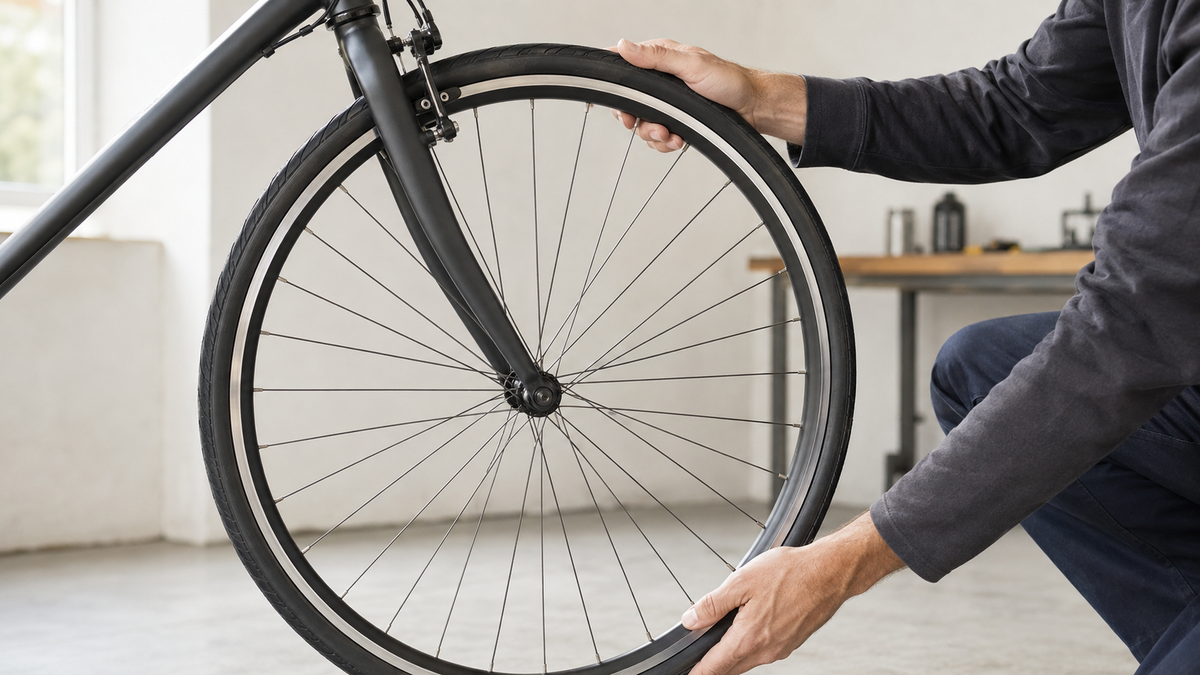
The wheel moves sideways even though the tire and rim appear undamaged, or the brake disc shifts when lightly pressed in the brake caliper: The bicycle hub may have play. However, before adjusting a bearing, you must rule out a loose axle, incorrect wheel installation, spoke problems, and play in other components. This guide shows how to perform a safe inspection with the bicycle stationary and explains which hub types can be adjusted at all.
When the bicycle must remain stationary
Do not continue riding if the wheel has visibly shifted in its mount, the axle is loose or not fully secured, the hub is making cracking noises or running roughly, the brake disc is rubbing heavily against the caliper, or cracks are visible on the hub, axle, rim, or fork. A professional inspection is also advisable after a hard impact. A wheel that locks or moves sideways can immediately lead to loss of control.
Park the bicycle securely and switch off the system on an e-bike. Check a raised wheel only in a secure repair stand. Do not place your hands near the spokes or brake disc while the wheel is turning. After riding downhill, let the brake cool down first.
Is it really the hub?
Play in the wheel initially describes only movement. The cause may lie in the bearing, axle mounting, fork or frame mount, spokes, or rim. When checking the rear wheel, you must also not automatically interpret cassette or freehub movement as hub play. Designs differ; if in doubt, the workshop should compare it with the manufacturer's specifications.
| Observation | Possible cause | Safe inspection point |
|---|---|---|
| The entire wheel moves in the mount | Axle not secured correctly | Check the installation according to the system instructions |
| Rim tilts while the axle visibly remains seated | Hub bearing with play | Observe movement directly at the hub body |
| Rim deflects locally | Rim runout or spoke tension | Turn the wheel slowly; do not adjust the bearing |
| Disc shifts when pressed from the side | Hub play or loose disc | Check the hub and disc mounting separately |
| Rough grinding when turning | Dirty or damaged bearing | Do not tighten it further; have it diagnosed by a workshop |
Check the wheel bearing seating and axle first
Check that the axle is fully seated in the intended mounts. Quick-release skewers, bolt-on axles, and thru-axles are operated differently. Follow the instructions for your bicycle and axle system; generic lever positions or torque values are not reliable. If there is visible damage, a missing retaining part, or a stiff thread, do not try to close the connection with additional force.
If the wheel was removed shortly beforehand, incorrect seating is more likely than a bearing that suddenly became worn. Reinstall it only if you are confident that you can do so safely. Then check the brakes and wheel rotation. If lateral movement persists with the axle correctly secured, proceed to checking the bearings.
Testing hub play on a stationary bicycle
Grip the tire at the top and bottom with both hands. Move it very slightly sideways, without pulling on the handlebar, mudguard, or luggage rack. Observe the connection between the hub and the fork or frame. A clearly perceptible clicking sound or visible tilting of the hub body relative to the axle is suspicious. Repeat the test with your hands on the left and right sides of the tire.
A flexible rim can also move under force. Therefore, use only light pressure and do not look for play by shaking vigorously. On a heavily loaded rear wheel, remove the bags. Do not apply the brake at the same time: This could introduce movement from the brake, fork, or headset into the test.

Assess wheel rotation and bearing feel separately
Turn the securely elevated wheel slowly. Lateral movement of the rim at a single point is more likely to indicate an issue with the rim or spokes. If the brake disc moves rhythmically, it may itself be warped. The article Bike brake disc rubbing explains this distinction.
A bearing should rotate smoothly. Seals and a hub dynamo can create a certain amount of design-related resistance, so absolute smoothness is not a universal benchmark. Grinding, hard notches, or changing resistance, however, are noticeable. Combined with play, they are more indicative of wear or damage than of a simple adjustment issue.
Cup-and-cone bearings or industrial bearings?
With classic cup-and-cone bearings, bearing play can be adjusted using the cone and locknut. Park Tool describes a very narrow range between too loose and too tight: Excessive play allows the wheel to rock, while excessive preload causes stiffness and accelerates wear. The adjustment must also take into account how the axle fastening affects the bearing when installed.
Many hubs use sealed cartridge or industrial bearings. These are generally not readjusted using a cone, but replaced with the appropriate tools when worn. Other systems have manufacturer-specific preload rings. You cannot reliably identify the type from a dust cap alone. Do not open the hub until the technical documentation, replacement parts, and tools have been clearly identified.
Special considerations for the rear wheel, internal-gear hub, and hub motor
At the rear wheel, the cassette, freewheel, or internal-gear hub adds further components. Lateral play only at the sprocket assembly is not automatically the same as bearing play in the entire wheel. With an internal-gear hub, the shift cable, fixing washers, and internal assemblies may be affected. For certain internal-gear hubs, Shimano requires adjustment without excessive axle play and with smooth, even rotation; however, the specific procedure is model-specific.
An e-bike hub motor combines wheel bearings, cables, and electrical components. Do not pull on the motor cable, open the housing, or use a general bearing guide for a conventional hub. Document the model, noise, and direction of movement, and contact a qualified service provider. Special components and torque specifications apply to motor-bearing axles.
Why “simply tightening it more” can cause damage
More tightening on an axle will not repair a worn bearing. Excessive bearing preload can also stress the races and balls. Use only the adjustment points specified by the manufacturer. Do not confuse axle fastening, locknut, preload ring, and brake disc fastening.
If you do not know the exact design, the diagnosis remains external. A workshop checks for play with the wheel correctly installed, carefully removes the hub, and assesses the bearing surfaces, balls, seals, and axle. If the races are worn or components are corroded, readjustment is not enough.
Prepare your workshop request properly
Note whether the play occurs at the front or rear, when cold or after a longer ride, and with or without brake noise. Describe the direction of movement and whether a clicking sensation can be felt. Mention the most recent wheel removal, any possible impact, and the mileage and weather exposure, if known. A short video taken from the side can show the movement.
Ask the workshop to inspect the axle seating, bearings, rim, spokes, brake rotor, and mount separately. This prevents adjustments from being made prematurely only at the bearing. After the repair, check the wheel attachment, unobstructed wheel rotation, and brake function. Begin a test ride slowly and in an area free of traffic.
Frequently asked questions about play in a bicycle hub
How much play may a bicycle hub have?
A blanket perceptible target value is not meaningful. With the wheel correctly installed, there should be no distinct clicking or rocking. Some systems have design-related tolerances; the manufacturer’s specifications and a professional inspection are decisive.
Can I continue riding with a wobbly hub?
Not if there is visible wheel movement, a loose axle, rough running, or brake contact. Even a small amount of unexplained play should be checked promptly because its cause and progression cannot be reliably predicted from the outside.
Can every hub with play be adjusted?
No. Cup-and-cone bearings can often be adjusted, but worn races cannot be repaired. Cartridge bearings are usually replaced; preload systems, internally geared hubs, and motors have their own specifications.
Can a loose brake rotor feel like hub play?
It can produce a similar noise, but it does not necessarily move the rim. Check both assemblies separately, and do not continue riding with a loose rotor.
Conclusion: attachment first, then bearings
If the bicycle hub appears to have play, first check that the wheel is securely seated and observe which part is actually moving. Only then assess the bearing type, smoothness, and possible subsequent symptoms. Clear movement, roughness, brake contact, or an insecure axle should be inspected by a workshop. This prevents you from simply tightening the wrong adjustment point.
As of: September 6, 2026. Axle attachment, bearing arrangement, adjustment range, and torque are system- and model-specific.
Share:
Bike chain broken: Stop, inspect the damage, plan your way home
Bent derailleur hanger: Recognize the symptoms and protect the rear derailleur