

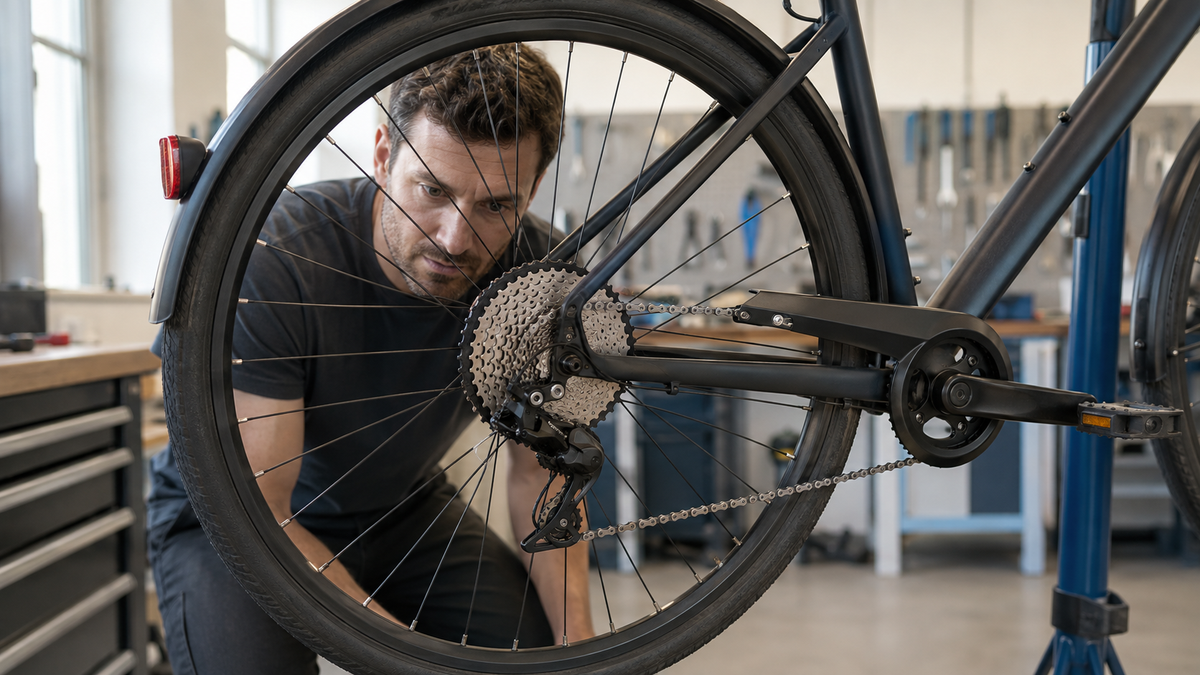
After a fall, the bicycle suddenly shifts inaccurately, even though the cable and chain were previously unremarkable. The chain rattles in individual gears, the derailleur is noticeably close to the spokes, or the derailleur pulleys no longer appear parallel to the cassette when viewed from behind. The derailleur hanger may then be bent. This small connecting part sits between the frame and derailleur and, in many designs, is intended to absorb stress before the frame is damaged. A safe diagnosis therefore begins not with the adjustment screws, but with a calm visual inspection.
When you should stop shifting
If the derailleur is visibly misaligned, touches the spokes or tire, the derailleur hanger is cracked, or the rear wheel has taken a hard impact, do not continue riding. Do not even test-shift toward the largest sprocket. A bent derailleur hanger can move the derailleur far enough inward for it to enter the spokes. This can damage the wheel, derailleur, and frame and cause the rear wheel to lock up.
Park the bicycle securely. On an e-bike, switch off the drive system; if you are working near the chain and derailleur, follow the system instructions for removing the battery. Keep your hands away from the drive system and turn the crank only in a controlled manner when the bicycle is safely raised. On a public road, walking the bicycle or arranging transport is the better choice than attempting a risky gear shift.
Typical symptoms of a bent derailleur hanger
A single symptom does not prove anything yet. Particularly telling is the combination of a preceding impact and a new malfunction affecting several gears. Shimano requires a straight derailleur hanger in its dealer documentation because an incorrect position impairs shifting performance. Exact alignment is checked with a designated checking tool, not confirmed by eye.
| Observation | Does it fit the derailleur hanger? | Also possible |
|---|---|---|
| Gears suddenly shifting inaccurately after a fall | Yes, especially after an impact to the derailleur | Loose cable, damaged derailleur |
| One gear rattles, others work | Possible | Indexing, worn sprocket or chain |
| Derailleur pulleys visibly misaligned when viewed from behind | Clear indication | Bent derailleur cage |
| Chain trying to move toward the spokes | Acute warning sign | Incorrectly adjusted limit |
| Shifting is poor only under load | Not conclusive | Shifting technology, chain wear, cable friction |
The safe visual check from behind
First look for clear signs of damage: a crack in the derailleur hanger, a loose connection, a bent cage, damaged spokes, or fresh impact marks. Then stand directly behind the bicycle and align your view along the rear wheel. The derailleur and jockey wheels should not visibly tilt inward or outward. This view reveals major deviations but does not replace a measurement. The tire, frame shape, and camera angle can deceive the eye.
Take a straight-on photo of the rear view and another from the drivetrain side. Note which gear is causing problems and whether the issue began after a fall, transport, or wheel removal. Also check that the rear wheel is fully seated in the dropouts and that the axle is secured according to the manufacturer's instructions. A misaligned wheel changes the visual reference line and can itself cause shifting problems.
Why adjustment screws are no substitute for a diagnosis
Cable tension or limit screws can sometimes seemingly compensate for a bent derailleur hanger in part of the cassette. However, shifting becomes worse elsewhere. Adjusting the inner limit is particularly dangerous: The chain can move too far toward the spokes. Therefore, do not mark or adjust any screw until the mechanical alignment has been clarified.

If the chain skips under load without an impact having occurred first, the chain, cassette, or shift cable may also be involved. The article Bicycle Chain Skips Under Load distinguishes between these wear- and adjustment-related causes. A bent derailleur hanger, on the other hand, remains a geometry problem at the interface between the frame and derailleur.
Derailleur hanger, derailleur cage, or frame?
The derailleur hanger is a replaceable part on many bicycles, but its shape, mounting, and material are specific to the frame. Some modern systems use different interfaces or direct mounting. A crooked appearance may also be caused by the derailleur cage itself or a damaged frame interface. Therefore, ordering based on “looks similar” is not enough.
- Derailleur hanger: is mounted to the frame and supports the derailleur; the replacement must match the frame exactly.
- Derailleur: may be damaged at the joint or cage even if the derailleur hanger is straight.
- Frame mount: must be professionally assessed if there is a crack, deformation, or a stripped thread.
- Rear wheel: incorrect seating or hub play can distort the visual inspection.
How the workshop measures alignment
A professional removes the derailleur according to the system specifications and screws a derailleur hanger alignment tool into the mounting point. The tool checks the distance to the rim at several positions. This does not merely show whether something appears crooked; it compares the alignment relative to the wheel axle. The professional then determines whether the part may be straightened according to the manufacturer's specifications or must be replaced.
This work requires a properly matching thread, a correctly seated wheel, controlled force, and a final gear adjustment. Shimano explicitly labels its dealer service manuals for professional bicycle mechanics. This is a good indication that the derailleur hanger should not be bent with pliers, a pipe, or an improvised lever. A brittle or already fatigued part can break in the process; on a carbon or aluminum frame, applying force incorrectly can cause additional damage.
Identifying the correct replacement part
Make a note of the manufacturer, model, year of manufacture, and, if applicable, the frame number, without posting this information publicly. Photograph both sides of the installed derailleur hanger, as well as the number and position of the mounting screws. The workshop or bicycle manufacturer can use this information to identify the correct part. Do not use a similar-looking alternative or grind a replacement part to make it fit. Even small differences can change the position of the derailleur.
The replacement also includes checking the threads, contact surfaces, and derailleur, as well as adjusting the limit screws according to the specific instructions. Torque values are not universal. The correct value can be found in the documentation for the frame, derailleur hanger, or derailleur. After installation, perform a controlled test of all gears on a work stand, followed by a short ride without heavy loads.
What you can do while on the road
If the shifting is only slightly erratic, the derailleur remains safely well clear of the spokes, and no crack or play is visible, you can push the bike until the issue is clarified. Whether riding cautiously is advisable cannot be determined categorically from a distance. In case of any contact, noticeable misalignment, or unusual creaking, keep the bike stationary. Do not remove the derailleur while on the road without the appropriate tools and a safe plan for the chain and cables.
For longer rides, carrying an exactly matching replacement derailleur hanger may be useful. It is small and not always available at short notice. However, the replacement part alone does not replace checking the frame or aligning it. Pack it with the model identification and manufacturer details so that a workshop can use it unambiguously.
Frequently asked questions about bent derailleur hangers
Can you recognize a bent derailleur hanger with the naked eye?
A major deviation may sometimes be visible. However, small angular deviations are enough to cause poor shifting performance and are difficult to assess reliably without measuring tools. Looking from behind is therefore only a screening check.
Can I straighten the derailleur hanger myself?
Not with pliers or an improvised lever. Whether a particular derailleur hanger may be straightened depends on the material, damage, and the manufacturer's approval. A specialist workshop will take controlled measurements and replace the part if it is cracked, severely deformed, or its condition is uncertain.
Why does the bike shift poorly after transport?
Lateral pressure on the derailleur can deform the derailleur hanger or cage. The rear wheel may also be seated differently, or a cable may have come loose. Document the initial condition and have the geometry checked first.
Are derailleur hangers universal?
No. There are many frame-specific shapes and different mounting systems. Only buy a part whose compatibility with your exact frame has been confirmed.
Conclusion: Geometry before adjustment
If the derailleur hanger may be bent, making further shifting attempts toward the spokes is the wrong diagnostic approach. Check the cause, ensure the wheel is seated securely, and inspect it from behind; document any abnormalities and have the alignment measured. Only once the derailleur hanger, derailleur, and frame mounting point are mechanically sound is fine-tuning the shifting worthwhile.
As of September 6, 2026. Installation, alignment, replacement part, and torque specifications depend on the frame and shifting system.


Share:
Bike chain broken: Stop, inspect the damage, plan your way home
E-bike battery not charging: Safe inspection without opening