

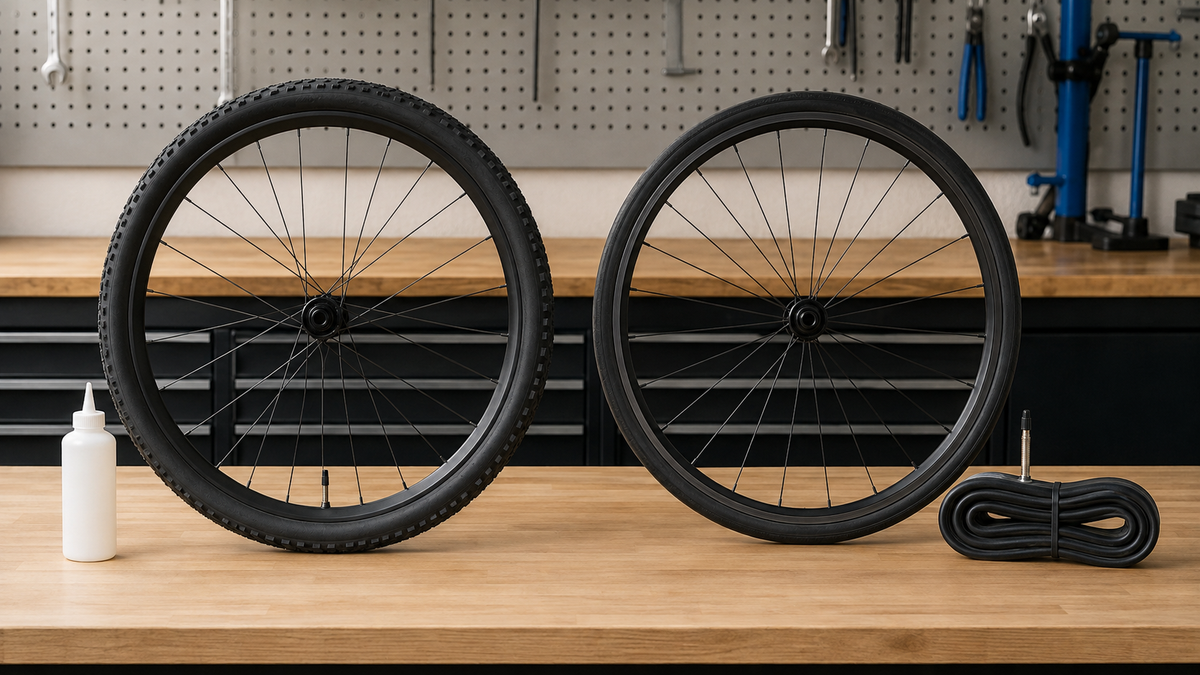
Tubeless or a tube on a bicycle is not simply a question of modern versus old. Both systems can work reliably when the tire, rim, valve, tire pressure, and intended use are well matched. Tubeless can improve comfort and puncture protection during performance-oriented use, but it requires compatible components and ongoing maintenance. A butyl tube is generally easier to install and simpler to replace on the road. The better choice therefore depends on the route, willingness to perform maintenance, and the wheels you already have.
What differs technically
In a classic tube-type system, a separate tube holds the air. The tire and rim guide and protect it. In a tubeless system, the tire, together with a suitable rim, airtight rim tape, and a tubeless valve, forms the air chamber. Many modern bicycle tubeless systems also require sealant to seal the system and close small punctures while riding.
| Criterion | Tubeless | Tube |
|---|---|---|
| Requirement | Approved tire and compatible wheel | Matching tire, tube, and rim tape |
| Puncture pattern | Sealant can seal small punctures | Patch the puncture or replace the tube |
| Maintenance | Check the sealant and airtightness regularly | Check tire pressure and condition, with less system maintenance |
| On the road | Repair may be clean or messy | Spare tubes are widely available |
| Lower pressure | More likely depending on the system | Limiting pinch flats and tube damage |
The table describes typical characteristics, not a guarantee. Tire construction, width, rim, load, and surface often influence the result more than the word “tubeless” alone.
Putting the advantages of tubeless into perspective
Schwalbe cites lower rolling resistance, greater comfort and grip, and a high level of puncture protection for tubeless tires. The manufacturer attributes this to the absence of friction between the tire and tube, the option of running lower tire pressure, and sealing small punctures with sealant. Schwalbe considers these features particularly interesting for performance-oriented riders.
This does not mean that every tubeless tire is faster or more puncture-resistant than every tire with a tube. Tread, casing, puncture-protection layer, tire pressure, and installation remain crucial. Larger cuts, sidewall damage, or a damaged rim cannot be reliably repaired with sealant. A tubeless system can also suddenly lose air.
Why the inner tube remains attractive for everyday use
Those who ride infrequently, want to do little maintenance, or prefer a straightforward repair while on the road are often well served by a suitable butyl inner tube. Schwalbe describes butyl as an elastic yet airtight synthetic rubber. A suitable inner tube can cover several similar tire widths; however, the size range printed on it remains decisive.
In the event of a puncture, you can look for the cause in the tire, repair a hole, or install a spare inner tube. This work is not automatically error-free: A pinched inner tube, a foreign object left behind, damaged rim tape, or the wrong size can quickly lead to another puncture. The advantage lies more in the manageable list of parts and good availability.
Compatibility comes first before purchasing
“Tubeless Ready” on a tire is not sufficient on its own. Check the markings and approvals for the tire and rim, as well as the wheel’s manual. Depending on the system, you need an airtight or tubeless-compatible wheel, suitable rim tape, a compatible valve, and approved sealant. The requirements are particularly strict for hookless rims: In its hookless information, Schwalbe requires a compatible TLE or TLR tire and compliance with the lower maximum pressure specified for either the rim or the tire.
For an e-bike, the permitted load must also be considered. The total weight, tire approval, rim approval, and intended use must be compatible. A tubeless designation does not automatically mean approval for e-bikes. For S-Pedelecs or fast e-bikes, additional legal or manufacturer requirements may apply.
Tire pressure is system-specific
Tubeless often allows a slightly lower pressure because no inner tube can be pinched between the rim and an obstacle. Pressure that is too low remains risky: The tire can become unstable in corners, lose air at the bead, or bottom out against the rim. Pressure that is too high can exceed the permitted combination. Therefore, do not use a blanket value from the internet.

The starting pressure depends on the tire and rim specifications, rider weight, luggage, tire width, and surface. Check the pressure when cold using a suitable pressure gauge and stay within all specified limits. Make small adjustments and test them on a safe route.
The maintenance required for tubeless tires
Sealant does not remain effective indefinitely. The inspection interval and refill quantity depend on the product, tire, climate, and usage profile. Follow the instructions from the sealant and tire manufacturer. If the bike is stored for a long time, a tubeless tire may slowly lose pressure or the sealant may dry out inside. A visual inspection of the tire, bead, and valve, as well as regular pressure checks, remains necessary.
Liquid residue may escape when opening the system. Protect brake discs, brake pads, and the ground from sealant. Use only compatible products; mixing different liquids without authorization can alter their function. Dispose of old sealant according to local regulations, not down the drain or into the environment.
A breakdown on the road: Both systems need a plan
With tubeless tires, small punctures are often sealed while riding. For its system, Schwalbe recommends bringing the affected area to the bottom or continuing to roll so that the sealant and flexing motion can take effect. This approach applies only as long as the bike remains safely controllable and the tire is not visibly coming off the rim. For large cuts, Schwalbe names a spare inner tube as an emergency solution.
For this, you must be able to safely remove the valve and, if necessary, repair materials. Pack gloves, a cloth, a suitable pump, tire levers, and an appropriately sized inner tube. With a tube system, you should also bring patches or a spare inner tube. In both cases, carefully search for the foreign object before installation. If it is still stuck in the tire, it will also destroy the new inner component.
Convert or stay with the existing system?
A conversion is more worthwhile when the rim and tire are explicitly compatible, you regularly ride on rough surfaces or ride aggressively, and you are prepared to maintain sealant and pressure. It is not a good spontaneous solution if the markings are missing, the rim tape is damaged, or you only want to perform maintenance rarely. Schwalbe points out that installation can be technically demanding and should be left to a specialist dealer if you lack experience.
Stick with an inner tube if reliability through simple maintenance, worldwide availability of replacement parts, and predictable repairs are more important. A good tire with the right pressure and an intact rim tape is not a “second-rate” system. If you only commute occasionally, tubeless does not automatically provide a noticeable everyday benefit.
Choosing based on riding profile
- City riding and occasional use: An inner tube is usually low-maintenance and easy to replace.
- Gravel or mountain bike: With a suitable combination, tubeless can handle pressure, grip, and small punctures better.
- Long trip: Repair skills and replacement-part availability are crucial; take a suitable inner tube even with tubeless.
- High payload or e-bike: Check the load, pressure, and e-bike approvals for all components.
- Infrequent maintenance: A butyl inner tube is usually a better fit than sealant that requires periodic maintenance.
Frequently asked questions about tubeless and inner tubes
Can I simply pour sealant into any tire?
No. For safe tubeless operation, the tire, rim, tape, valve, and sealant must all be suitable. An arbitrary combination may leak or compromise tire retention.
Do I still need a spare inner tube with tubeless?
It is useful for longer rides. Large cuts or damage that sealant cannot seal can be bridged temporarily, provided the tire and rim remain undamaged.
Is tubeless always lighter?
Not necessarily. The tire, tape, valve, and sealant all matter. Compare the complete, compatible configuration rather than just the inner tube and sealant.
Can a tubeless tire be ridden with an inner tube?
With many combinations, this is possible as a puncture solution, but only if the manufacturer approvals, size, and rim shape are compatible. The specific manual is decisive.
Conclusion: The right system is the well-maintained system
Tubeless offers advantages with compatible equipment for sporty riding, lower adjusted pressure, and sealing small punctures. Inner tubes score points with simple component logic and less maintenance. Decide based on wheelset approval, route, load, and your own repair experience. Regardless of the system, checking pressure, inspecting condition, and having a realistic puncture plan remain essential.
As of September 6, 2026. Tire, rim, pressure, load, and sealant approvals depend on the current specifications of the specific components used.
Share:
E-bike software update: Prepare safely and avoid errors
Raise the handlebars: safely distinguish between quill and Ahead stems