

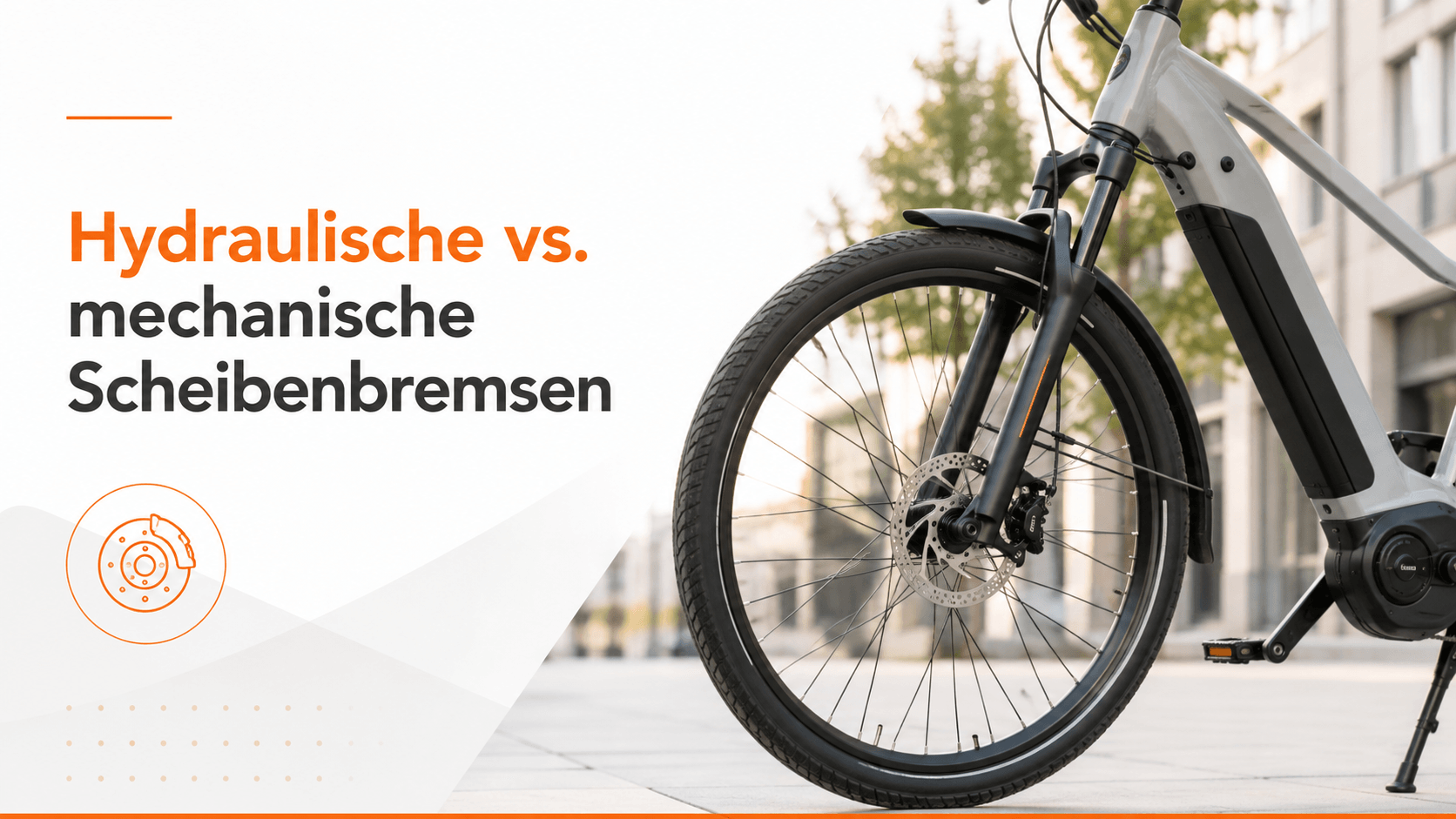
Hydraulic vs. Mechanical Disc Brakes: Which Brake Is Better Suited to an E-Bike?
Anyone looking to buy an E-Bike will quickly encounter two terms: hydraulic disc brakes and mechanical disc brakes. Both systems brake via a disc on the wheel, but they differ significantly in braking feel, maintenance, and everyday use.
The simple difference
With a mechanical disc brake, braking force is generally transmitted via a Bowden cable. With a hydraulic disc brake, force is transmitted through fluid in a closed system. As a result, a hydraulic brake often feels more direct, consistent, and easier to modulate.
Direct comparison: hydraulic or mechanical?
For E-Bike riders, the difference is particularly relevant because E-Bikes are heavier than conventional bicycles and are often ridden at higher average speeds in everyday use.
| Criterion | Hydraulic disc brakes | Mechanical disc brakes |
|---|---|---|
| Braking feel | Direct, finely adjustable, consistent | Solid, but more dependent on cable tension and adjustment |
| Hand force required | Usually lower | Often higher, especially on long rides |
| Everyday maintenance | Less frequent adjustment, but bleeding may require special tools | Easier to understand, but the cable and brake pads need to be checked more frequently |
| Cost | Usually slightly higher | Often more affordable |
| Suitable for heavy E-Bikes | Very good | Dependent on quality and adjustment |
| Suitable for urban traffic | Very good for stop-and-go traffic and wet conditions | Good when properly adjusted |
Why E-Bikes Particularly Benefit from Hydraulic Brakes
On a conventional bicycle, a simple braking system is often sufficient if weight and speed remain moderate. E-bikes are different: the battery, motor, and sturdier frames increase the overall weight. In addition, many riders travel more frequently, farther, and with consistent assistance.
- Greater vehicle weight means higher demands on the braking system.
- Urban traffic requires frequent, controlled braking.
- Wet conditions, cobblestones, and downhill sections require good modulation.
- When carrying a load or luggage, consistent braking performance becomes even more important.
Anyone who rides regularly in everyday life, commutes, or carries luggage is usually better served by hydraulic disc brakes than by basic mechanical brakes.
When mechanical disc brakes can still make sense
Mechanical disc brakes are not automatically bad. They can be sufficient for simple bicycles, budget-oriented models, or very short trips. Their main advantage lies in their simple technology: the brake cable, lever, and caliper are easy to understand and often easier to readjust yourself.
Maintenance: How do the two systems differ?
Maintenance is a common reason for asking, “hydraulic or mechanical?” Mechanical brakes require more frequent attention to cable tension and pad positioning. Hydraulic brakes are often more convenient in everyday use, but may require professional bleeding if air enters the system.
| Maintenance item | Hydraulic | Mechanical |
|---|---|---|
| Checking the brake pads | Required regularly | Required regularly |
| Cleaning the brake disc | Important for preventing noise and loss of performance | Important for preventing noise and loss of performance |
| Adjusting the brake cable | Not applicable | Relevant regularly |
| Bleeding | Possible if the pressure point feels spongy | Not required |
| Workshop required | Useful if bleeding or line problems occur | Often easier to check yourself |
Which brake is right for which type of rider?
The best brake depends not only on the system but also on your daily routine. An e-bike for short trips has different requirements than a bike for daily commuting, shopping, or longer journeys.
Which Cyseekin models particularly benefit from hydraulic braking performance?
For Cyseekin, the relevance of the brakes depends heavily on the intended use. Unlike a purely technical comparison, the focus here is not on the brake alone, but on the interplay of weight, tires, use, and everyday riding.
Discover Cyseekin e-bikes with reliable braking performance
Compare models for everyday use, city traffic, commuting, and practical use.
View all Cyseekin e-bikes →Further content
FAQ – Hydraulic vs. mechanical disc brakes
What is the biggest difference between hydraulic and mechanical disc brakes?
The biggest difference lies in power transmission. Mechanical brakes usually operate with a brake cable, while hydraulic brakes use fluid in a closed system.
Which disc brake is better for heavy e-bikes?
Hydraulic disc brakes are generally better suited to heavy e-bikes because they can offer greater braking power and finer modulation.
Are mechanical disc brakes easier to maintain?
Yes, mechanical brakes are often easier to understand and simpler to adjust yourself. However, the brake cable and adjustment need to be checked more frequently.
Why do hydraulic brakes often feel more powerful?
Hydraulic power transmission results in less power loss. As a result, less hand force is often needed to achieve strong and consistent braking performance.
Which brake is better in the rain?
Both systems can work in the rain. However, hydraulic disc brakes often offer more stable and finer control in changing conditions.


Share:
E-Bike Online vs. Local Dealer: Which Suits You Better?
A Saturday at the Bike Shop | E-Bike Everyday Life in Germany