

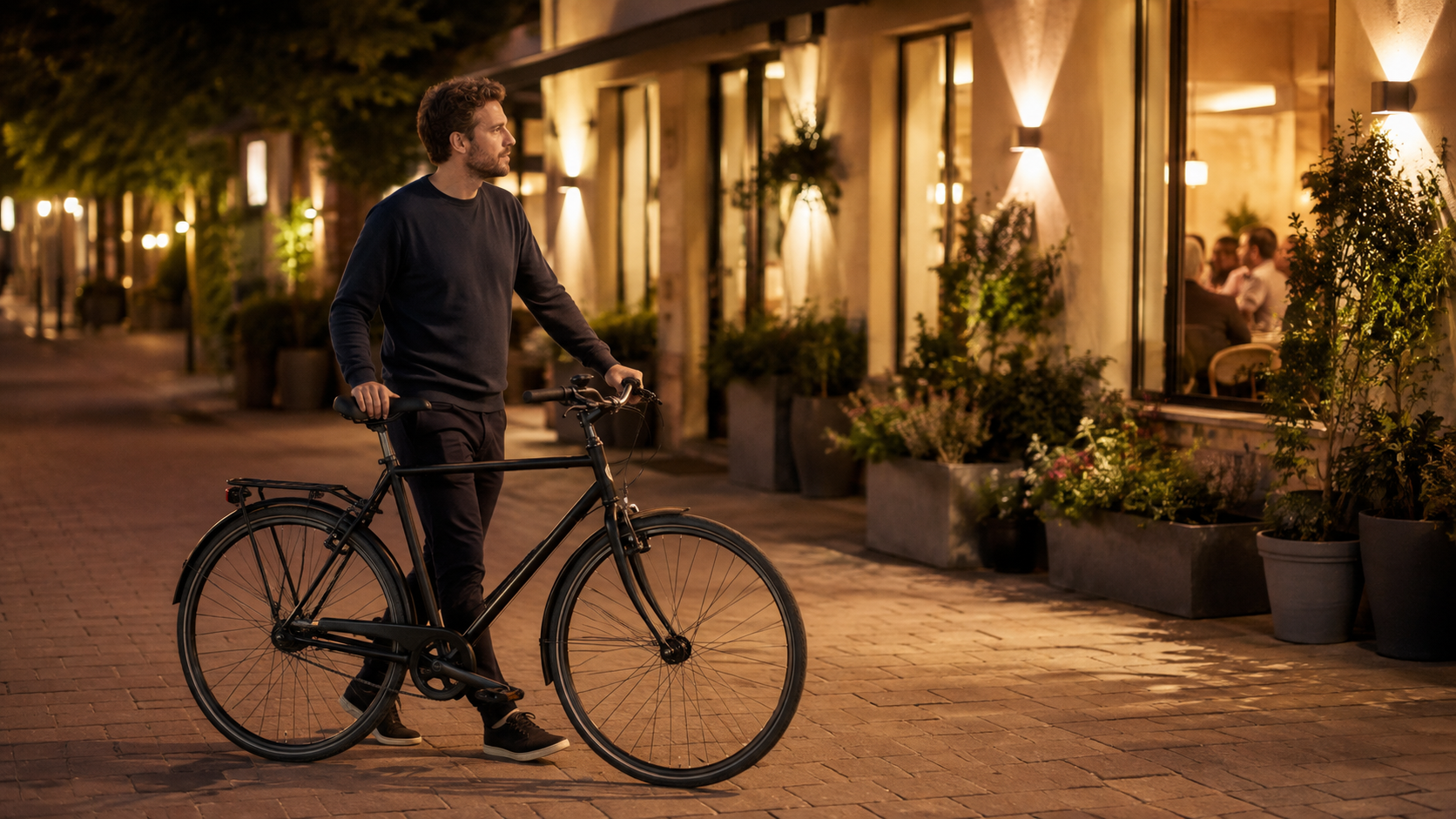
“How many per mille are permitted on a bicycle?” sounds like a simple question, but it points in the wrong direction. The familiar 0.5-per-mille rule applies to motor vehicles and is not a safe limit for an ordinary bicycle. Even with significantly less alcohol, driving errors or an accident can be relevant under criminal law. The most reliable decision is therefore: after drinking alcohol, do not ride; walk your bicycle, leave it where it is, or choose another way to get home.
Alcohol on a bicycle: a brief legal overview
Section 24a of the German Road Traffic Act (StVG) expressly sets the 0.5-per-mille limit for operating a motor vehicle. An ordinary bicycle is not a motor vehicle. A pedelec whose electric motor assistance complies with the statutory limit of no more than 250 watts, decreases as speed increases, and ends at the latest at 25 km/h is likewise not treated as a motor vehicle under Section 1(3) of the StVG.
However, this does not mean that alcohol on a bicycle would automatically be permitted up to another specified level. Section 316 of the German Criminal Code (StGB) concerns operating a vehicle while unfit to drive due to alcohol or intoxicating substances. The term “vehicle” includes bicycles. Anyone who can no longer ride safely but nevertheless participates in traffic may be committing a criminal offense; negligent conduct is also covered.
0.5, 0.3, and 1.6 per mille do not mean the same thing
| Value or rule | Typical classification | Important limitation on what this statement means |
|---|---|---|
| 0.5‰ under Section 24a of the StVG | Administrative-offense limit for motor vehicles | No general safe limit for ordinary bicycles |
| Approximately 0.3‰ plus signs of impairment | Relative inability to drive can be relevant under criminal law | The figure alone is not sufficient; driving errors or an accident must also be involved |
| From 1.6‰ on a bicycle | In legal practice, absolute inability to drive | Court-established threshold, not stated as a figure in the wording of Section 316 |
| 1.6‰ or more while operating a vehicle | Section 13 of the FeV provides for an order to undergo a medical-psychological assessment in licensing proceedings | Consequences depend on expert assessments and the individual case |
These values are not a planning aid for alcohol consumption. Body weight, time, food, medication, and individual response alter the effects without guaranteeing that you are fit to drive safely. A calculation based on the number of drinks can neither replace a blood alcohol measurement nor predict whether a person will recognize a danger in time.
Relative inability to drive can begin early
Under established case law, relative unfitness to drive may exist from around 0.3‰ if alcohol-related signs of impairment are present. These may include pronounced weaving, balance problems, a serious traffic violation, or an accident. The issue is not an abstract number, but the combination of alcohol and specific unsafe conduct.
No one should conclude from this that riding below 0.3‰ is guaranteed to be unproblematic. Even small amounts can impair attention, reaction, and risk assessment. Anyone who is tired, taking medication, or facing a demanding route may be additionally impaired. The criminal-law threshold and a safe personal decision are not the same thing.
Why 1.6‰ is not a “permitted limit”
From 1.6‰, established legal practice presumes that cyclists are absolutely unfit to drive. No additional riding errors need to be proven first. The figure does not appear literally in Section 316 of the German Criminal Code (StGB); rather, it is based on case law and traffic-medical classification. It therefore does not mark a permitted zone just below that level.
In addition, Section 13 FeV provides that the driving licence authority orders a medical-psychological assessment if someone has operated a vehicle with a blood alcohol level of 1.6‰ or more. This may also be relevant after riding a bicycle under the influence of alcohol. The Federal Administrative Court has confirmed the significance of such a bicycle ride under driving-licence law.
An MPU, criminal proceedings, and measures affecting a driving licence are separate matters. A blood alcohol level of 1.6‰ does not automatically result in the permanent revocation of a driving licence in every case. The authority requires an assessment; further consequences depend on the result and the specific proceedings.

Do not confuse a standard pedelec with an S-Pedelec
For a pedelec legally classified as a bicycle, the bicycle provisions in this article generally apply to alcohol. The technical limit of up to 25 km/h describes the level of assistance, not a permitted alcohol limit. An S-Pedelec, by contrast, is a motor vehicle. The alcohol regulations applicable to motor vehicles therefore apply, among others; the bicycle threshold of 1.6‰ must not be applied to it.
Anyone who is not sure of the vehicle class should check the type plate, operating permit, and manufacturer’s documentation. Appearance, tire width, or a display are not sufficient for legal classification. This distinction is important, but it should not be taken as an invitation to drink “up to the limit” of any class.
What applies during the probationary period?
The special alcohol ban for novice drivers in § 24c StVG applies to operating a motor vehicle during the probationary period or before reaching the age of 21. A regular bicycle does not thereby become a motor vehicle. Nevertheless, § 316 StGB and all consequences of unsafe or accident-prone riding remain in force. For an S-pedelec, the classification as a motor vehicle is decisive again.
Even without a specific probationary-period violation, riding a bicycle under the influence of alcohol can affect your driving licence. Driving-licence law assesses whether a person is fit to operate vehicles safely in traffic. Therefore, the statement “I was only riding a bicycle” is not reliable protection against further proceedings.
Plan a safe journey home before the first drink
- Plan your return journey: Choose public transport, a taxi, a pickup, or a walking route in advance.
- Park the bicycle safely: Plan a lock and an authorized parking location; collect it sober the next day.
- Do not calculate by the glass: Do not try to calculate an allegedly safe journey based on the amount consumed and the time.
- Push the bicycle if unsure: Sitting on or rolling along on the bicycle to “test” whether you can still manage is not a safety check.
- Do not let others drive: An accompanying person is not a solution if they have also been drinking.
Anyone who pushes the bicycle is no longer considered the rider of the bicycle. Nevertheless, walking also requires attention. In cases of severe impairment, arrange for a sober escort or direct transportation instead of continuing alone with the bicycle.
Frequently asked questions
Can you ride a bicycle with less than 1.6 per mille?
The figure 1.6 is not a permitted limit. From around 0.3 per mille, alcohol-related riding errors or an accident can already result in relative inability to drive and criminal consequences.
Does the 0.5-per-mille limit apply to a regular e-bike?
The everyday term “e-bike” is imprecise. A road-legal pedelec with up to 250 watts and assistance ending at 25 km/h is not a motor vehicle; an S-pedelec is. The actual vehicle class is decisive.
Is your driving licence automatically revoked at 1.6 per mille on a bicycle?
No, a permanent revocation is not automatically determined solely by the number. FeV § 13 provides for an MPU order; the further driving-licence proceedings depend on the assessment and the individual case.
How many beers are still safe?
There is no reliable number for this. The effects of alcohol and blood alcohol concentration depend on many factors. For traffic safety and legal clarity, the right plan is: drink or drive, not both.
As of September 5, 2026. This article provides general guidance for Germany and does not replace legal advice or a medical assessment.
Share:
Bicycle in a roundabout: entering, circulating, and exiting
Bicycle Bell: Legal Requirement, Inspection, and Proper Warning Usage