

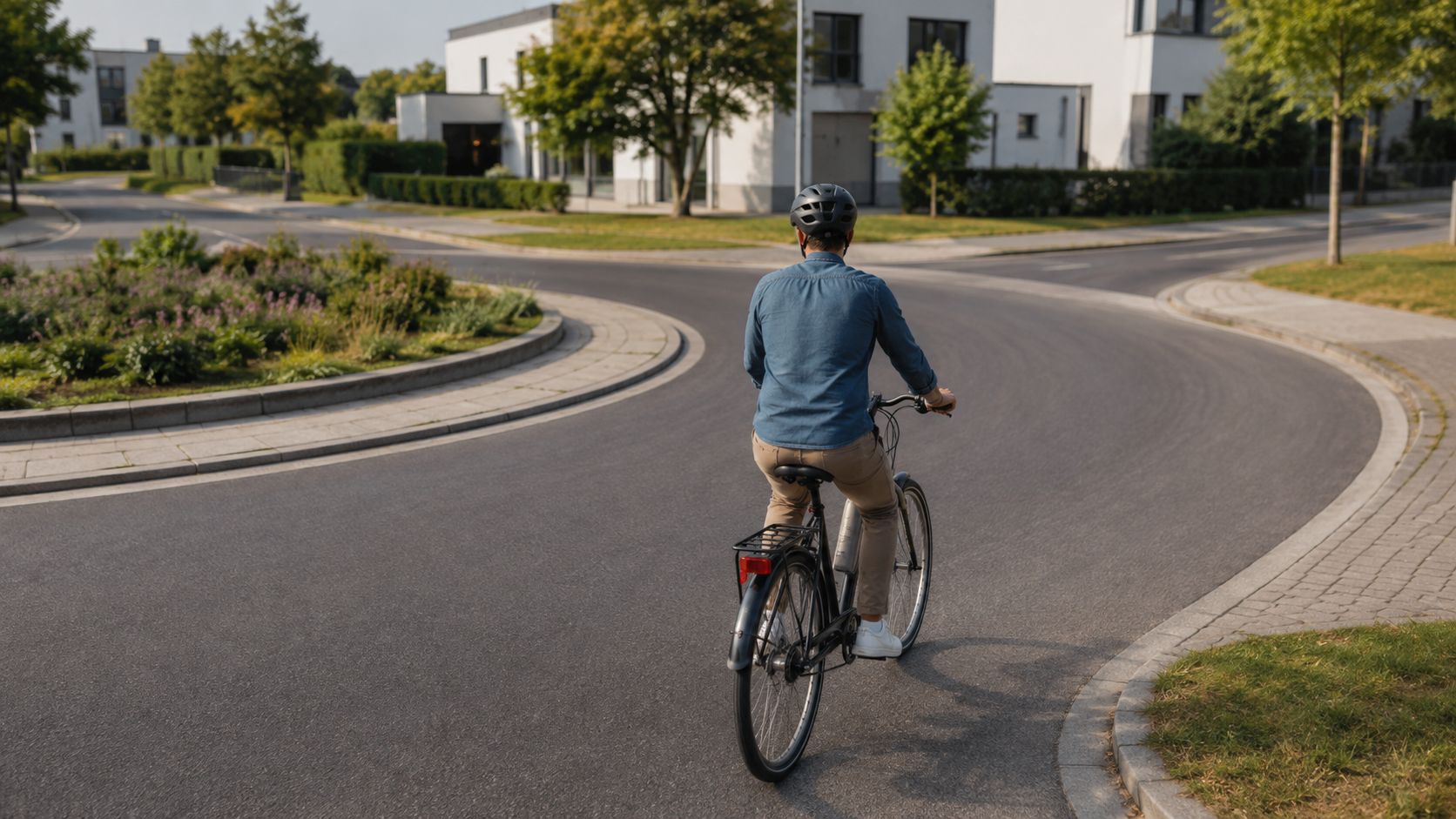
At roundabouts, bicycles are subject to the same basic rules as other vehicles, but cycle facilities along the edge often make the situation unclear. The first and most important question is: Is this a conventionally signed roundabout with signs 205 and 215, or merely a circular intersection? Entry, circulation, and exit should then be assessed separately. Red surfaces or a bicycle pictogram alone do not determine right of way.
Roundabouts and right of way: check the signs first
A classic roundabout is marked at the entrance with sign 205 “Give way” and sign 215 “Roundabout.” Under Section 8 (1a) of the German Road Traffic Regulations, traffic on the circulating roadway then has priority. Entering traffic must wait until a safe gap is available.
If this combination is absent, the right-of-way rule must not be inferred solely from the circular shape. Other signs, traffic lights, or general right-of-way rules may apply at a circular intersection. A small central island alone does not automatically make an intersection a roundabout in the legal sense.
Phase 1: enter correctly
Reduce your speed before entering and observe traffic in the roundabout. With signs 205 and 215, the person already riding in the roundabout does not have to brake for someone entering. Cyclists should therefore remain behind the stop line until the gap is not merely narrow but completely safe. A vehicle currently circulating in the roundabout may still miss the exit or continue without giving a clear signal.
When entering a roundabout marked with these signs, no turn signal may be used. For cyclists, the practical implication is: do not give a misleading hand signal when entering. Entering is not a right turn that should be announced by extending your right arm. Both hands can remain on the handlebars for stable steering and readiness to brake.
Phase 2: travel in the prescribed direction
Sign 215 requires traffic to travel in the direction around the roundabout. The central island must not be driven over; stopping on the circulating roadway is also prohibited. These rules are set out in Annex 2 to the German Road Traffic Regulations. If you miss an exit, continue in a controlled manner and take another lap instead of stopping abruptly or cutting across a lane.
On a simple single-lane roundabout, a steady, clearly visible road position is helpful. Avoid sudden changes of direction and keep your distance from curbs, drains, and any vehicle doors that may be opened near the exits. Multi-lane roundabouts, marked cycle lanes, or physically separated cycle paths must be assessed according to their specific layout; no single standard position suits every design.

Phase 3: Indicate the exit in good time
Leaving the roundabout is a turning manoeuvre. Under Section 9 of the German Road Traffic Regulations, the direction must be indicated in good time and clearly. On a bicycle, this is usually done with a right-hand signal. Check the surroundings before signalling; after clearly indicating the manoeuvre, the hand may be returned to the handlebars for safe control.
A hand signal does not replace looking. Before the exit, pedestrians or cyclists may use a crossing. Traffic lights, cycle crossings, waiting or stop lines and other signs must be observed. Anyone who cannot safely reach the intended exit should remain predictable in the roundabout and complete another lap.
Three phases at a glance
| Phase | Priority-to-the-right rule | Action on the bicycle |
|---|---|---|
| Entry with signs 205 + 215 | Traffic in the roundabout has priority; do not signal when entering | Wait, check for a gap, do not give a misleading hand signal |
| Circulation | Mandatory direction; do not drive over the central island; do not stop | Maintain a consistent line and sufficient safety distances |
| Exit | Turning under Section 9; clearly indicate the direction | Give a right-hand signal, check crossings, maintain control |
Cycle path beside the roundabout: Do not guess who has priority
A cycle path running around a roundabout may be close to the roundabout carriageway or set far farther out. At the crossings, vehicles may turn out of the roundabout while cyclists continue following the curve. For turning traffic, the duty under Section 9(3) to exercise consideration and wait for cyclists travelling in the same direction is particularly important.
This does not, however, support a rule that cyclists always have priority at every crossing of every roundabout. Specific signs 205, traffic lights, stop lines, the distance from the roundabout carriageway and the specific layout can change the situation. Therefore, read the signs and signals first, then assess the direction in which the vehicles are moving. A red surface does not cancel an imposed obligation to wait.
When a car wants to leave the roundabout
When a car exits the roundabout and crosses a cycle path running in the same direction immediately beside the carriageway, the person turning must generally give way to cyclists continuing along it. Nevertheless, cyclists should still pay attention to the position and speed of vehicles and make eye contact. An existing right of way does not physically protect anyone from a person who overlooks the cycle path.
Defensive checking is not an instruction to universally waive your right of way. It provides braking reserve. If you recognize that a vehicle is approaching the crossing without slowing down, reduce your speed early and stop if necessary. The incident can then be assessed separately from the immediate avoidance of danger.
Common mistakes when cycling through a roundabout
- Signal right when entering: In a standard signed roundabout, this incorrect signal should be avoided.
- Rely on priority without checking the signs: The circular design alone is not sufficient.
- Do not signal the exit: Leaving the roundabout must be announced in good time and clearly.
- Interpret a red surface as proof of right of way: Markings and color do not replace signs or signals.
- Brake after missing your exit: Taking another lap is safer.
- Watch only for cars in the roundabout: Crossing pedestrian and bicycle traffic at the exit must also be considered.
A brief guide to unfamiliar roundabouts
- Before entering, look for signs 205 and 215, traffic lights, and the cycle-path routing.
- Reduce your speed and, when traffic on the roundabout has right of way, wait for a complete gap.
- Enter in the prescribed direction under control, without giving a hand signal when entering.
- Maintain a predictable line in the roundabout and identify your intended exit early.
- Check your surroundings before exiting and clearly signal to the right.
- Be aware of crossings, signals, and possible turning conflicts; when in doubt, continue riding rather than cutting across.
Frequently asked questions
Who has right of way at a roundabout?
With the combination of signs 205 and 215, traffic on the circular carriageway has right of way. Without these signs, the rules and signs at the specific junction apply.
Do you have to give a hand signal when entering by bicycle?
No. When entering a roundabout marked with signs 205 and 215, you must not signal. Cyclists should therefore not give a misleading right-hand signal.
Do you have to give a hand signal when exiting?
Yes, exiting is a turning maneuver and must be signaled in good time and clearly. After signaling, the hand may return to the handlebars if this is necessary for safe control.
Do cyclists always have right of way on a circulating cycle path?
No, not universally at every design and crossing. Signs, traffic lights, lane markings, and the location of the cycle path also play a role. Where a vehicle exiting the roundabout crosses cyclists traveling in the same direction, Section 9 (3) is particularly relevant.
As of September 5, 2026. Signage, signals, and routing at the specific roundabout are decisive. This article does not replace legal advice for individual cases.
Share:
Dog on a Bike: Legal Requirements, Training, and Stop Signals
Bicycle Bell: Legal Requirement, Inspection, and Proper Warning Usage