

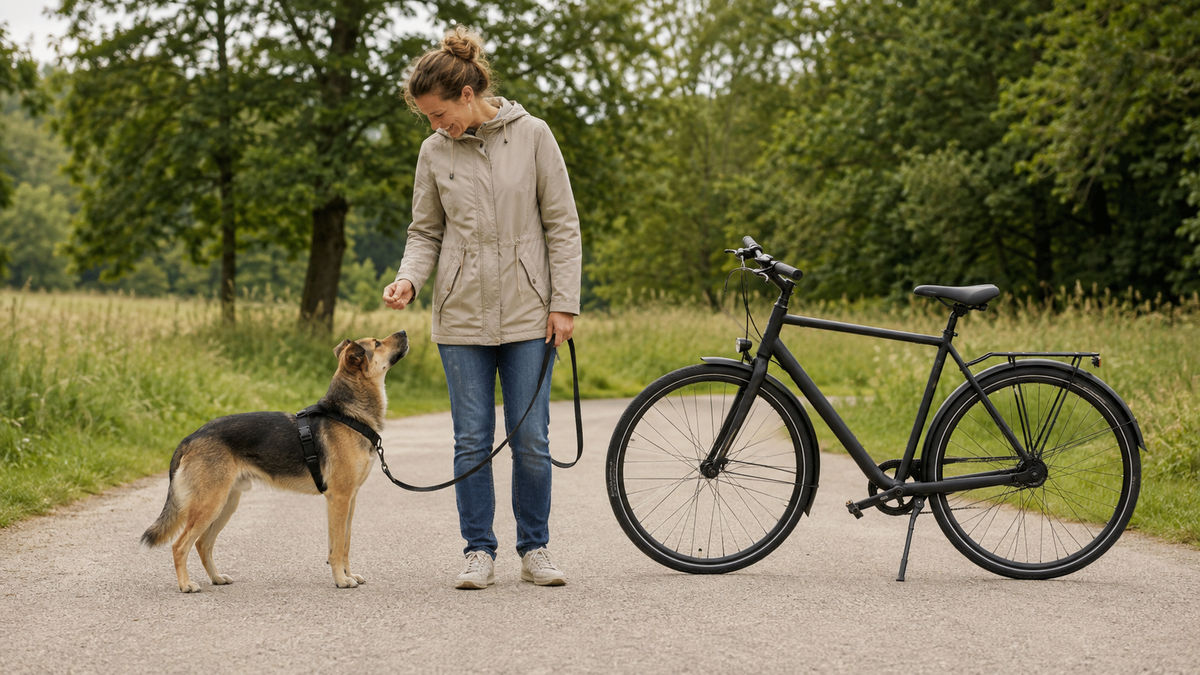
In Germany, taking a dog along on a bicycle is generally possible, but it is not suitable exercise for every animal or every route. Two aspects are decisive: The person riding must be able to control the dog sufficiently in traffic, and the exertion must suit the dog's breed, age, health, and level of training. Local leash regulations must also be taken into account, as they may vary depending on the federal state, municipality, forest, or protected area.
Dogs on bicycles: What the StVO permits
Under Section 28(1) of the German Road Traffic Regulations (StVO), domestic and farm animals that could endanger traffic may only be accompanied by suitable people who can exercise sufficient control over them. Animals may not be led from motor vehicles. However, only dogs may be led from bicycles. This neither permits other animals nor means that every dog is automatically suitable for running alongside a bicycle.
“Sufficient control” is a specific question of control. The dog should reliably respond to commands despite distractions, must not suddenly change sides, and must not charge at vehicles, wildlife, or other dogs. The person riding must also be able to brake and steer safely while observing the surroundings. If this control is not in place, training should initially take place in a suitable area free of traffic, not on a public road.
Animal welfare is not a minor matter
Section 2 of the Animal Welfare Act (TierSchG) requires care and housing appropriate to the animal's species and needs. Animals must not be caused pain, avoidable suffering, or harm. Section 3 of the Animal Welfare Act (TierSchG) also prohibits demanding performance from an animal that it is clearly unable to provide because of its condition or that clearly exceeds its strength.
The Animal Welfare Dog Ordinance requires sufficient outdoor exercise adapted to the breed, age, and state of health. However, it does not establish a uniform nationwide minimum or maximum distance for cycling with a dog. Fixed recommendations regarding age, speed, or temperature would also be misleading. A young, old, ill, short of breath, or orthopedically compromised dog requires an individual assessment, where necessary by a veterinary practice.
Five questions to clarify before your first run together
- Is the dog physically suitable? Any concerns about growth, joints, heart, respiratory system, or weight should be clarified by a veterinarian.
- Does the dog remain responsive? Basic commands must also work around bicycles, people, dogs, and wildlife.
- Is the environment suitable? A quiet, clearly laid-out area is more suitable for getting started than traffic, narrow paths, or steep descents.
- Do local requirements apply? Municipal leash requirements and access rules for forests or nature conservation areas should be checked in advance.
- Is there a plan for stopping? The person must be able to stop and dismount at any time and continue the return journey on foot.
Training begins beside the stationary bicycle
The first step is not speed. The dog initially gets to know the bicycle while it is stationary: the tires, pedals, and handlebars should not trigger a startled reaction. The bicycle is then pushed. This allows you to practice which side the dog should run on, how it keeps its distance from the wheels, and how stops work. Only once this is calm and reliable should you briefly ride in a suitable area with little traffic.
At first, sessions remain deliberately short and are changed only gradually. Do not increase distance and speed at the same time. A steady pace is more important than a sporty average speed. Asphalt can put more strain on paws than softer surfaces; coarse gravel, heat, ice, or road salt can create additional problems. There is no single nationwide temperature or distance limit for this, so the decision depends on the observed strain on the individual dog.
A leash or holder must not get caught in the spokes or pedals, nor transmit an abrupt pull to the bicycle or dog. The market offers various systems, but no product replaces training and supervision. The choice of harness, leash, and attachment should suit the dog’s build and behavior and comply with the manufacturer’s approval. If you are unsure, qualified dog trainers or specialist retailers can help, without presenting this as a universal solution for every animal.
Stop signals during the ride
Panting alone is not always a clear indicator, because dogs also pant to regulate their body temperature. What matters is any change from normal behavior. Stop immediately if the dog’s gait becomes uneven, it falls behind, pulls unusually hard, seeks shade, refuses to continue, or its paws appear sensitive. Coughing, disorientation, or vomiting are also not signs of a training phase that should be “pushed through.”

After stopping, offer water and allow the dog to rest in a suitable place. If symptoms are unusual or persist, seek veterinary advice. The return journey does not have to be made by bike: walking, arranging for someone to pick you up, or using a safe means of transport are sensible choices. The training plan is adapted to the dog, not the other way around.
Check local leash rules before every route
Germany’s Federal Road Traffic Regulations do not contain a simple rule stating that dogs must always be kept on a leash everywhere in Germany or may be walked everywhere without one. Federal states, municipalities, forest laws, and protected-area regulations may set their own requirements. Breeding and nesting seasons, nature conservation areas, and public parks are regulated differently from region to region.
Before a trip, the official information from the responsible municipality, forestry authority, or protected-area administration is therefore checked. A navigation app or a sign at the parking area may be helpful, but does not replace the complete regulations. If the route changes, the local requirements must also be reassessed.
Running alongside and transport are two different situations
| Situation | Main question | What needs to be clarified in advance |
|---|---|---|
| Dog runs alongside the bicycle | Can the person maintain sufficient control, and is the strain appropriate? | Health, training, control, surface, and local leash regulations |
| Dog travels in a trailer or cargo bike | Is the transport safe and suitable for the animal? | Weight, restraint, ventilation, and approvals for the bicycle and transport system |
| Dog runs for part of the time and is then transported | Is a safe changeover possible? | A calm place to stay, secure restraint, and sufficient capacity |
The German Road Traffic Regulations on leading a dog from a bicycle do not automatically answer all questions about transport. In a trailer or cargo bike, the dog does not run alongside. Safe accommodation, permissible load, a stable connection, and the manufacturer's specifications are therefore the priorities. An unsecured basket is not a shortcut.
A practical starting sequence
- Clarify health and individual suitability.
- Check local leash and protected-area regulations.
- Train the dog to remain calm beside a stationary and pushed bicycle.
- Practice stops, side positioning, and distractions away from road traffic.
- Take the first short ride on a clear, suitable surface.
- After each session, monitor gait, paws, and recovery.
- Stop immediately at the first signs of overexertion and adjust the plan.
Frequently asked questions
Can every dog run alongside a bicycle?
No. The German Road Traffic Regulations only permit leading dogs from a bicycle, while requiring sufficient control. Animal welfare and individual suitability remain essential. Some dogs should not run alongside a bicycle for health or behavioral reasons.
Is there a statutory minimum age or maximum distance?
The federal rules mentioned do not set a uniform figure. Growth, breed, health, and training level must be assessed individually.
Does the dog have to be on a leash everywhere?
There is no identical nationwide rule for all locations. State and municipal law, as well as forest and protected-area regulations, may require dogs to be kept on a leash. The route must therefore be checked locally.
Is a dog trailer the same as “leading a dog while riding a bicycle”?
No. During transport, the dog does not run alongside the bike. Among other things, safe accommodation, permissible load, and approval of the transport system must be checked.
As of September 5, 2026. This article provides general legal and safety guidance for Germany and does not replace legal advice or veterinary assessment.
Share:
Bicycle in a roundabout: entering, circulating, and exiting
Bicycle Bell: Legal Requirement, Inspection, and Proper Warning Usage