

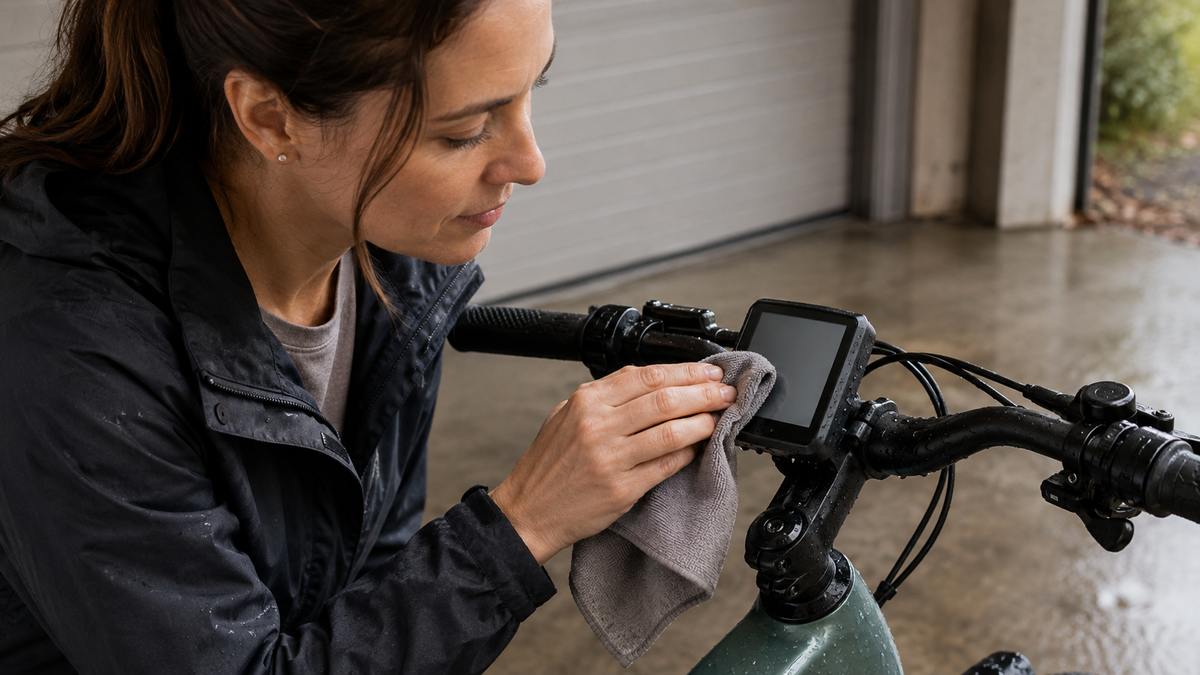
An e-bike display often fogs up after moving between cold, damp outdoor air and a warm room. Nevertheless, you should not immediately continue riding or open the housing. What matters is where the moisture is located, whether the display can still be read reliably, and whether any other malfunctions occur. The appropriate action also depends on the specific display: some devices are removable, while others are permanently integrated into the handlebar or frame.
First determine: outside, beneath a film, or inside the display?
Switch off the e-bike while stationary according to its instructions and dry only the outside with a clean, soft cloth. If the haze disappears completely, the moisture was probably on the surface. If a sharply defined bubble remains, water may be trapped between the protective film and the screen. A diffuse haze that cannot be wiped away from the outside is more likely to indicate condensation behind the visible screen.
| Observation | Likely location | Next safe step |
|---|---|---|
| Drops can be wiped away | Outer surface | Dry gently and check the controls |
| Spot has a clear edge beneath the accessory film | Possible between the film and the screen | Check the accessory instructions; do not open the display |
| Milky haze remains after wiping | Condensation in the viewing area possible | Store in a dry place and document how it develops |
| Water droplets visibly move inside the housing | More than light fogging possible | Do not continue testing; contact service |
| Display flickers, buttons respond incorrectly | Malfunction | End the ride and use the manufacturer’s service process |
This observation does not replace a leak-tightness test. However, it prevents an external raindrop from being mistaken for a housing problem or a genuine functional warning from being overlooked.
Readability is a safety factor while riding
If the speed, assistance level, or a warning message can no longer be seen safely, find a suitable place to stop. Do not swipe on the display while riding or operate menus in traffic. On a pedelec, assistance can generally function without constantly looking at the screen, but an unreadable or faulty control unit can obscure important system notifications.
Stop using it immediately if the display switches by itself, flickers, becomes unusually hot, smells burnt, or if the assistance and lights fail at the same time. Visible cracks, a detached housing, or water in electrical connectors are also not a drying task to handle while out and about.
What Bosch recommends for a fogged-up Intuvia
In an official Intuvia FAQ, Bosch explains that fluctuations in ambient temperature or humidity can cause condensation in and on the display. For the product described, the temporary haze may impair readability without damaging the display. Bosch recommends removing the detachable display from the e-bike after the ride and storing it in a dry room.
This statement is product-specific. It is not permission to continue using every fogged-up screen. Do not apply the disassembly instructions or assessment uncritically to a permanently installed display, another Intuvia generation, or a different system. Bosch provides separate instructions by model year and device; verifying this assignment is the safe starting point.
Dry gently – without heat and without opening the housing
A removable display should only be detached as specified in the original instructions. Switch off the system beforehand, hold the device securely, and do not touch the contacts with metal. Place it indoors in a dry room at a normal temperature, on a clean surface. Direct sunlight, radiators, hair dryers, ovens, and hot air are unsuitable: localized heat can damage plastics, seals, adhesives, or the display’s battery.

A permanently integrated control unit remains on the bike. Store the bicycle in a dry, well-ventilated place if the bicycle and battery instructions permit this storage location. Do not seal the damp cockpit in a plastic bag; it can trap moisture. Rice, powders, and loose desiccants should not be placed in connectors or on sealing joints. Do not pry open, drill into, or blow out the housing with compressed air.
Note the time, outdoor temperature, whether you rode in the rain, and when you moved indoors. A photo immediately after the issue appears and another after the drying period will show whether the haze is clearing. This documentation is more informative than restarting the system repeatedly.
Only inspect contacts and the mount externally
If the display may be removed according to the instructions, you can inspect the mount and visible contact surfaces with the system switched off. They should appear clean, dry, straight, and free of corrosion. Do not spray contact cleaner, oil, or household cleaner into them. In a current instruction manual for an information display, Shimano advises against intentionally immersing components in water, using a pressure washer, or using thinners or other solvents.
Wipe only with the material permitted in the relevant instructions. A contact that is discolored greenish, loose, scorched, or mechanically damaged should be serviced. Do not repeatedly unplug and reconnect connectors as “cleaning”; this can place additional strain on seals and contact surfaces.
Test in a controlled manner after drying
- Check the dry housing for cracks, deformation, and loose seal edges.
- Install a removable display only according to the original instructions and without using force.
- Switch on the system while stationary.
- Check that the display, buttons, and visible warning symbols are all working properly.
- Check whether the time, assistance level, or connection jumps implausibly.
- Only take a short test ride in light traffic if everything is functioning properly.
- Observe whether condensation forms again under similar conditions.
A vanished haze is a good sign, but not confirmation of a repair. If moisture frequently returns, drying takes unusually long, or the amount increases, the dealer or manufacturer should assess the component. Include the serial number, model designation, and photos in a private service channel.
Preventing condensation without sealing the display
Park the bike somewhere as dry as possible and avoid large, rapid temperature changes whenever everyday conditions allow. A display that can be removed according to the instructions may be stored dry indoors after a wet ride. Transport it in a clean, shock-protected bag, but do not put it in an airtight bag while it is still wet. The display and mount must be dry before insertion.
Additional films or covers must not obstruct buttons, sensors, heat dissipation, or secure mounting. Adhesive tape, silicone, or sealant applied to housing seams is not a suitable repair. It can trap water, make subsequent diagnosis more difficult, and violate the manufacturer's specifications. Clean the cockpit without a high-pressure jet, and do not direct even a normal water jet at seams or connections.
When light fogging requires service
- The haze does not disappear in a dry room or becomes worse.
- Visible droplets are present inside, or water is running inside the housing.
- The display, buttons, lighting, or assistance respond incorrectly.
- The housing is cracked, warped, loose, or damaged after a fall.
- The contacts show corrosion, burn marks, or mechanical damage.
- Fogging regularly returns without any significant change in temperature.
Frequently asked questions about a fogged-up e-bike display
Can I dry the display with a hair dryer?
No. Concentrated heat can damage materials and seals. Use a dry room at normal temperature and follow the device instructions.
Is condensation automatically a defect?
Not necessarily. Bosch describes short-term fogging on the Intuvia caused by fluctuations in temperature or humidity. For other devices and in the event of malfunctions, an individual assessment is required.
Should I open the housing so it dries faster?
No. Opening it can damage seals, expose electrical components, and worsen the condition. Internal inspection is a matter for authorized service.
Can I continue riding immediately after wiping it off?
Only if the moisture was on the outside, the device is fully legible and mechanically undamaged, and there is no malfunction. If there are internal droplets or recurring malfunctions, do not ride the bike.
Conclusion: Dry it, monitor it, do not seal it
When an e-bike display is fogged up, the exact location of the moisture is the first thing that matters. Water on the outside can be gently removed; possible internal condensation must be treated according to the product specifications and without heat. A detachable device may only be stored dry in accordance with its instructions. Opening the housing, using a pressure washer, and applying improvised sealants are prohibited. Recurring moisture or any malfunction should be handled by a specialist service.
As of: September 6, 2026. Disassembly, cleaning, storage, and reuse depend on the current instructions for the display and e-bike system actually installed.
Share:
E-bike software update: Prepare safely and avoid errors
Raise the handlebars: safely distinguish between quill and Ahead stems