

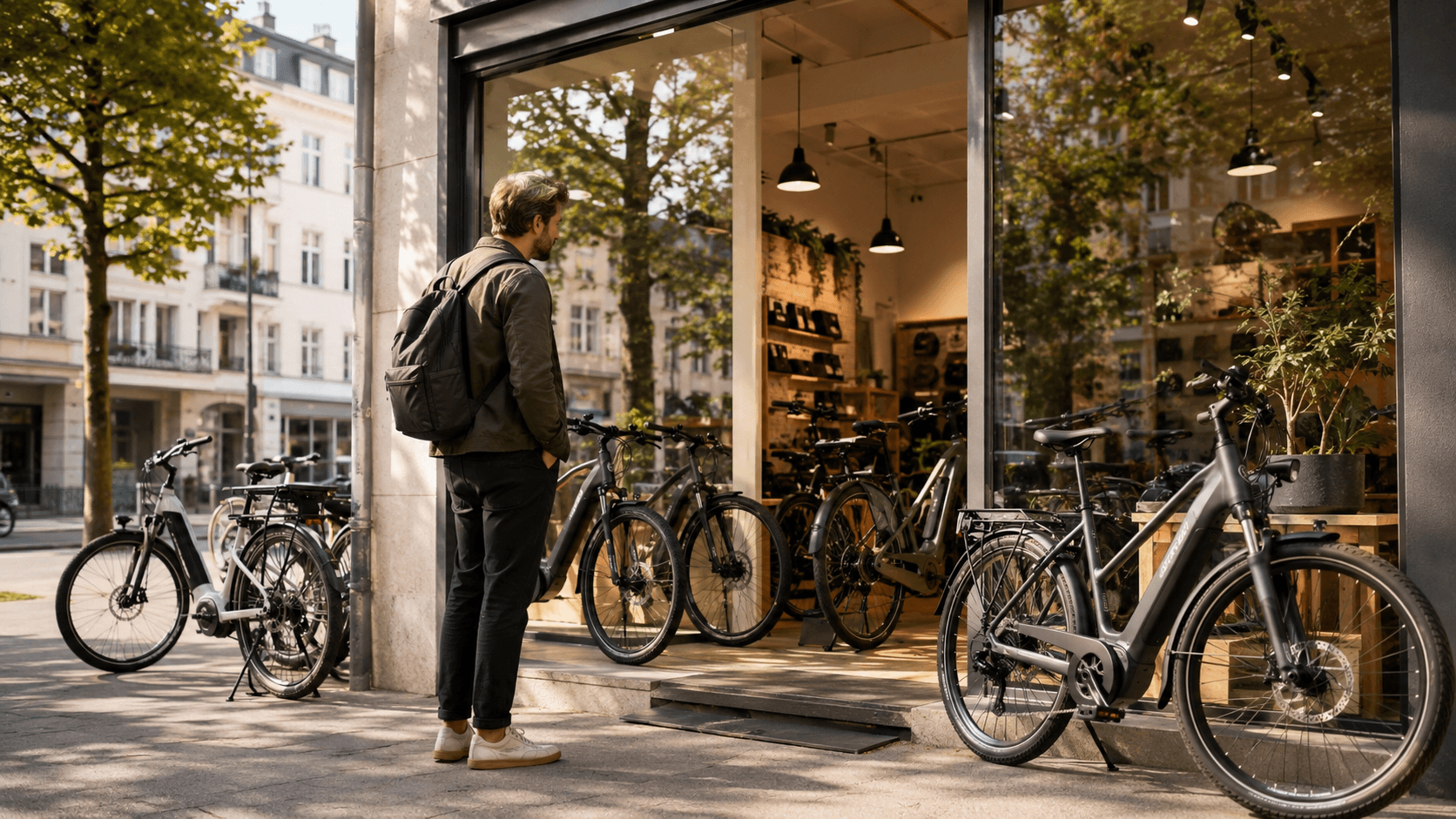
My In-Person E-Bike Visit: What I Learned from Looking Around German Bike Shops About Everyday Use, Advice, and Riding Feel
I live in Germany and regularly ride short distances in the city. That’s why I didn’t want to look at e-bikes only online—I also wanted to experience them in person: How do the bikes look and feel in a real shop environment? What do people here pay attention to when choosing an e-bike? And which details do you only notice when you are standing directly in front of one?

Why I deliberately went to the shop
Online, prices, battery capacity, and technical specifications can be compared quickly. But an e-bike is not a product that only needs to work on a screen. It needs to fit your everyday life.
That is exactly why I wanted to see the situation for myself. In a bike shop, you immediately notice which questions really matter: How comfortable is mounting? How heavy does the bike feel when pushed? Are the handlebars comfortable? Does the bike stand securely? And is it suitable for the routes I ride every day?
Especially in Germany, you now see e-bikes everywhere: outside supermarkets, at train stations, in residential areas, and on the way to work. For many people, they are not just for leisure but a practical part of their daily mobility.
Advice often begins not with the technology, but with everyday life
What particularly stood out to me in the shop was that good advice rarely starts with watt-hours, motor designations, or display functions. It starts with very simple questions. Where will the bike be stored? Does it need to be taken down to the basement? Will it be used every day? Will it carry groceries? Will one person mainly ride it, or will several people in the household share it?
These questions may sound simple, but they are crucial. An e-bike doesn’t just need to ride well. It also needs to fit your living situation, parking arrangements, charging routine, and transport needs.
My impressions on site: Small details make a lasting impression
A store visit is not just about the big picture. Small details in particular reveal a lot about an e-bike: tire tread, frame design, battery placement, brake levers, display, grips, and the ability to carry luggage.
I realized that you look at an e-bike differently in person than online. You do not just look at a product photo; you automatically imagine riding it to work, stopping in front of the supermarket, or parking it at home.


What I would pay particular attention to during a test ride
After my visit, I would never view a test ride as just a short lap. It only becomes truly informative when typical everyday situations are included: starting, braking, slow maneuvering, cornering, riding over slight unevenness, and making a brief stop, such as at a traffic light.
| Check point | My impressions on site | Why it matters in everyday use |
|---|---|---|
| Motor assistance | The assistance should engage evenly and not feel nervous. | When starting at intersections or on slight inclines, a smooth motor provides greater confidence. |
| Braking feel | The brakes should be easy to modulate and should not respond too abruptly. | In city traffic with bike lanes, cars, and pedestrians, controlled braking is essential. |
| Frame design | A low step-through frame feels especially comfortable in everyday use. | Practical for frequent stop-and-go riding, shopping, or when several people use the same bike. |
| Tires & stability | Wider tires often provide a smoother ride on uneven surfaces. | Cobblestones, curbs, and wet roads are simply part of everyday life in many cities. |
| Battery & charging | A battery that is easily accessible or removable can be very practical in everyday use. | People who live in an apartment often want to charge the battery separately without having to bring the entire bike to the power outlet. |
| Storage | A basket, luggage rack, or bag can immediately make the bike more useful. | For the supermarket, the office, or short family trips, carrying capacity is often more important than expected. |
After-Sales Service: A Point I Consider More Important Today
Another thought occurred to me during the visit: When buying an e-bike, the decision does not end with the model. Service, spare parts, repair options, and clear support after the purchase also play a major role.
With a technical product such as an e-bike, you want to know whom to contact if questions arise later. That is why I think it makes sense not only to compare the bike itself, but also to look at a provider’s service offering.
My View of Cyseekin After the Visit
After visiting the store, I compared my impressions once again with the Cyseekin models. It became clear to me: Not every e-bike has to do everything. What matters much more is being able to quickly identify which model suits which everyday routine.
That is why I see the Cyseekin models less as mere technical data sheets and more as different solutions for different everyday situations.
What I took away from the store visit for buying online
A visit in person does not replace an online comparison, but it changes how you look at one. Today, when buying online, I would not focus only on price, range, and motor. I would first consider how the bike will actually be used in my everyday life.
Further impressions from the visit
What I found particularly interesting was how quickly your perception changes when you see different e-bikes directly next to one another. One model may look large in photos but pleasantly compact in person. Another may look elegant but feel heavier than expected when maneuvering.
That is precisely why, even when comparing online, it is worthwhile not to base your decision on just one figure. Range, motor, battery, and price are important. But the frame design, tires, brakes, storage space, and controls often determine whether you will really enjoy using the e-bike after a few weeks.


My Personal Checklist After the Visit
If I were choosing an e-bike for everyday use after this visit, I would answer these questions before buying:
- Do I mainly ride short city trips, longer commutes, or weekend outings?
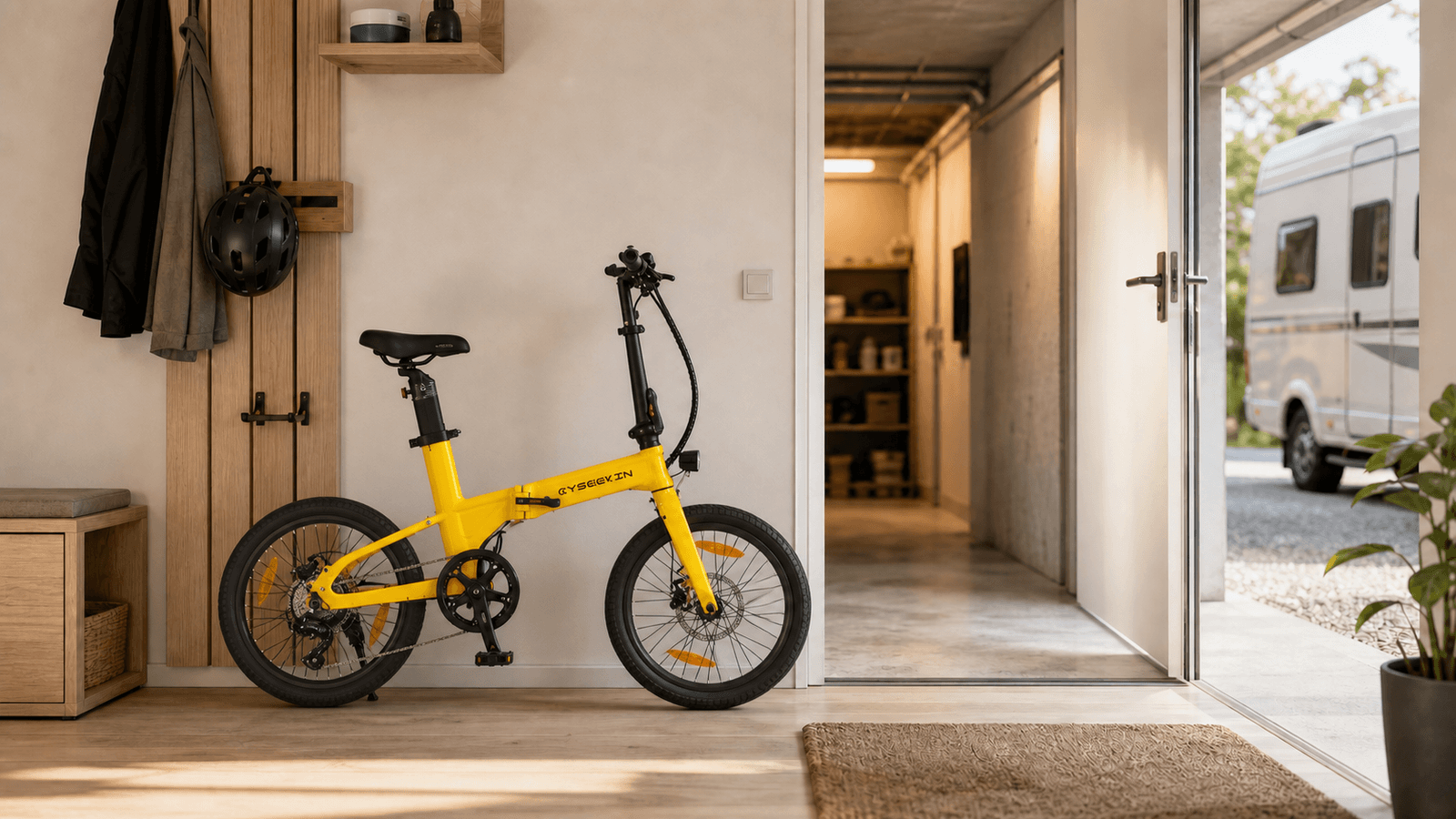
- Do I need a folding e-bike because I have limited space?
- Would a step-through frame be more comfortable for me in everyday use?
- Do I want to regularly carry groceries, a bag, or accessories?
- Can I charge the battery easily, even when the bike is not right next to a power outlet?
- Do I feel safe enough with the tires, brakes, and riding position?
- Is after-sales service easy for me to access and clearly explained?
- Will the e-bike still suit my everyday life in a few months, not just make a good first impression?
Find the Right Cyseekin E-Bike for Your Everyday Life
Whether compact, comfortable, or offering more storage space: compare the Cyseekin models for city riding, commuting, and everyday use.
View Cyseekin E-Bikes →Further Content on Cyseekin
FAQ – Visiting an E-Bike Store and Buying Online
Is it worth visiting an e-bike store if I plan to buy online later?
Yes. Visiting a store in person helps you better assess the frame shape, riding position, weight, braking feel, and everyday practicality. You can then compare options online more effectively.
What should I look for in an e-bike for everyday use?
Important factors include good brakes, reliable lighting, a comfortable riding position, sufficient range, stable handling, and practical carrying options for a bag or groceries.
Which Cyseekin model is suitable for shopping and commuting?
The Cyseekin C20 Mini Cargo is especially interesting for shopping, commuting, and flexible everyday trips, as it combines compact dimensions with practical carrying capacity.
Is a folding e-bike practical for everyday use?
A folding e-bike makes sense when space is limited or the bike needs to be stored more often in the car, basement, office, or apartment.
Why should I also consider after-sales service?
An e-bike is a technical everyday product. Clear help, repair information, and an easy-to-understand service section can be very helpful after purchase.
Share:
E-Bike Battery Guide: Capacity, Range, Maintenance & Buying Advice
Buy e-bike online safely in Germany