

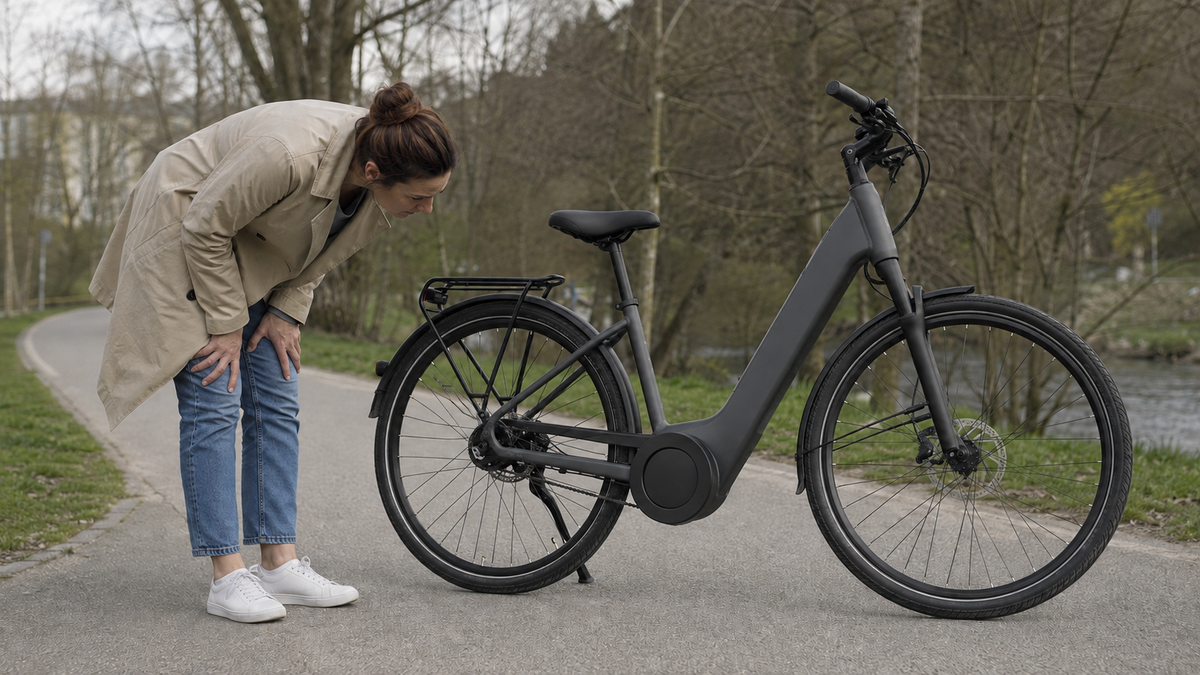
An e-bike motor makes noises because the drive, gears and bicycle components operate under varying loads. Newly occurring grinding, harsh cracking or a clearly changed humming sound should nevertheless not be ignored. The cause can rarely be determined reliably from the listening position alone: the frame and attachments transmit sound, so a noise may seem to come from the motor even though it originates from the pedal, chain, chainring, wheel or luggage rack. Good troubleshooting therefore begins with a safe stop and a reproducible pattern.
The ride ends if any of these signs appear
Stop immediately if the noise occurs together with a drive that locks up or brakes jerkily, noticeable play in the crank or wheel, smoke, a sharp smell, unusually intense heating, damaged housing, loose motor mounting or an error message. Switch off the system according to the manufacturer's instructions. Do not remove, charge or touch a damaged or unusually hot battery. Keep your distance in the event of smoke or a fire hazard and call 112.
Even without immediate danger, a new sound is not a reason to ride up the incline again under full assistance. Such load tests can worsen mechanical damage. Park the bike securely and inspect only externally accessible areas. Keep the motor cover, drive unit, battery and electrical connectors closed.
Describe the noise as a pattern
| Observation | What it helps narrow down | What you record |
|---|---|---|
| Sound only occurs when assistance is switched on | Possible connection with system operation or additional load | Mode, speed, cadence, incline |
| Sound also occurs when the system is switched off | Mechanical bicycle component likely remains the cause | Gear, crank position, coasting or pedaling |
| Crack once per crank revolution | Pedal, crank, chainring or contact point possible | Left/right, seated/standing, with and without load |
| Noise changes with the gear | Chain, cassette, derailleur or chainline possible | Affected gear and shifting quality |
| Sound also occurs while coasting without pedaling | Wheel, brake, tire, fender or freewheel possible | Speed, brake contact, surface |
| Noise after rain, transport or a fall | Moisture, loose attachments or damage possible | Event, timing, visible changes |
The table does not provide a remote diagnosis. However, it prevents every noise from being attributed to the motor prematurely. A short phone video can help the workshop, provided it is recorded while stationary or by a second person in a safe location. Do not film while riding, and do not publish legible serial numbers.
Check the simple external sources of noise first
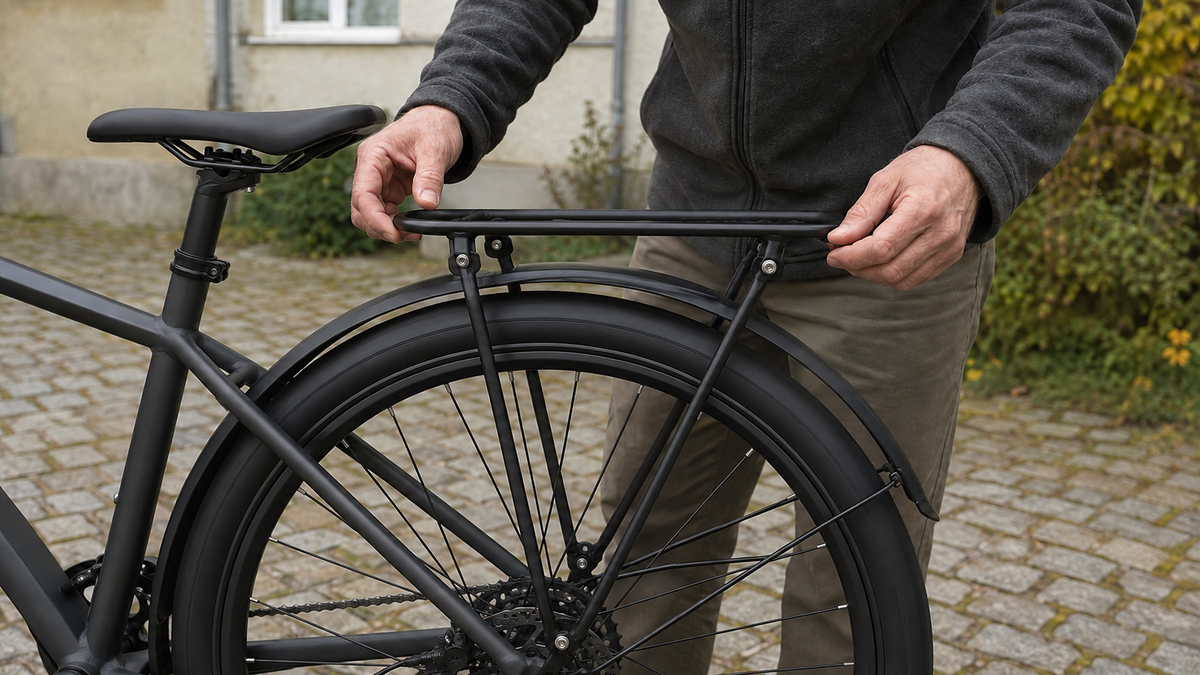
Canyon points out that clicking and creaking can occur at many connection points and that the frame can act as a resonating body. Therefore, with the bike switched off and stationary, first check whether the bottle and holder, lock, pannier, rack, mudguard, or loose cables are hitting the frame. Remove loose accessories for comparison, without dismantling safety-relevant parts.
Inspect the chain, chainring, and cassette for heavy dirt, foreign objects, or visible damage. Check whether the chain runs at an unusual angle or rubs against a cover. Do not turn the crank with your fingers near the chain and teeth. Spokes, axles, brakes, pedals, and cranks should only be checked for visible play, loose parts, or rubbing marks; torque settings and disassembly should follow the specific instructions.
A noise that occurs only while seated may also come from the saddle or seat post. If it occurs while pushing the bike without pedaling, look more closely at the wheel, brake, tire, and mudguard. Such comparisons are more informative than placing a screwdriver against the motor cover on suspicion.
Compare electric assistance and the mechanical drivetrain properly
If there are no warning signs and the bicycle appears mechanically safe, a very brief test on a level, traffic-free surface can help clarify the pattern. Use the same gear and a steady cadence: first without assistance, then at a low assistance level. Stop immediately if the sound becomes louder, the drivetrain jerks, or control changes.

If the noise remains the same when the system is switched off, the motor is less likely to be the sole cause. If it occurs only under electric assistance, the connection is more likely, but it is still not proven: Additional chain force can also make a loose chainring, a worn drivetrain, or a connection in the frame audible. Testing a higher assistance mode is not necessary.
Also avoid comparing different gears under high load. Shift with reduced pedal pressure and follow your system’s manual. Rough running in only one sprocket position is more likely to indicate a local mechanical deviation than a noise that occurs independently of the gear and is directly linked to system operation.
Which noises may be system-related?
The electric motor, gearing, and freewheel may operate audibly depending on the design. Volume and sound vary according to the system generation, assistance level, pedaling cadence, load, and frame. Therefore, there is no cross-brand threshold and no universal list of “normal” sounds. The benchmark is the current system manual and, above all, a clear change from the familiar condition.
A steady operating noise that has remained unchanged since the first ride and occurs without accompanying symptoms should be assessed differently from sudden grinding after an impact. An audible warning from the display is also not a motor noise. If you hear a signal tone, check the display and the manual for that display instead of looking only for the source of the sound.
Why the motor remains closed
An e-bike drive unit contains electrical and mechanical components whose diagnosis may require specialist knowledge, suitable software, and system-specific replacement parts. Opening it can compromise seals, electrical safety, and warranty claims. Do not spray oil or contact cleaner through gaps, drill a drainage hole, or try to eliminate suspected play with unrelated washers.
Shimano explicitly identifies dealer service manuals as documents for professional bicycle mechanics. User manuals refer users to the point of sale or a specialist dealer when unusual noises or problems occur. This is a sensible boundary: external observation and documentation are suitable for users, but internal motor inspection is not.
This creates a useful workshop report
- Record the bicycle, motor, display, and battery models without sharing serial numbers publicly.
- Describe the sound in simple terms: steady, grinding, clicking, knocking, or scraping.
- Note whether the noise occurs while coasting, pedaling, shifting, braking, or only with assistance.
- Record the gear, assistance mode, speed, incline, weather, and approximate state of charge.
- Document any fall, transport, cleaning, or heavy exposure to moisture immediately before it first occurred.
- Photograph visible damage and the complete error display.
Also tell the workshop which safe comparisons you have already made. Phrases such as “three times with low assistance on level ground; not audible when switched off” are more helpful than “motor probably broken.” This keeps the diagnosis open and prevents components from being replaced unnecessarily.
What to avoid until your appointment
- Do not take a long ride if the noise is new, getting worse, or accompanied by play.
- Do not open the motor or battery cover, and do not remove any seals.
- Do not tighten screws without clear model-specific torque specifications.
- Do not use a pressure washer or apply lubricant to the motor housing.
- Do not delete error codes before they have been fully documented.
- Do not connect comparison parts, batteries, or displays without the manufacturer’s approval.
Frequently asked questions about e-bike motor noises
Is an audible humming automatically a defect?
No. An electric drive can be audible by design. What matters is a change, accompanying symptoms, and the information provided by the specific manufacturer—not a general comparison found online.
Why does the motor sound louder uphill?
Load, cadence, and frame resonance change the sound. Nevertheless, a clearly new or rough noise under load should be documented and inspected rather than provoking it with further hill tests.
Can the chain sound like a motor problem?
Yes. Additional drive power can amplify noises from the chain, chainring, cassette, or gears. Comparing operation without assistance and under different safe operating conditions can help narrow it down.
Can I continue riding an e-bike that is creaking?
Not if the creaking is new, getting worse, or accompanied by play, jamming, damaged parts, or a warning. Without a clear cause, walking the bike or having it collected is the safe choice.
Conclusion: Don’t guess based on the sound—distinguish between conditions
If the e-bike motor is making noises, start troubleshooting outside the motor housing. Stop if there are any danger signs, remove loose accessories, inspect visible mechanical areas, and document when the sound occurs. A brief comparison with and without low assistance can help, provided the bike is safe. New, harsh, or recurring noises should be taken to a specialist workshop with a precise record; keep the motor itself closed.
As of September 6, 2026. Normal operating noises, inspections, and repair limits are governed by the current documentation for the specific e-bike system installed.
Share:
Cleaning a bicycle helmet: Gently caring for the shell, padding, and straps
Bicycle gear cable snapped: respond safely and identify the cause