

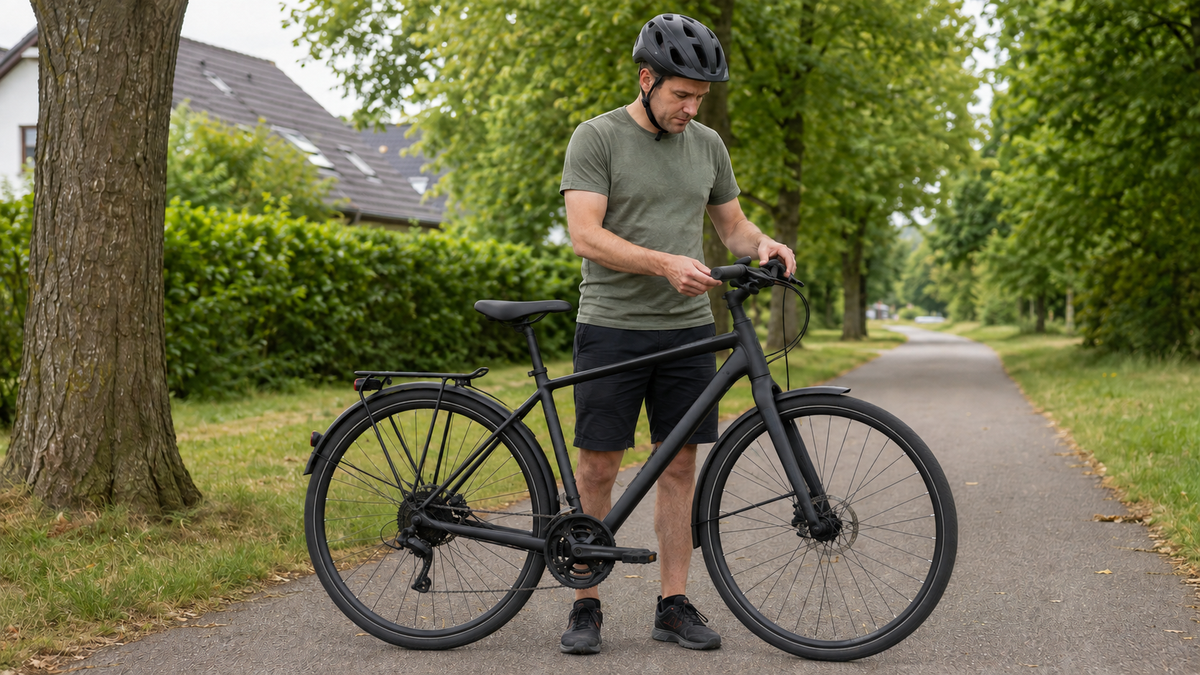
A broken shift cable does not always give warning. The shift lever suddenly moves without its usual resistance, a gear change does not occur, or the derailleur jumps to an end position. This is annoying, but not a reason for hurried roadside repairs. The priority is to park the bicycle safely and determine whether the cable has actually broken or whether another shifting problem is present.
What to do immediately after the failure
Take the pressure off the pedals, stop in a controlled manner, and move the bike away from traffic. Do not repeatedly pull hard on the shift lever. A frayed cable can continue winding up inside the lever or expose sharp wire ends. Touch such ends only while wearing gloves, and keep your fingers away from the chain, chainring, and cassette.
Check that the rear wheel turns freely, the chain is running on a sprocket, and the derailleur and derailleur hanger are not getting caught in the spokes. If the chain is jammed, a part is hanging toward the wheel, or the derailleur is visibly bent after a fall, walk the bicycle. Section 23 of the German Road Traffic Regulations (StVO) requires a vehicle with a significant defect affecting road safety that occurs during a journey to be removed from traffic by the shortest route; bicycles may then be walked.
These signs indicate a broken shift cable
| Observation | Most likely area | Safest next step |
|---|---|---|
| Lever suddenly has almost no resistance, gear remains unchanged | Cable torn or released at the clamping point | Inspect the external cable routing; do not keep pulling the lever |
| Shifting has become stiff or inaccurate over several days | Cable or housing is dirty, corroded, kinked, or frayed | Have the cable and housing inspected together |
| Lever clicks normally, derailleur does not move | Cable head, cable routing, or clamping area affected | Document the model-specific cable routing |
| Chain jumps after an impact or fall, cable appears intact | Possible issue with the derailleur hanger, derailleur, or adjustment | Do not treat it as a cable-only failure; workshop required |
| Electronic shifting does not respond | No conventional mechanical shift cable | Check the system instructions and error display |
With a mechanical derailleur system, the cable pulls and releases the rear derailleur or front derailleur. If the cable breaks, the return spring often moves the component to an end position. Which gear ratio remains then depends on the design and which cable is affected. Therefore, do not rely on the blanket statement that the bike will always end up in the easiest or always in the hardest gear.
Check the cable, housing, and clamping point separately
With the bicycle stationary, follow the visible cable from the shifter to the derailleur. Look for loose ends, broken strands, rust, a sharp kink, or housing that has slipped out. The cable’s entry into the shifter, tight bends at the handlebar, frame stops, and the clamping point at the derailleur are particularly common trouble spots. With internally routed cables, much of the cable remains invisible; do not open covers or motor covers for this purpose.
Park Tool describes worn, frayed, corroded, or kinked cables and housings as typical causes of slow, uneven, stiff, or completely failed shifting. A broken cable can therefore be the end result of a longer process of friction or wear. Replacing only the inner cable while leaving a damaged housing in place may not eliminate the cause.
If the cable has merely come loose at the clamping point, it may initially look similar. Nevertheless, do not tighten the bolt by feel. Cable routing, clamping groove, bolt type, and torque are model-specific. An incorrectly clamped cable may slip again, become damaged, or move the derailleur outside its safe position.
Can you still ride home?
There is no general clearance to ride. If the wheel, chain, crank, derailleur, and brakes are undamaged, the chain runs stably on one sprocket, and nothing can get caught in the spokes, a bicycle may in some circumstances be moved carefully in a remaining gear. However, this is not a repair. An unsuitable gear ratio makes starting and climbing more difficult; an unstable chain line can cause the chain to come off.

When in doubt, choose to walk the bike: push it, have it collected, or head to a nearby workshop. Do not ride with a loose cable end that could be pulled into the crank or wheel. Do not tie it to moving parts with wire either. On an e-bike, switch off the system according to the instructions before performing an external check; electrical shifting components, motor covers, and cable connectors remain closed.
Why replacement procedures differ depending on the shifting system
Shift cables differ in their head, diameter, material, length, and compatibility. Lever access, internal routing, housing ends, and attachment at the derailleur also vary. Park Tool explicitly points out that cable routing inside the lever depends on the model. A general video guide can therefore show the basic procedure, but it cannot replace the instructions for your specific component.
A complete replacement typically requires a compatible inner cable, a suitable shift housing and end caps if necessary, and an appropriate cable cutter. Ordinary side cutters can crush the strands and housing. After installation, the cable head and housing must be seated correctly, the cable end secured properly, and the shifting indexed. Limit screws should not be adjusted to compensate for an incorrectly routed cable.
In its documentation system, Shimano distinguishes between user manuals and dealer’s manuals for professional bicycle mechanics. Therefore, first check the exact model number on the lever and derailleur. If the cable has broken inside the shifter, is internally routed, or is difficult to access because of an e-bike drive system, using a professional workshop is usually the more sensible option.
What the workshop should know
Note whether the front or rear derailleur is affected, which gear the failure occurred in, and whether the lever felt stiff or imprecise beforehand. Photos of the shifter, external cable routing, housing ends, and clamping point are helpful. Also specify the type of shifting system and model numbers. It is not possible to give a reliable price without this information, because the material, internal routing, handlebar tape, and any necessary adjustment affect the amount of work involved.
Ask for the entire cable system to be inspected rather than just having the visible damaged section cut off. A kinked housing, sharp frame routing, or a stiff lever can put renewed strain on a new cable. After replacement, the function should be checked through all gears on a repair stand and then during a short test ride in an area free of traffic.
How to recognize wear earlier
- Watch for increasingly high lever resistance and delayed gear changes.
- Check visible cable sections for rust, kinks, and individual broken strands.
- Check that the housings are seated cleanly in their stops and do not form a tight, pinched curve.
- Have a shifting system inspected if its behavior suddenly changes after a fall or transport.
- Use lubricant only where and in the manner permitted by the component manufacturer.
A fixed replacement schedule does not suit all bikes. Weather, mileage, exposed or continuous housings, and storage conditions affect wear. The progression of the bike's shifting performance is therefore more important than a blanket annual interval.
Frequently asked questions about a snapped gear cable
Is the derailleur also damaged if the cable has snapped?
Not automatically. The cable itself may be the only part that has failed. However, after an impact, a jammed chain, or contact with the spokes, the derailleur and derailleur hanger must be checked separately.
Can I tie a knot in the cable while on the road?
This is not recommended. A knotted or improvised connection will not run reliably through the housing and cable clamp and could come loose or get caught in moving parts.
Does the cable housing always need to be replaced as well?
Not in every case, but it should be checked. If it is kinked, corroded, frayed, or stiff internally, a new inner cable alone may not restore smooth shifting.
Why does a gear cable snap at the shifter?
This is where the cable moves and bends with every shift. Wear, friction, or an unfavorable routing can add up. The exact cause can only be assessed after model-specific disassembly.
Conclusion: Securely park the bike, document the cable routing, and repair it properly
If the bicycle gear cable has snapped, the priority is not the quickest makeshift fix but a clear assessment of the situation. Securely park the bike, check the chain, derailleur, and visible cable routing, and walk the bike if the chain is unstable or any parts are damaged. Select the cable and housing to match the specific derailleur, route them correctly, and then adjust the system. This prevents a sudden failure from causing further damage.
As of September 6, 2026. The installation method, component compatibility, and torque specifications are based on the current documentation for the specific derailleur installed.
Share:
Cleaning a bicycle helmet: Gently caring for the shell, padding, and straps
E-bike motor making noises: safely narrow down the pattern