

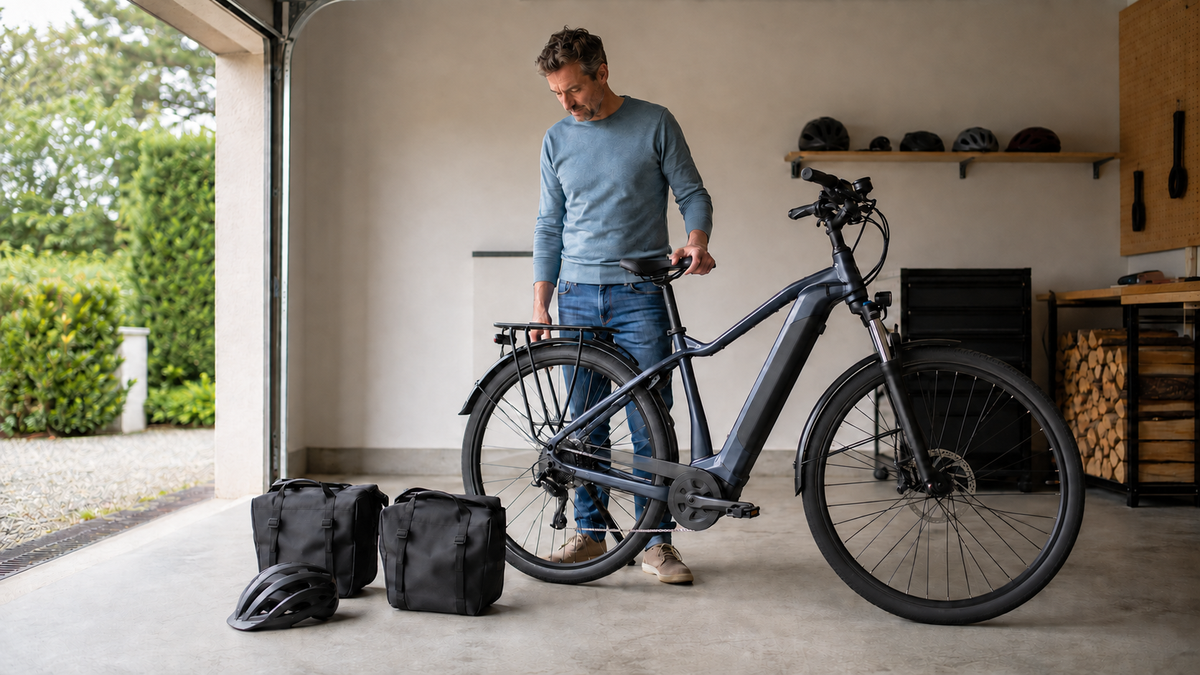
“Permitted total weight: 150 kilograms” may initially sound like a lot. However, every kilogram of the e-bike already uses part of this limit. The battery, lock, bags, rider, and contents are not added only afterward. Anyone who wants to know how much luggage is still possible therefore needs three things: approval for the exact model, the actual weight of the equipment being ridden, and a complete addition.
What the permitted total weight includes
In its FAQ on the permitted total weight, the manufacturer HERCULES defines this as the sum of the fully assembled pedelec, body weight, and luggage. Riese & Müller also describes it as the weight of the bike, rider, and luggage. The specific limit depends on the model; it cannot be derived from the motor power, frame shape, or wheel size.
The basic formula is:
actual total weight = ride-ready e-bike + rider in riding clothes + entire carried load
The carried load includes more than just the contents of a pannier. A lock, bottles, tools, phone holder, basket, child seat, additionally mounted luggage rack, and subsequently installed components also have mass. Accessories that were not included in the manufacturer’s stated weight must be included in your calculation.
Where to find the correct model limit
First, check the operating manual, the technical model description, and the type or CE sticker on the bicycle. HERCULES explicitly refers to the model specification and CE sticker in its FAQ. If the values on the retailer’s website, in the catalogue, and in the manual do not match, clarify the discrepancy with the manufacturer or specialist dealer using the frame number, model year, frame variant, and equipment.
Do not rely on a similarly named product line. Even the battery option, frame size, gearing, suspension fork, or model year can change the weight and approved limits. Save the relevant manual and note the source of the value. This makes it possible to verify later whether you actually used your bicycle’s limit.
Weigh the e-bike in its ride-ready configuration
Catalog weights often refer to a specific frame size and standard equipment. Your bicycle may be heavier with a larger frame, a higher-capacity battery, pedals, lock, and accessories. The current weighing guidance from Riese & Müller therefore recommends weighing the individual bicycle, for example with a suitable hanging scale or by using the difference method on a bathroom scale.

For the difference method, weigh yourself once alone and once with the safely lifted bicycle. The difference is the bicycle's weight. Use this method only if you can hold the e-bike steadily without straining and the scale is suitable for the total load. For a heavy or bulky bicycle, a workshop scale is the better solution.
Weigh the configuration that will actually be ridden: installed battery, pedals, permanently mounted holders, lock, and permanent accessories. Weigh loose luggage separately. Record the values with a realistic level of precision instead of creating an apparently exact figure from inaccurate estimates.
How to calculate payload and reserve
Two useful values can be derived from the manufacturer's limit:
- maximum calculated payload: permissible total weight minus actual bicycle weight
- remaining reserve: permissible total weight minus bicycle, rider, and already planned load
A purely fictional example: The manual specifies 150 kilograms. The e-bike ready to ride weighs 29 kilograms, the person with clothing and helmet weighs 86 kilograms, and accessories and luggage together weigh 14 kilograms. The total is 129 kilograms; mathematically, 21 kilograms remain before reaching the overall limit. These example values are not a recommendation for a real model.
The reserve is not automatically free capacity for a single carrier. It only shows that the total remains below the overall limit. In addition, all partial limits must be observed. A safety margin makes sense in everyday use because scales may vary, clothing changes, and water or shopping may be added while out and about.
The smallest limit is decisive
An e-bike may have additional limits besides the total weight: maximum rider weight, luggage rack load, front rack load, approval for a child seat or trailer, and limits for individual wheels and tires. The current product page for the Riese & Müller Packster2 70 CT shows by way of example that total weight, rider weight, and rack ratings are specified separately. Such values must not be combined or added together.
For example, if your total calculation leaves 18 kilograms, but the specific luggage rack is approved for only 12 kilograms, you may not place 18 kilograms on it. Conversely, a high rack rating does not increase the total limit. The applicable limit reached first for the respective configuration always determines the maximum.
Accurately account for rider weight, luggage, and accessories
- Rider: Body weight plus shoes, clothing, helmet, and backpack carried on the body
- Bicycle: Complete bicycle with battery, pedals, and all permanently mounted parts
- Everyday accessories: Lock, bottles, pump, tools, phone mount, and spare parts
- Luggage: Bags including their own weight, groceries, work materials, or travel equipment
- Passenger transport: Seat or cabin, as well as the child and their equipment, only with explicit approval
It is best to weigh bags once they are fully packed. The weight of sturdy bags themselves is easily forgotten. For child seats, trailers, or cargo bikes, additional manufacturer instructions apply regarding mounting, position, tongue or trailer load, and number of occupants. The instructions for the specific bicycle must explain whether and how a trailer is included in the total weight calculation.
Why overloading is not just a frame problem
More weight puts greater strain on the tires, wheels, brakes, fork, frame, and connecting parts. Braking distance and handling may change, especially downhill or in wet conditions. Merely staying formally below the total weight therefore does not replace correct tire pressure, properly functioning brakes, and safe load distribution.
A limit that has been exceeded cannot be “compensated for” by riding more slowly. Even short trips can involve potholes, curbs, or emergency braking. If you notice cracking noises, handlebar wobble, unusual rubbing, or a spongy riding feel, stop, unload the bike, and have the cause checked.
Plan the load before the bag is full
- Identify the model, model year, and frame size unambiguously.
- Record the total limit and all relevant component approvals from primary sources.
- Weigh the bicycle ready to ride and the rider in their actual gear.
- Weigh bags, accessories, and any other carried load separately.
- Add everything up and then check each individual component approval.
- Distribute permitted loads low, symmetrically, and securely according to the instructions.
After packing, check the tires, wheels, brakes, and fasteners. Begin with a short, slow test ride away from heavy traffic. Steering and braking must remain predictable; a calculated reserve is not approval for unstable or poorly positioned loads.
Frequently asked questions
Is the permissible total weight the same as the payload?
No. The total weight already includes the e-bike. The calculated payload is only determined by subtracting the actual bicycle weight from the total limit. The rider and luggage then jointly use this capacity.
Does the battery count toward the bicycle’s weight?
For a typical ride with the battery installed, it is part of the riding configuration and therefore included in the total. Use the actual weight of your fully equipped bicycle rather than a catalog value without clearly specified equipment.
Can I load the entire remaining capacity onto the luggage rack?
Only if the rider’s own approval, the installation instructions, and all other limits are also complied with. The total reserve does not increase a separate rack limit.
Can I simply estimate the rider’s weight?
A scale is more reliable. Clothing, shoes, helmet, and backpack are part of the actual riding weight. If the calculation is close, you should not work with optimistically rounded values.
Conclusion
The permissible total weight is a sum, not a promise of additional luggage capacity. First find the limit for the exact model, weigh the bike ready to ride, and add the rider and every load being carried. Then check the separate limits for the rider, racks, child seat, trailer, and components. Anyone who calculates before packing knows their actual reserve—and avoids an individual component approval unknowingly becoming the weakest link.
As of September 6, 2026. The operating instructions and approvals for the specific bicycle and the installed components are authoritative.
Share:
Headset loose? Check your bike for play safely
Crossing tram tracks by bicycle: angle, wet conditions, and a safe line