

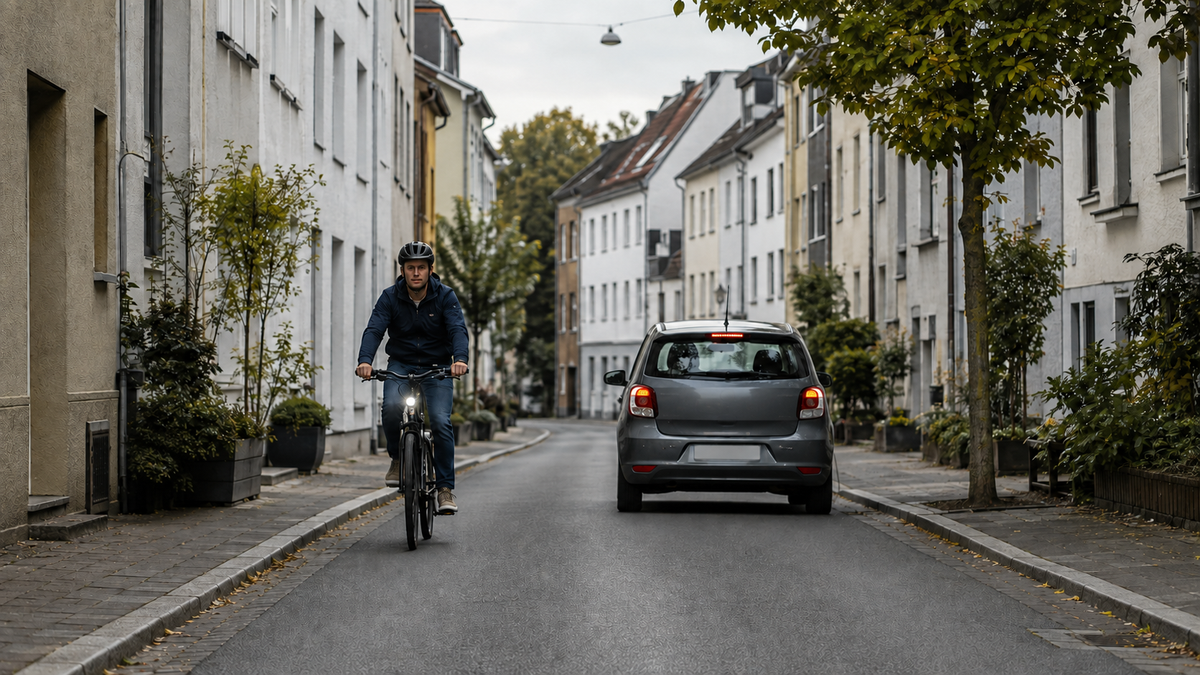
Even when riding a bicycle, you may generally use a one-way street only in the direction indicated by the signs. Entry against the direction of travel is permitted only when a supplementary sign expressly permits bicycle traffic. In that case, you are legally traveling in the opposite direction—but you do not automatically have priority. The keep-right rule, priority signs, right-before-left rule, and rules for narrow sections continue to apply.
You must distinguish between these signs
| Location | Signage | Meaning for cyclists |
|---|---|---|
| Entry in the regular direction | Sign 220 “One-way street” | The carriageway may only be used in the direction of the arrow |
| Regular entry with traffic in the opposite direction | Sign 220 plus a supplementary sign with a bicycle and arrows in both directions | When turning and while riding along the street, expect permitted bicycle traffic approaching from the opposite direction |
| Entry in the opposite direction | Sign 267 “No entry” | Without permission, bicycles may not enter either |
| Entry in the opposite direction permitted | Sign 267 plus “Cyclists permitted” | Cyclists may enter against the general direction of the one-way street |
Under Annex 2 of the German Road Traffic Regulations (StVO), sign 220 requires vehicles on the carriageway to follow the direction of the arrow. The corresponding supplementary sign indicates that traffic is permitted in the opposite direction. The ADAC points to sign 267 with “Cyclists permitted” for entry from the restricted side. A cycle marking painted on the asphalt alone is not a reliable substitute for this permission.
Ride against the direction of a one-way street only when permitted
Check the sign on the side from which you actually intend to enter. If the supplementary sign is missing, damaged, or cannot be clearly assigned, do not ride past sign 267. Dismount and walk on a permitted pedestrian area, or choose another route. A navigation app may be outdated and does not override local signage.
The permission applies to the section indicated by the corresponding signs. It does not mean that every subsequent one-way street is also open to cyclists traveling in the opposite direction. After junctions, roadworks, and changes to the traffic layout, check the signs again. Temporary signs and traffic orders take precedence over outdated map information.
Where do you ride in the opposite direction?
An open one-way street does not automatically have a separated cycle path. Cyclists and motor vehicles often share the same carriageway. Under Section 2 of the German Road Traffic Regulations (StVO), you must keep to the right: ride as far to the right as reasonably possible from your perspective, while maintaining a safe distance from curbs, drains, parked vehicles, and their doors.
Road markings can make the intended route clearer. They do not change the principle that you should ride predictably and keep to the right in your direction of travel. Do not use a pavement as an escape route if cycling is not permitted there. When facing oncoming traffic, you should choose a line early enough for both sides to pass with sufficient clearance.
Who has priority at the junction?
Opening a one-way street to oncoming traffic does not create its own priority rule. Traffic lights and signs 205, 206, 301, or 306 take precedence. If there is no special regulation, the basic rule under Section 8 of the StVO is priority to the right. This also applies to a cyclist legally travelling against the one-way direction. Annex 2 expressly clarifies that this principle remains unaffected when oncoming traffic is permitted.
For example: You are legally cycling against the one-way direction and, from the perspective of cross traffic, are approaching from the right. In the absence of other signs, you may have priority. Nevertheless, you should not assume that you have been seen. Many drivers look for traffic only in the expected direction. Reduce your speed, establish eye contact, and be ready to brake—without equating voluntary caution with waiving all your rights.

If the opened one-way street leads into a priority road, cyclists leaving the street must follow the regulations there. The StVO explanation provides for sign 205 in this situation. What matters is the sign actually present, not the direction from which you arrive.
Passing parked cars and navigating bottlenecks
On narrow roads, the carriageway is not always wide enough for two-way traffic to pass simultaneously. Under Section 6 of the German Road Traffic Regulations (StVO), anyone who has to move left to avoid an obstacle must generally let oncoming traffic pass first, unless signs 208 or 308 regulate priority differently. This applies regardless of whether the obstacle is on the side of a car or a bicycle.
The regular one-way direction therefore does not have priority at a bottleneck merely because of the arrow. Communicate early and clearly. Do not enter a gap if you would not have a safe clearance beside a wide vehicle. As a cyclist, you do not have to swerve into the door zone of parked cars or over a high curb.
Turning: Keep oncoming cyclists in mind
Anyone turning into a one-way street opened to bicycle traffic must expect bicycles coming from the opposite direction. The supplementary sign below Sign 220 specifically indicates this. When turning, Section 9 (3) of the German Road Traffic Regulations requires oncoming vehicles and bicycles traveling parallel to be allowed to pass, provided the situation described there applies. Looking over your shoulder and turning slowly remain essential.
Cyclists should also signal changes of direction in good time with hand signals, check traffic behind them, and not enter the intersection from a blind spot beside a turning vehicle. Legal right of way is no substitute for a clear line of sight.
Practical routine for riding in the opposite direction
- Check at Sign 267 whether “Bicycle traffic permitted” is clearly displayed.
- Check whether construction or temporary signs change the route.
- Ride on the right in your direction of travel and keep your distance from parked vehicles.
- Reduce your speed early before bottlenecks, driveways, and intersections.
- Check the right of way separately; authorization alone does not give you priority.
- Make eye contact, remain ready to brake, and do not continue on the sidewalk.
What rules apply to pedelecs?
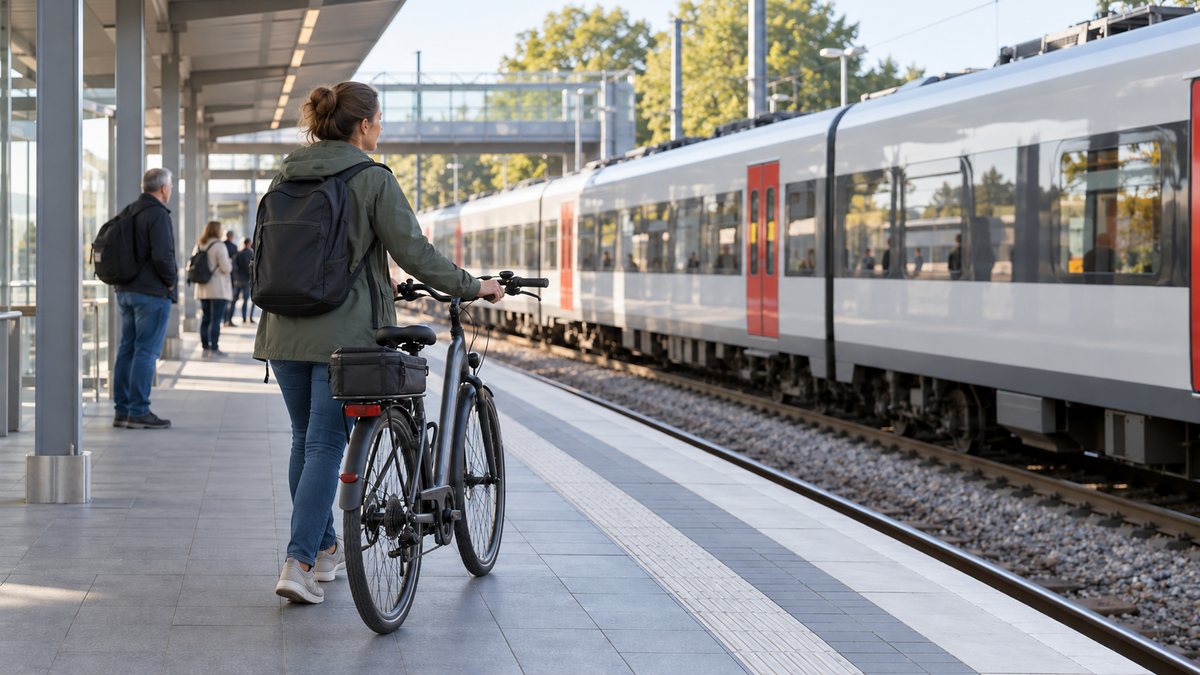
A pedelec that meets the statutory criteria for bicycles and whose assistance ends no later than 25 km/h is treated like a bicycle. It may use an opposite direction opened to bicycle traffic. An S-pedelec, on the other hand, is a motor vehicle. The supplementary sign for bicycle traffic does not automatically authorize it; fast pedelecs are subject to the rules applicable to their vehicle class.
Frequently asked questions
May bicycles always travel the wrong way on a one-way street?
No. It is permitted only if the opposite direction has been opened to bicycle traffic by an appropriate supplementary sign. Without authorization, the prescribed arrow direction also applies to bicycles.
Is a painted bicycle symbol sufficient?
Do not rely on that. The relevant signage determines whether it is legally permitted. If it is unclear, dismount or use another route.
Do cyclists traveling in the opposite direction always have the right of way?
No. Traffic lights and right-of-way signs decide; otherwise, the basic rule is priority to the right. The legally permitted opposite direction does not change these rules.
Who has to wait at a bottleneck?
Anyone who has to swerve left because of an obstacle must generally let oncoming traffic pass, unless traffic signs specify otherwise. The normal one-way direction does not automatically have priority.
May I cycle against the direction of traffic on the sidewalk?
Only if a specific regulation permits cycling there; authorization of the roadway does not authorize the sidewalk. Without authorization, you must dismount and walk the bicycle.
Share:
Headphones and smartphones while cycling: What is permitted
Oil your bicycle chain: apply precisely and protect the brakes