

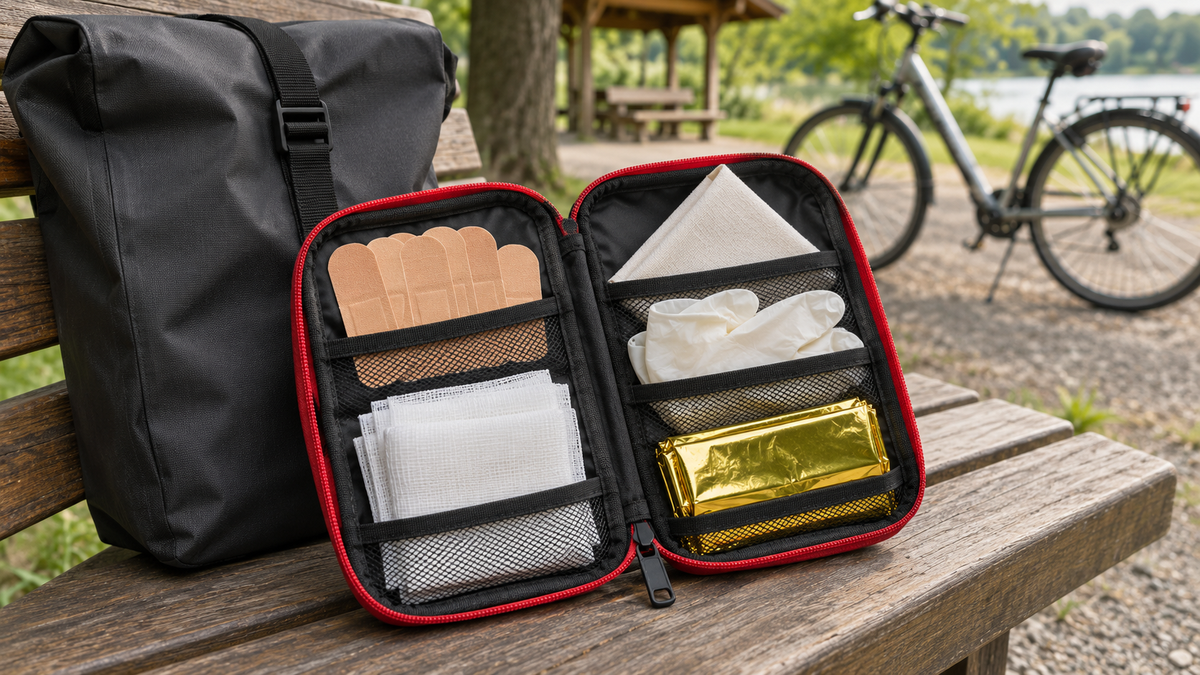
A bike first-aid kit should be small enough to carry but suited to the ride, group size and personal needs. In Germany, private cyclists are not required to carry one, and there is no specific bicycle DIN standard equivalent to the one for car first-aid kits. That does not mean any miniature pouch will do: what matters is having dressing materials that are easy to reach, intact sterile packaging, disposable gloves, an emergency blanket and knowing how to call for help in an emergency.
You can keep basic supplies compact. However, medications, personal allergy treatments and a personal travel medicine kit do not belong on every list by default. Plan for these separately based on personal needs and, if necessary, with advice from a doctor or pharmacist.
Bike first-aid kit: the short answer
For a regular day trip, a compact kit with adhesive bandages, sterile compresses, at least one suitable first-aid dressing, fixation materials, disposable gloves and an emergency blanket is a reliable starting point. For longer rides or trips through remote areas, consider adding other sizes, a large wound dressing or blister plasters, depending on the group and route. Scissors or tweezers are useful only if safely packed and the person knows how to use them.
- Basic supplies: Cover minor wounds and secure dressing materials.
- Personal protection: Pack disposable gloves where they are easy to reach.
- Keeping warm: Carry an emergency blanket that is dry and undamaged.
- Organization: Prepare emergency numbers, your location and personal information.
A ready-made kit is a starting point, not a permanent tick on your packing list. Check its contents, expiration dates and packaging before the season and after every use.
What basic supplies should you pack?
The Malteser Hilfsdienst recommends taking items such as adhesive bandages, sterile compresses, first-aid dressings, elastic or fixation bandages, a triangular bandage and disposable gloves on bike rides. For longer cycling trips, the German Red Cross also recommends a large wound dressing, an emergency blanket and blister plasters. This leads to the following practical checklist:
| Area | Practical essentials | Checkpoint |
|---|---|---|
| Minor wounds | Assorted plasters or cut-to-size adhesive wound dressing | Clean and dry, adhesive surface intact |
| Wound covering | Sterile gauze pads and dressings in suitable sizes | Packaging unopened, within its expiry date |
| Securing | Conforming bandage or elastic bandage, triangular bandage if needed | Practise using them in advance during a course |
| Personal protection | Several pairs of disposable gloves | Suitable size, protected from heat and damage |
| Retaining warmth | Emergency blanket | Securely closed packaging, quick to reach |
| Optional item | Bandage scissors, tweezers or blister plasters | Tour requirements, safe storage and your own knowledge |
More supplies are not automatically better. An overfilled case makes items harder to reach and can make it easy to overlook expired or damaged items. Choose a few clearly organised supplies whose purpose you understand.
Day trip, cycling tour or group: tailor the contents
For a city commute, professional help is usually easier to reach than on a remote stretch of a cycling tour. A fixed universal list does not account for this difference. So consider the duration, distance from populated areas, number of riders, weather, mobile coverage and any specific personal needs.
For a multi-day tour, supplies should last longer than just the first day. Replace used first-aid supplies along the way. In a group, it makes sense to agree before setting off on who is carrying a kit, who has up-to-date first-aid training, and where personal emergency information is kept. This should not mean that anyone else sets off without their own essential medication or contact details.
The ADFC bikepacking checklist separates the first-aid kit, sun and insect protection, and personal medication. This separation is practical: the group can easily identify general first-aid supplies, while personal medication can be individually labelled and stored according to each person’s needs.
Pack compactly and protect from the weather
A first-aid kit for cycling need not be large, but it should be protected from rain, dirt and abrasion from other items. Only describe a container or bag as “waterproof” if it has been proven to be designed for that purpose. For an ordinary case, “weather-protected” is more honest. An additional sealable inner pocket can protect sterile packaging, but it does not replace an inspection after heavy rain.
Arrange the supplies by accessibility: gloves and plasters at the front, larger sterile items and the emergency blanket behind them. Secure scissors or tweezers so they cannot puncture packages. Liquids may leak and make other supplies unusable; include them only if their packaging, use and transport are all suitable.
Label the case clearly without displaying medical details on the outside. A small contents list with the month of the last check helps with maintenance. If you ride at night, you should be able to find the kit without unpacking the entire bag.
Where to keep the kit accessible on the bike
A kit at the very bottom of a tightly strapped-down luggage roll is hard to reach in an emergency. A clearly designated side pocket, frame bag or top compartment that can be opened even when the bike is loaded is a better option. The case must not rattle around loose in the basket or interfere with steering, brake lines or pedal movement.
On group rides, at least two people should know where the supplies are. If the person carrying them gets separated from the group or is injured, they must still be accessible. Personal medication remains the responsibility of the person concerned; other riders should only know where to find relevant emergency information if this has been agreed to voluntarily in advance.
At your destination, do not store the kit permanently in direct sunlight or in a vehicle that has become very hot. The manufacturer's instructions for the temperature and storage of individual items take precedence.
Check expiry dates and completeness regularly
After each use, replace not only the item that was used. Check whether nearby packages are dirty, damp or torn. Sterile compresses and dressing packs with damaged packaging can no longer be considered reliably sterile. Disposable gloves can also be damaged by age, heat or friction.
The German Federal Ministry of Health's portal gesund.bund.de notes that first aid supplies have expiry dates and should be checked regularly. Set two fixed dates each year for this, such as before spring and before a longer trip. Also carry out a quick visual check before every multi-day tour.
- Compare the contents list with the actual stock.
- Check expiry dates and sterile packaging.
- Replace any items that are damp, dirty or damaged.
- Replace used supplies immediately.
- Put the case back in its designated, accessible compartment.
Supplies are no substitute for calling emergency services or taking a first aid course
A first-aid kit is only helpful if the situation is assessed correctly and professional help is called in promptly. In an acute or potentially life-threatening situation in Germany, call 112. Give your location as precisely as possible, briefly describe what happened, and answer the emergency operator’s questions. On cycle paths, the path name, intersection, bridge, kilometer marker, or GPS position can help responders find you.
This packing list is not a guide to diagnosis or treatment. Loss of consciousness, breathing problems, severe bleeding, a head injury, or a marked deterioration require professional help. Follow the emergency operator’s instructions and do not put yourself at risk. The gesund.bund.de portal emphasizes that first aid must be learned through practice; a course and regular refreshers are therefore more valuable than extra specialist items that no one has practiced using.
Frequently asked questions about bicycle first-aid kits
Is a first-aid kit on a bicycle required by law?
According to Malteser, in Germany there is no equivalent requirement to carry one for private bicycles and no specific bicycle standard. The motor vehicle rule for first-aid kits must not be applied to bicycles.
Does the kit have to comply with DIN 13164?
No. DIN 13164 applies to motor vehicle first-aid kits. It can illustrate types of supplies, but it is not a legal packing requirement for a private bicycle.
Should painkillers or allergy medication be included?
Not on a general standard checklist. Personal medication should be planned individually, labeled, and carried in accordance with medical or pharmaceutical advice and the manufacturer’s instructions.
Is a mini kit from a store enough?
That depends on the actual contents, the ride, and the group. Compare the case with your own checklist rather than relying on the label “Mini” or “Bike.”
Bottom line: open it, check it, and store it securely today
Take the kit you already have out of your bag today and check it against the basic equipment list. Remove damaged or expired items, add gloves and a thermal blanket, and set a regular date to check it. Then store the case in a weatherproof place where someone else can find it quickly too. The next useful step is a current first-aid course—not an ever-larger kit.
As of November 3, 2026. These tips are intended to help you prepare for your ride and do not replace medical advice, a first-aid course, or instructions from emergency services.
Share:
Choose a bike wall mount: check the weight, wall type, and available space
Replacing an e-bike charger: Check compatibility before buying