

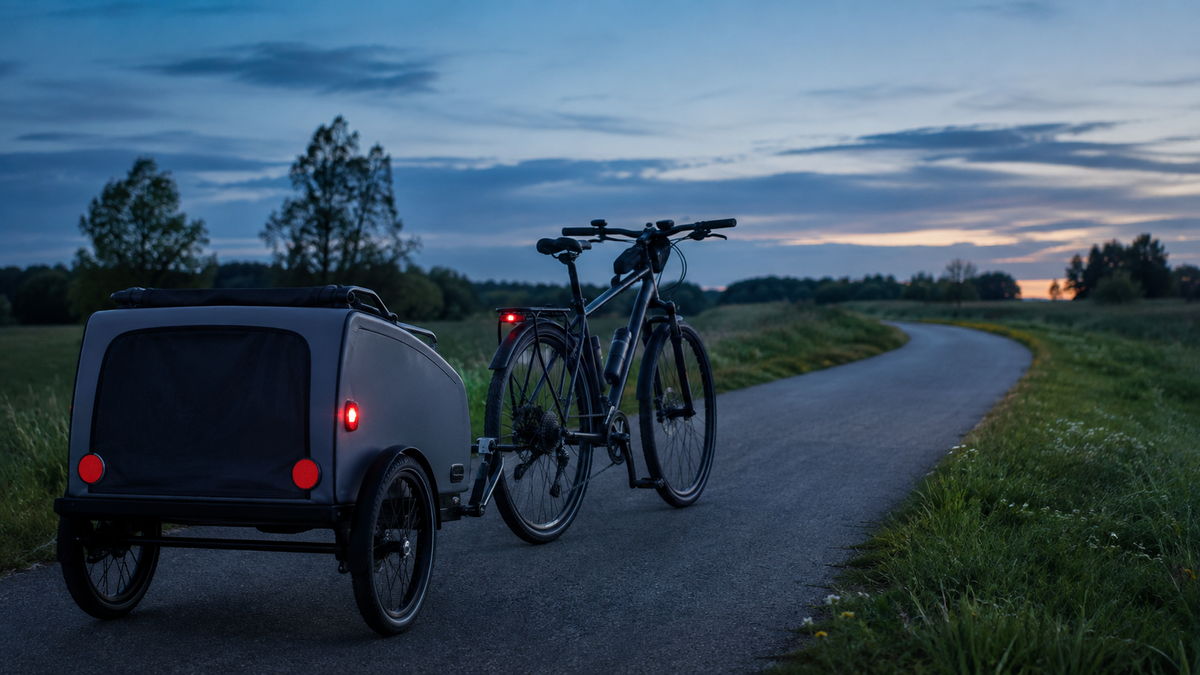
For bicycle trailer lighting, asking “Does it have a tail light?” is not enough. Section 67a of the StVZO distinguishes based on width, viewing direction, and whether the trailer obstructs the towing bicycle's tail light. With three measurements and a walk-around inspection, you can systematically check the equipment before setting off.
The three details you need first
Measure the trailer's greatest width, not just the tub or interior. Then, from normal eye level behind the fully loaded combination, check how much of the visible illuminated area of the bicycle's tail light is obstructed. To determine whether an exception for older trailers may apply, you also need the date of first use or reliable proof of purchase or manufacture.
This inspection applies equally to child, cargo, dog, and touring trailers. Their use does not change the basic lighting requirements. What matters is the specific trailer attached to the specific towing bicycle, including the drawbar position, luggage, and any covering.
Basic rule: approved, visible, and securely mounted
Section 67a (1) of the German Road Traffic Licensing Regulations (StVZO) permits only the prescribed and type-approved lighting equipment on a bicycle trailer. It must not be obstructed. A small clip attached to the fabric that twists or is covered by a bag does not reliably meet this practical requirement.
Check the mount, cables, and battery compartment after every folding, transporting, or loading operation. The light should point straight backward and must not come into contact with the wheel, drawbar, or ground. Reflectors must be clean and function in the intended direction. A safety vest on the trailer body does not replace a required light or retroreflector.
Front: White reflectors are required above 600 millimeters
If the trailer is more than 600 mm wide, it requires two white retroreflectors mounted in pairs at the front. Their maximum distance from the respective outer edge is 200 mm. They therefore mark the actual width; two reflectors positioned close together in the center do not fulfill this purpose.
If the width exceeds 1,000 mm, an additional light for white light is required at the front left. Up to and including 1,000 mm, a white front light may be fitted, but it is not mandatory under this width rule. The thresholds are each defined as “more than”: exactly 600 mm does not trigger letter a, and exactly 1,000 mm does not trigger letter b.
Rear: Tail light based on width and obstruction
A red rear light on the left side of the trailer is required if the trailer is more than 600 mm wide. It is also required if more than 50 percent of the bicycle's visible illuminated area is obscured. Either of these two conditions alone is sufficient.

Regardless of this, Section 67a requires two red Category Z rear reflectors at the back. They must be positioned as a pair and no more than 200 mm from the outer edges. The category is part of the component's approval; color and shape alone do not constitute proof. Optionally, a second red rear light may be added on the right.
Side: Every wheel must be clearly visible
For visibility from both sides, the law specifies three alternatives. These can be continuous, ring-shaped white reflective strips on the tires, rims, or wheels. Alternatively, all spokes can be white retroreflective, or each spoke can carry a reflective sleeve. The third option is at least two yellow spoke reflectors per wheel, offset by 180 degrees.
Choose a complete option instead of mixing individual elements from different systems as a half-measure. Check both trailer wheels, because a correct left side does not compensate for missing marking on the right. After riding through mud, clean the reflective surfaces; replace damaged or loose parts.
Quick decision guide
| Inspection point | Consequence under Section 67a |
|---|---|
| Width up to and including 600 mm | No white front reflectors solely because of the width; rear and side requirements must still be checked |
| Width over 600 mm | Two white front reflectors and left red rear light required |
| Width over 1,000 mm | White front light on the left also required |
| More than 50% of the bicycle's rear light obscured | Left red rear light on the trailer required, regardless of width |
| Every trailer within the scope of paragraph 2 | Two red Category Z rear reflectors and complete side marking |
What applies to trailers from before 2018?
Paragraph 6 exempts bicycle trailers placed on the market before January 1, 2018, from paragraph 2. This is a transitional rule and does not mean that the old trailer is highly visible or technically safe. The date it was placed into service should be verifiable; the year of manufacture of an individual component is not automatically sufficient for this purpose.
Even for an older trailer, a voluntary, professional upgrade may be worthwhile if the combination would otherwise be difficult to see. Use only suitable, approved equipment and follow the manufacturer's specifications for the fabric, frame, and cable routing. Drilling or clamps must not damage load-bearing parts or folding mechanisms.
Power supply and retrofitting
A rear light may be powered by its own batteries, a dynamo connection, or a designated e-bike interface, depending on the system. The approvals from the bicycle, drive-system, and lighting manufacturers are decisive. An unknown tap from the e-bike battery is not a safe universal solution.
Route cables with enough slack for turns, but without loops near the wheel or coupling. Connectors must be suitable for the weather and clearly disconnectable when uncoupling. For battery-powered lights, check the charge level and secure fit before setting off. After coupling, always perform a function test on the complete trailer combination.
The 60-second walk-around
- Front: check the white reflectors or front light according to the width.
- Rear: switch on the left rear light and inspect both red category Z reflectors.
- Side: check the complete marking on both wheels.
- Secure the load and check from several angles whether anything is obscured.
- Check the mounts, cables, tow bar, coupling, and safety connection.
- Stop after a few meters and check whether anything has twisted out of position.
This lighting check does not replace checking the tires, frame, permitted load, and coupling. However, it prevents a technically sound trailer from remaining invisible at dusk because a light is obscured or its battery is empty.
Equip it fully during the day, too
Reflectors and mandatory lights are part of the trailer’s equipment, not just for an impromptu night ride. Fog, tunnels, rain, or an unexpected delay can change visibility conditions. Therefore, keep removable components with the trailer and install them in good time. A smartphone light or loose flashlight is not a substitute for an approved, correctly aligned device.
Frequently asked questions
Does every bicycle trailer need its own rear light?
A red left-hand rear light is mandatory if the trailer is more than 600 mm wide or obscures more than 50 percent of the visible illuminated area of the bicycle’s rear light. Both conditions are assessed separately.
Which reflectors are mandatory at the rear?
Section 67a specifies two red category Z reflectors, installed in pairs and no more than 200 mm from the outer edges.
Is a reflective strip on one side of a trailer sufficient?
No. The mandatory side marking must be effective on both sides and cover each wheel according to one of the three legally prescribed options.
May I install indicators on a bicycle trailer?
Yes, Section 67a (4) permits optionally installed direction indicators that have been approved accordingly. They do not replace any missing mandatory basic equipment.
As of September 6, 2026. The current Section 67a of the German Road Traffic Licensing Regulations (StVZO) and the trailer and lighting manufacturer’s documentation are authoritative.

Share:
Riding a bicycle without using your hands: What Section 23 of the German Road Traffic Regulations prohibits
Retrofitting bicycle turn signals: What the German Road Traffic Licensing Regulations permit