

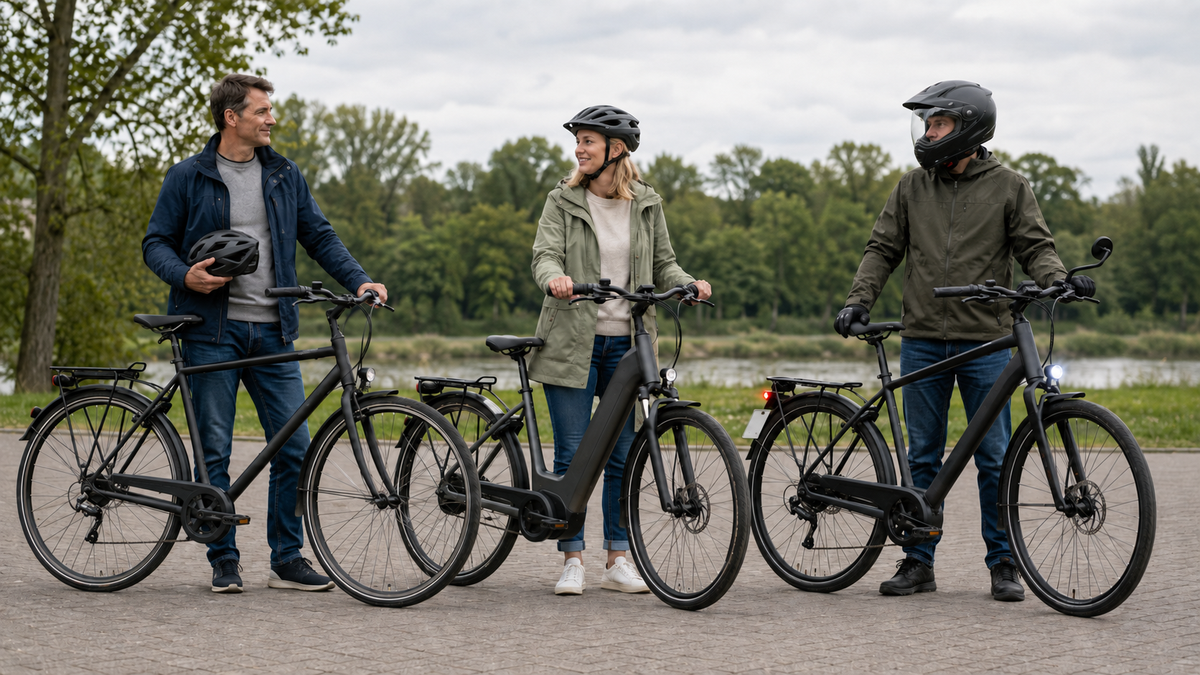
There is no general mandatory bicycle helmet requirement in Germany. This applies to adults and children on a conventional bicycle as well as to a pedelec whose motor provides assistance only while pedaling and switches off at 25 km/h. The situation is different for an S-pedelec: it is legally treated as a motor vehicle, which is why an appropriate protective helmet is mandatory. To answer the question correctly, the vehicle class must therefore be clarified first.
Mandatory bicycle helmets in Germany: the short answer
- Conventional bicycle: no legally mandated helmet.
- Pedelec up to 25 km/h: legally a bicycle, so there is likewise no general mandatory helmet requirement.
- S-pedelec up to 45 km/h: motor vehicle; an appropriate protective helmet is mandatory.
- Children: There is no separate nationwide mandatory helmet requirement for conventional bicycles solely because of age.
“Not mandatory” does not mean that a helmet is useless. It merely describes the legal situation. Personal safety decisions, an organizer’s requirements, and the classification of the vehicle are separate matters.
Why a pedelec up to 25 km/h is considered a bicycle
Section 63a of the German Road Traffic Licensing Regulations (StVZO) classifies an electrically assisted vehicle as a bicycle if the pedal assistance has a rated continuous power of no more than 0.25 kW, decreases as speed increases, and switches off at 25 km/h or when pedaling stops. A starting or walking-assistance function up to 6 km/h does not change this classification.
For such a pedelec, the same basic helmet rules apply as for a bicycle without a motor. What matters is not whether people colloquially say “e-bike” in everyday life. The decisive factors are the design and the vehicle documents. A bicycle can travel faster than 25 km/h downhill or through the rider’s own muscle power without automatically becoming an S-pedelec. The limit describes when motor assistance ends, not a general speed limit for the bicycle.
Helmets are mandatory on S-pedelecs
An S-pedelec typically provides assistance up to 45 km/h and is no longer in the bicycle class. Section 21a(2) of the German Road Traffic Regulations (StVO) requires people riding motor vehicles with a design-related maximum speed of more than 20 km/h to wear a suitable protective helmet. For an S-pedelec, the helmet requirement is therefore not merely a voluntary recommendation.
Whether an existing bicycle helmet is considered “suitable” for the specific fast vehicle should not be decided based on advertising or appearance. The relevant factors are the vehicle class, the information in the documents, and the helmet’s stated standard and suitability. Anyone taking over a used electric bicycle without being certain of its class should check the type plate, operating permit, and documents before the first ride.
Is there a special helmet requirement for children?
No. For conventional bicycles and 25-km/h pedelecs, federal law does not require children to wear a helmet solely because of their age. This applies regardless of whether the child is riding independently, sitting in a suitable child seat, or traveling in a properly equipped bicycle trailer. The ADFC summarizes the legal situation accordingly.
Parents can still make helmet use a family rule. In that case, it is important to use a properly fitting, correctly adjusted helmet that is not pushed forward by a headrest when the child is in a seat or trailer. The absence of a statutory requirement does not replace the transport equipment’s operating instructions or a careful fit check.

What happens after an accident without a helmet?
The statement “without a helmet, you receive no compensation” is too broad. In case VI ZR 281/13, the Federal Court of Justice ruled that the claim of a commuter cyclist was generally not to be reduced for contributory negligence because she was not wearing a helmet. The ruling concerned an accident from 2011 and the general traffic practices at that time.
This does not guarantee the outcome of every future individual case. Sporting use, particular hazards, contractual rules, or a different vehicle class may affect the assessment. After an accident, injured people should be cared for first and evidence secured. Any question of liability allocation should be handled by insurers or qualified legal counsel.
Four questions clarify your own situation
- Which class is stated in the documents? Bicycles, 25-km/h pedelecs, and S-pedelecs are not treated the same way.
- Does a special usage rule apply? A club, race, employer, or event may require a helmet even if the StVO does not.
- Does the helmet really fit? The forehead, straps, and buckle must be positioned according to the manufacturer’s instructions.
- Is it still usable? After a strong impact or in the event of visible damage, do not rely merely on its external appearance; follow the manufacturer’s information.
This check prevents two typical mistakes: a voluntarily worn, poorly fitting helmet does not automatically provide safety, and an S-pedelec does not become a bicycle simply because it looks similar.
Wearing a helmet voluntarily without distorting the legal situation
Many people choose to wear a helmet even when it is not mandatory. A sensible routine is straightforward: choose the right size, briefly check the straps before every ride, and do not push the helmet so far back that the forehead remains exposed. Thick hats, hoods, or loose items under the helmet can alter its fit. If in doubt, consult a specialist retailer or the manufacturer’s instructions.
The legal information should remain accurate. Campaigns, recommendations, and personal caution are not statutory requirements. Conversely, the absence of a general requirement does not reduce the risk of a head impact. Keeping these two levels separate allows people to make an informed decision without attributing a nonexistent rule to others.
Rental, company, and tour bicycles
For a rental or company bicycle, the statutory helmet requirement initially also follows from the vehicle class. In addition, rental companies, employers, or tour operators may set conditions for use. Such contractual rules must be distinguished from the general StVO situation. Before taking over the bicycle, check the vehicle documents, terms of use, and any helmet provided. A borrowed helmet should be used only if its size, condition, and adjustment range are suitable; a shell merely supplied with the bicycle is not proof of a secure fit.
Frequently asked questions about mandatory bicycle helmets
Do I have to wear a helmet on a Cyseekin pedelec?
The decisive factor is the legal vehicle class of the specific model, not the brand. If it is a compliant pedelec with assistance up to 25 km/h, there is no general mandatory helmet requirement. The model documentation must confirm this classification.
Does the helmet requirement begin at 25 km/h of the rider’s own speed?
No. For a pedelec, 25 km/h is the point at which motor assistance switches off. The rider’s own downhill speed does not change the vehicle class. An S-pedelec, by contrast, is a motor vehicle by virtue of its design and approval.
Do children have to wear a helmet in a bicycle trailer?
There is no nationwide statutory requirement for this. Parents should nevertheless follow the trailer’s instructions and pay attention to the seating position and sufficient head clearance. A helmet must not push the child’s head forward into an unfavorable position.
Can an organizer require a helmet?
Yes. Participation requirements, club rules, or workplace policies may be stricter than the general traffic regulations. Anyone taking part in an organized ride should read these conditions beforehand.
As of: September 5, 2026. This article explains the general legal situation in Germany and does not replace legal advice in an individual case.
Share:
Bicycle Accidents on the Way to or from Work: When Statutory Accident Insurance Applies
Taking children on a bicycle: seats, trailers, and age limits