

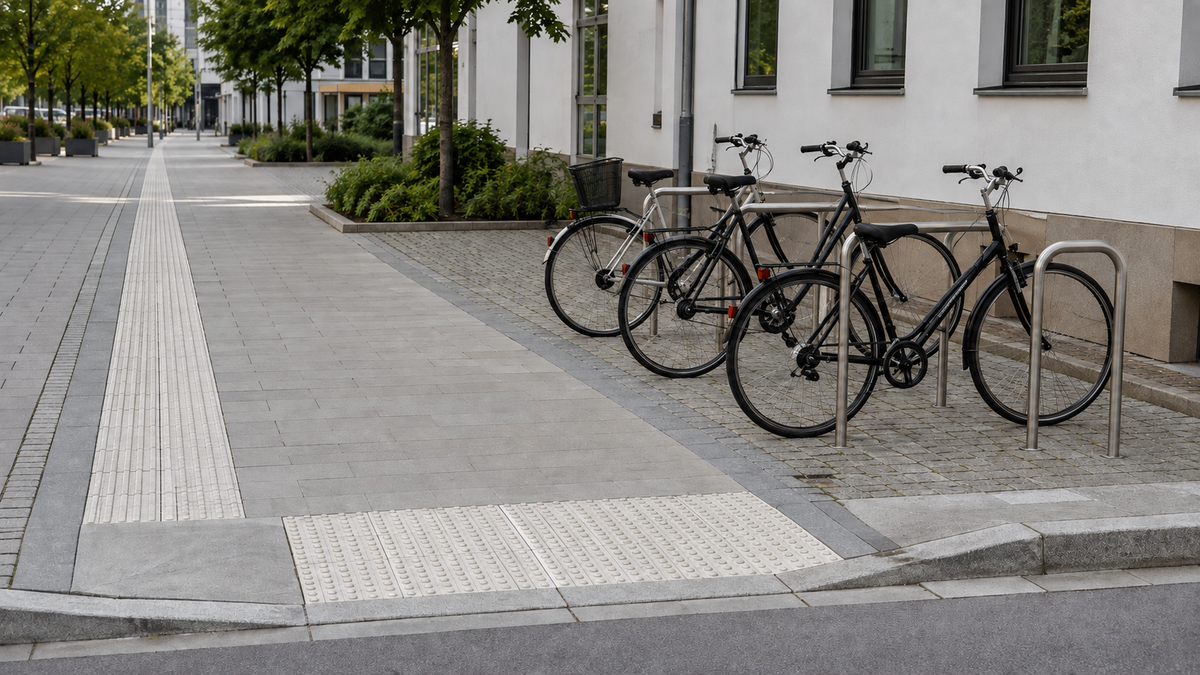
In Germany, a bicycle may generally be left on public property. On a sidewalk, in a public square, or at the side of the road, however, the decisive factor is not simply whether there is a bicycle rack there. The bicycle must not obstruct anyone, block an emergency or traffic area, or be left unlit on the road in darkness. Securing a bicycle properly and parking it lawfully are two different considerations.
Leaving a bicycle: What is generally permitted
The German Road Traffic Regulations do not contain a general parking ban specifically for bicycles. The ADFC points out that bicycles may be left on sidewalks and in public squares as long as pedestrians and wheelchair users are not obstructed. Leaving a roadworthy bicycle is generally considered a permitted use of public roads.
An existing bicycle rack is usually the best solution, but it is not automatically the only permitted location. Conversely, the absence of a prohibition sign does not make a narrow spot suitable. Anyone who places a bicycle across a walking route, blocks a ramp, or obstructs access to a door creates an obstruction. In such cases, the bicycle may be moved or removed under the applicable conditions.
On the sidewalk, clear passage is what matters
When parking on the sidewalk, the bicycle should be placed as parallel as possible and outside the clearly recognizable walking path. Enough space must remain for wheelchairs, strollers, walkers, and people approaching from the opposite direction. A fixed nationwide minimum remaining width cannot be derived from the German Road Traffic Regulations for every situation; the local layout and actual obstruction are decisive.
Particular care is required around lowered curbs, tactile guidance strips, bus stops, entrances to homes and businesses, and narrow passageways. A bicycle that sighted people can still walk around may nevertheless be an obstacle for blind or mobility-impaired people. Handlebars, pedals, and trailer drawbars must not project unexpectedly into the path.
These areas must remain clear
- officially marked fire department access routes and emergency routes,
- driveways and entrances to properties,
- lowered curbs and accessible crossings,
- cycle paths, advisory cycle lanes, and visibility areas at intersections,
- bus stop areas, doors, and escape routes,
- areas where the bicycle obscures traffic signs or signals.
Section 12 of the German Road Traffic Regulations contains general rules on stopping and parking, including protected areas at intersections, property driveways, and lowered curbs. Not every provision is equally relevant in practice to a bicycle that can easily be moved as it is to a car. Nevertheless, the basic idea remains useful: do not block visibility, access, or traffic space.

May a bicycle be left at the side of the road?
Bicycles are vehicles. They may generally be left lengthwise at the right-hand edge of the road or on a suitable hard shoulder. On a one-way street, the left side may also be considered under the general rules. The bicycle should be positioned in a space-saving and stable manner, not across the traffic lane.
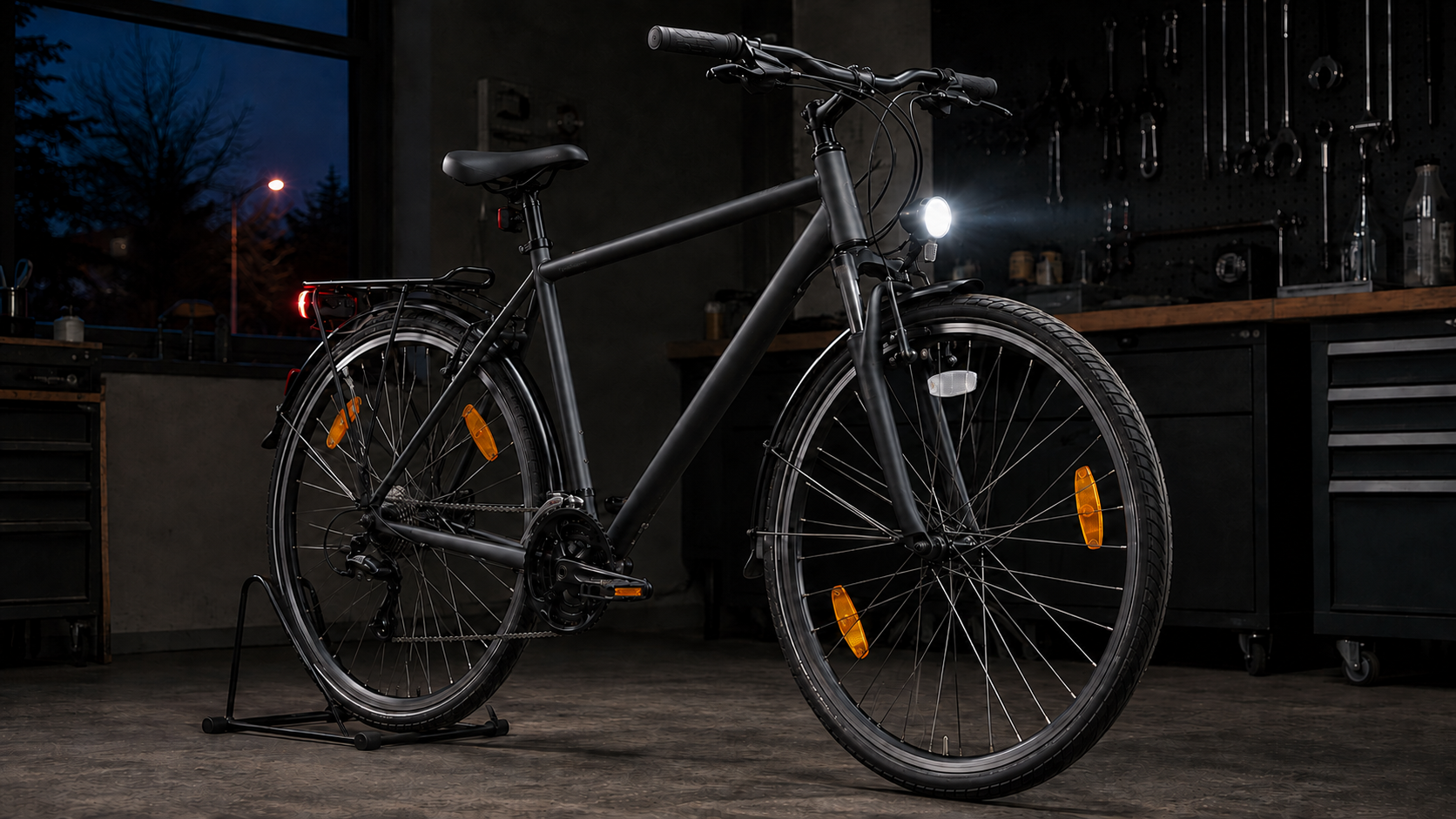
There is an important restriction in darkness: Section 17(4) of the German Road Traffic Regulations does not permit a bicycle that can be removed from the road without difficulty to be left there unlit. For everyday parking, a rack outside the road is therefore usually the safer option. Do not park at places with poor visibility or limited width.
Locking a bicycle without affecting someone else’s property
Public traffic space and private property are separate matters. A bicycle cannot simply be locked to every railing, fence, or structural element. Private house rules, station regulations, and the terms of use for a property may impose additional requirements. Barriers, handrails, and tree-protection guards also serve other purposes.
Route the lock so that no sharp edge or long loop extends into the sidewalk. Do not chain the bicycle to young trees, movable construction equipment, or fire department facilities. When using a designated parking area, keep the frame within the marked space and do not block neighboring spaces.
E-bike batteries and accessories when parking
Removing the battery does not change the parking rules, but it can affect theft and weather-related risks. Remove the battery only in accordance with the bicycle’s instructions. Keep the contacts dry and protected; do not carry a hot, damaged, or unusual-looking battery in a bag or into your home. Instead, take it out of service and have it professionally inspected in accordance with the manufacturer’s instructions.
Loose baskets, child seats, or bags must not make the passage wider. Do not leave a child trailer on the sidewalk with its drawbar extended. A long cargo bike requires a correspondingly large parking space; the distance between two bollards in a standard rack is not automatically sufficient.
When a parked bicycle may be removed
A municipality may not remove a usable bicycle solely because it is visually bothersome. A specific obstruction, danger, special local legal basis, or the appearance of an abandoned scrap bicycle may change the situation. Temporary construction-site or event-related orders must also be observed.
If a bicycle has been moved or removed, first document the location, time, and any notices that were present. The lost-and-found office, public order office, transport company, or property management can then provide assistance. An immediate accusation of theft is not always correct, but an authority may not remove every bicycle indiscriminately without a legal basis either.
The 30-second parking check
- Is the bicycle outside the pedestrian and cycle paths?
- Are lowered curbs, entrances, bus stops, and emergency routes clear?
- Do the handlebars, pedals, lock, or trailer project into the passage?
- Is the bicycle stable and unable to tip onto people or vehicles?
- May the selected facility be used, and is it not someone else’s handrail or private fence?
If any of these questions cannot clearly be answered with yes, choose another location. A detour of a few meters is usually easier than a blocked crossing or a bicycle that is later moved.
Check again when parking for longer periods
A location that is suitable today may be subject to different rules tomorrow because of construction, a weekly market, or an event. Anyone leaving a bicycle for several days should check temporary signs and visit the location regularly. A contact note attached to the frame does not replace permission and does not protect against necessary relocation. At a station or in a residential complex, the operator’s or owner’s clearly displayed terms of use also apply.
Frequently asked questions about bicycle parking
Do I always have to use a bicycle rack?
No, there is no general obligation to do so. However, a rack is often the safest and most considerate option. Elsewhere, the bicycle must not obstruct another person or a traffic area.
May I leave my bicycle on the sidewalk?
Generally yes, provided that sufficient clear passage remains. Tactile guidance strips, lowered curbs, entrances, and the needs of wheelchair and walker users require particular consideration.
May a bicycle be left at the side of the road at night?
A bicycle that can easily be removed from the road may not be left there unlit in darkness. A suitable parking space away from the road is generally the better solution.
Can the city remove a bicycle that has been left for a long time?
A specific obstruction, danger, local order, or condition indicating that the bicycle is abandoned scrap may justify removal. Mere visual dissatisfaction is not automatically sufficient under the case law described by the ADFC.
As of: September 5, 2026. Local orders, private house rules, and temporary construction-site signage must also be observed.
Share:
Bicycle Accidents on the Way to or from Work: When Statutory Accident Insurance Applies
Bicycle helmet requirements in Germany: What applies to bicycles, pedelecs, and S-pedelecs?