

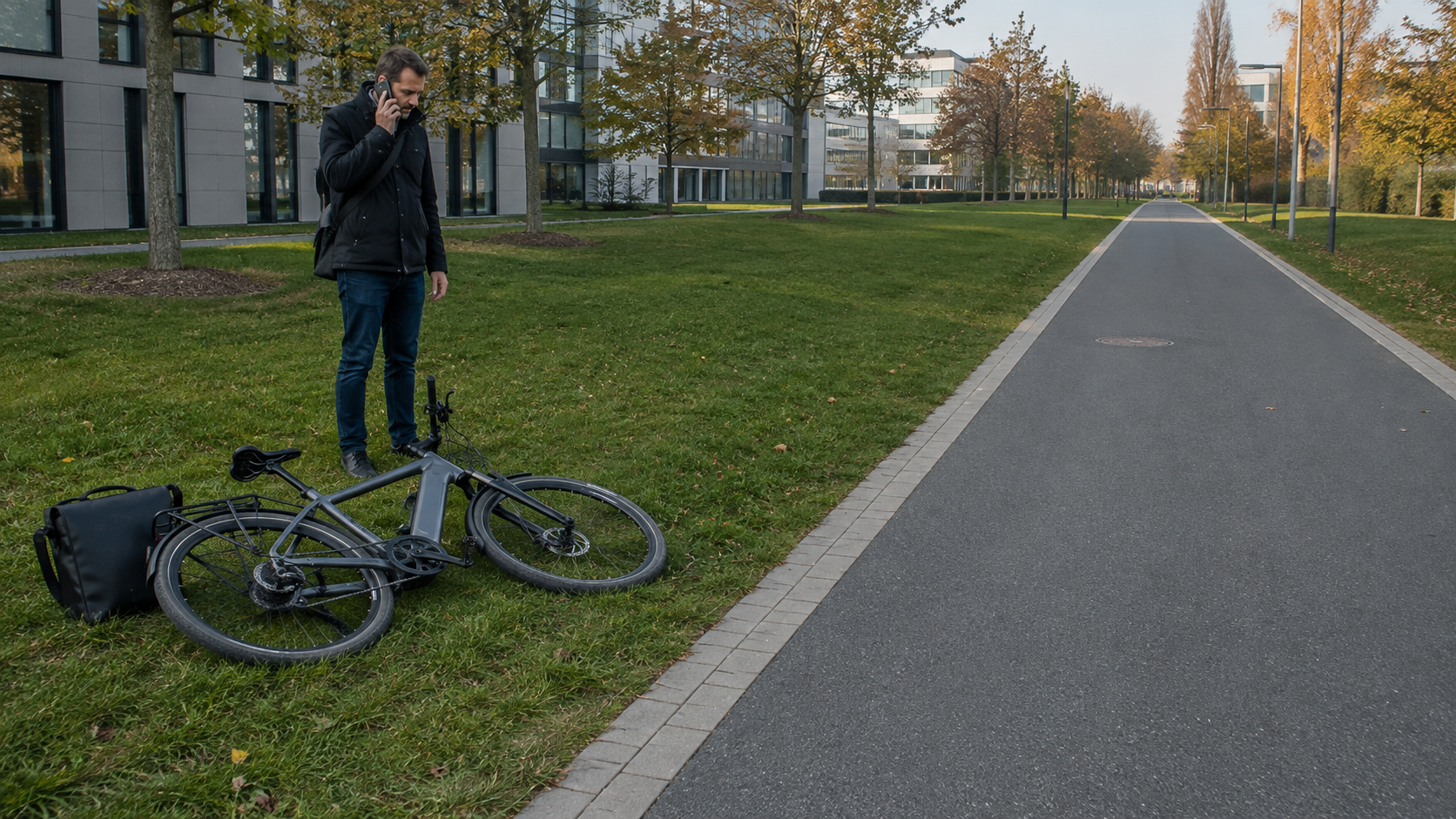
A bicycle crash on the way to work can qualify as a commuting accident. In principle, the insured route is the direct route between your home and your insured work activity; the means of transport does not matter. However, “direct” does not always mean the shortest route. A route with better traffic conditions, a detour, or a necessary route to childcare may also be covered, while a private shopping detour interrupts coverage.
What is a commuting accident involving a bicycle?
The German Social Accident Insurance refers to accidents occurring on the way to or from work or an educational institution as commuting accidents. This can include a fall from your own bicycle, a pedelec, or a borrowed bike. What matters is the connection to the insured activity, not who owns the bicycle.
According to the DGUV, the route generally begins when you leave the exterior door of your residential building and ends when you pass through the exterior door of your destination. An accident inside your own home or in the interior stairwell is therefore assessed differently from a fall on the public route outside the building. In individual cases, the responsible accident insurance provider examines the actual circumstances.
The direct route does not have to be the shortest
The direct route is insured. The DGUV FAQ makes clear that it does not necessarily have to be the shortest or fastest route. A somewhat longer route with better traffic conditions can still be direct. This is important for cyclists when a safe route via a side street or cycle path is available, while the shortest connection uses a dangerous main road.
A signposted detour or a route on which the workplace can be reached more quickly despite the greater distance may also be insured. There is no blanket mileage limit. It is helpful to be able to explain the objective reason for the route: construction work, a safer crossing, a cycle path, traffic routing, or a customary connection.
Which deviations may also be covered?
Statutory accident insurance recognizes certain necessary deviations. These include the route taken to drop off or pick up children from childcare during working hours. Carpooling and necessary detours do not automatically end insurance coverage either.
This exception is not a free pass for any errands. The childcare must be connected to the insured activity. Anyone who drives privately to the lake after leaving their child at daycare has left the route serving the insured purpose. When there are multiple destinations, each section is therefore assessed according to its purpose.
Private interruption: shopping, cafés, and visits
A private detour to the supermarket, friends, or a café is generally not part of the insured commute. There is no commuting accident coverage during this deviation. Once the original route is resumed, coverage may generally resume.

Longer interruptions are subject to an additional limit. According to the DGUV, a private interruption lasting more than two hours may mean that the entire remaining journey home is no longer insured. Whether an action is merely a minor interruption or an independent private trip is assessed based on the specific sequence of events. For this reason, the time, route, and purpose should be documented truthfully after an accident.
Working from home and changing workplaces
Working from home does not automatically mean that every journey from home is insured. A journey to a work-related appointment, the workplace, or an insured event may be covered if it is connected to the work activity. A private trip to exercise remains private, even if emails are answered later.
For changing work locations, business trips, or self-employed work, responsibility depends more heavily on the type of employment and the assignment. A general blog statement should not be treated as a binding decision in such cases. Employers, employers’ liability insurance associations, or accident insurance funds can assess the specific coverage.
After the accident: take medical and safety measures first
The classification as a commuting accident comes after dealing with the accident itself. Secure the accident scene, assist injured people, and call 112 or the police if necessary. Record the details of those involved and witnesses, photos, the time, and the exact location. Keep a damaged helmet and the bicycle for later examination.
When receiving medical treatment, state from the outset that the accident occurred on the way to or from work, school, or training. This helps initiate the correct billing and documentation. The employer or responsible office should be informed as early as possible; for school pupils, students, or university students, the educational institution is an important point of contact.
Who reports a commuting accident?
Employees should report the incident internally, even if the initial inability to work appears brief. If an insured person is unable to work for more than three days as a result of a work-related or commuting accident, or dies, the company must, according to the DGUV, submit an accident report to the employers’ liability insurance association or accident insurance fund. Educational institutions have corresponding reporting procedures.
The person affected should keep medical reports, certificates of incapacity for work, tickets or route records, photos, and witness contact details. Complete documentation does not by itself determine entitlement, but it prevents gaps in memory. Final recognition is decided by the responsible accident insurance provider.
What statutory accident insurance covers
If the commuting accident is recognized, the focus is on restoring health and participation. Depending on the case, medical treatment, rehabilitation, and other benefits from statutory accident insurance may be relevant. This does not imply any blanket payment.
Damage to the bicycle is not automatically compensated in the same way as personal injury. Claims against an at-fault party’s liability insurer and benefits from your own bicycle or accident insurance are separate issues. Mixing them up can lead to false expectations.
Four everyday examples
The safe cycle path is two kilometers longer
A longer route with better traffic conditions may qualify as the direct insured route. The route should be objectively justified by safety or traffic flow, not by a private training goal.
Buying groceries on the way home
The trip to the store and the shopping are private. Insurance coverage is generally interrupted during this phase. After returning to the original route home, coverage may resume depending on the duration and circumstances.
Taking your child to daycare before work
The necessary deviation for this purpose may be insured if childcare is required because of the work activity. A subsequent private extra trip is not covered by this provision.
Taking a large training loop to work on a road bike
You are free to choose your bicycle. However, a training loop motivated primarily by private interests is not a commute simply because it ends at the workplace. The purpose of the route remains decisive.
Frequently asked questions about commuting accidents
Am I insured on a pedelec in the same way as on a bicycle?
The choice of means of transport is generally unrestricted for commuting accident coverage. What matters is the insured person, route, and purpose. Traffic violations or incorrect vehicle classification may nevertheless have other legal consequences.
Is a detour due to construction work insured?
A necessary diversion may form part of the insured route. The route and construction situation should be documented as precisely as possible after the accident.
Do I have to report a minor fall to my employer?
Early internal reporting is advisable because symptoms may appear later. The formal accident report depends, among other things, on the duration of the inability to work.
Who decides whether my accident is recognized?
The responsible employers’ liability insurance association or accident insurance fund examines each individual case. The employer, medical practice, and person affected provide the necessary information, but do not decide recognition on their own.
As of September 5, 2026. This article provides a general overview and does not replace a decision by the responsible accident insurance provider.
Share:
Bicycle Accident: What You Should Do First at the Scene of the Accident
Bicycle helmet requirements in Germany: What applies to bicycles, pedelecs, and S-pedelecs?