

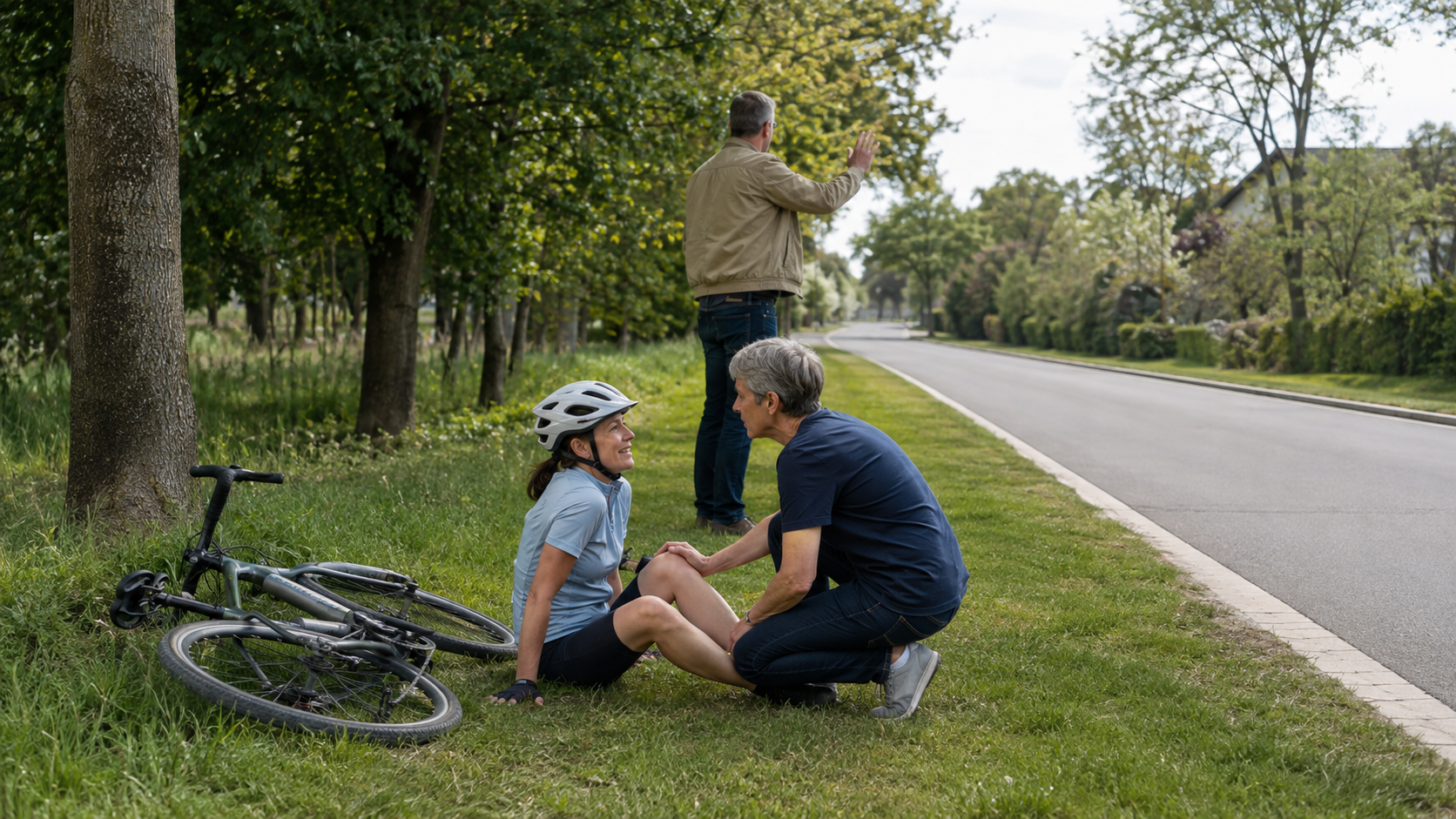
After a bicycle accident, safety comes first—not determining who is at fault. Anyone able to act should stop, protect the accident scene from secondary accidents, check for injuries, and call 112 in a medical emergency. The people involved, witnesses, vehicles, and traces should then be documented. Even in the case of apparently minor damage, no one may simply continue before the necessary findings have been established.
Bicycle accident: the correct order of steps
- Stop and take stock: Do not reflexively walk into moving traffic.
- Secure traffic and clear the area immediately in the event of minor damage: Warn others and, where possible without endangering yourself, immediately move the bicycle or vehicles involved out of the way.
- Assist injured people: Check consciousness and breathing, provide first aid, and call 112 if necessary.
- Call the police: Particularly in the event of injuries, disputes, hit-and-run, or significant damage.
- Secure data and evidence: Personal details, registration numbers, witnesses, photos, and an accident sketch.
This order follows the basic duties set out in § 34 StVO. Under paragraph 1, number 2, vehicles must be moved out of the way immediately in the event of minor damage; the roadway should therefore not be cleared only after all evidence has been fully secured. A quick overview photo beforehand is appropriate only if it can be taken safely and does not delay clearing the area. Moving aside does not mean leaving the accident scene.
Securing the accident scene without putting yourself in danger again
A fallen bicycle, loose luggage, or broken glass can become a second hazard for approaching traffic. Anyone who is uninjured and able to act should make themselves visible and ask other people for assistance. On a fast or confusing road, no one should stand in the middle of the lane to take a photo.
A bicycle usually has neither hazard warning lights nor a warning triangle. Therefore, act from a safe distance and protect yourself: choose a highly visible position, warn traffic, and enter a dangerous roadway only if it is justifiable. The Bavarian Police emphasizes that a rescue operation before the scene has been secured can endanger additional people.
When to call 112 and when to call 110
112 is for emergency medical services and the fire department. It should be called for serious injuries, unusual consciousness or breathing, and any unclear medical emergency. If you cannot reliably assess the person’s condition, describe only what you observe to the emergency dispatcher and follow their questions. The dispatcher will ask for the location, what happened, the number of people affected, and their condition. The call ends only when there are no further questions.
110 connects you to the police. The ADFC recommends calling the police in the event of injuries or a dispute about how the accident happened. Hit-and-run, suspected alcohol or drug use, missing personal details, and a dangerous traffic situation are also reasons to do so. If people are injured, emergency medical services and the police may both be needed.
Do not downplay injuries
Symptoms may still be unclear immediately after an accident. After an impact to the head, impaired consciousness, or a noticeable deterioration, do not continue riding; have the person’s condition assessed medically. Describe symptoms to the emergency dispatcher or medical professionals rather than diagnosing them yourself. Keep the helmet and bicycle for documentation. Medical professionals decide whether an examination or transport is necessary.
Do not move an injured person unnecessarily if a spinal or pelvic injury is possible. However, if there is an immediate danger from traffic, fire, or another threat, follow the dispatcher’s instructions. Anyone providing first aid should act within what can reasonably be expected; doing nothing out of fear of making a mistake is not a good solution.
These details belong in the accident record
- Names and addresses of everyone involved,
- vehicle registration numbers and vehicle and insurance details, where available,
- telephone numbers and contact details of independent witnesses,
- exact location, date, time, weather, and lighting conditions,
- directions of travel, signal status, markings, and visible damage,
- case number or police station if the police record the accident.
Take photos from a safe position, both overview and detail shots. They should show vehicle positions, road layout, skid marks, damage, and visible injuries with the necessary respect. A brief sketch with arrows may later be more understandable than many close-up photos. Under § 34 paragraph 3 StVO, traces of the accident may not be removed before the necessary findings have been established; this does not affect the obligation to move aside immediately in the event of minor damage.

Do not prematurely admit fault
At the accident scene, record the facts: Who came from which direction? Where was the bicycle? Which traffic light was visible? A blanket statement such as “It was entirely my fault” is neither necessary for providing first aid nor for documenting the accident. Insurers and, where applicable, courts assess liability based on the evidence.
A jointly completed accident report can record details and a sketch without automatically constituting an admission of liability. Sign only what you have actually understood and observed. Leave out free-text additions based on speculation.
Why a note alone is not enough
Anyone who damages a parked vehicle must stop and wait for a reasonable period appropriate to the circumstances. § 142 StGB requires enabling the identification of the person, vehicle, and involvement in the accident. After a justified departure or once the waiting period has expired, the necessary findings must be enabled immediately afterward.
A name on a note can be lost and does not reliably replace the statutory obligations. If no one can be reached, contact the police and coordinate the next steps. No fixed waiting time can be specified generally for every location, time of day, and amount of damage.
Check the bicycle before riding on
After a fall, a bicycle may appear rideable while still having a bent handlebar, damaged fork, loose wheel, or impaired brake. Do not continue riding if there is a crack, deformation, unusual play, rubbing, a damaged cable or hose, or a warning message on a pedelec. Push the bicycle or have it collected.
For subsequent claims processing, keep damaged parts, the helmet, clothing, purchase receipts, and the workshop inspection report. Document repairs. If the accident occurred on the way to or from work or training, also notify the responsible statutory accident insurance provider.
Organize the documents after the accident
On the same day, secure photos, the sketch, contact details, and case number without changing them. Make a brief personal note separating observations from assumptions and recording the sequence of events. Medical documents, certificates of incapacity for work, travel expenses, and workshop estimates should be kept clearly organized in the same case file. Deadlines and specific claims depend on the individual case; if you are unsure, contact your insurer, the accident insurance fund or employers’ liability insurance association, or qualified legal counsel.
Frequently asked questions after a bicycle accident
Does the police have to attend every bicycle accident?
Not every clear case of minor property damage requires a police report. However, in the event of injuries, disputes, hit-and-run, missing details, or significant damage, calling the police is advisable or urgently necessary.
May I remove my bicycle from the road immediately?
Yes. In the event of minor damage, the bicycle must be moved out of the way immediately under § 34 paragraph 1, number 2 StVO; complete documentation must not delay clearing the area. A quick photo beforehand is appropriate only if it can be taken safely and causes no delay. Moving aside does not mean leaving the accident scene.
Should I continue riding after hitting my head if it barely hurts?
No. Symptoms may appear later. If there are noticeable symptoms or the condition is unclear, call 112; otherwise, seek medical assessment rather than attempting to diagnose yourself remotely.
What happens in an accident involving a parked car?
Stop, assess the damage, wait a reasonable amount of time, and enable the necessary findings to be established. If no one appears, a note is not a reliable solution; contact the police and report the incident immediately afterward.
As of: September 5, 2026. In the event of immediate danger or injuries: protect yourself, provide first aid, and call emergency services first.
Share:
Bicycle Accidents on the Way to or from Work: When Statutory Accident Insurance Applies
Bicycle helmet requirements in Germany: What applies to bicycles, pedelecs, and S-pedelecs?