

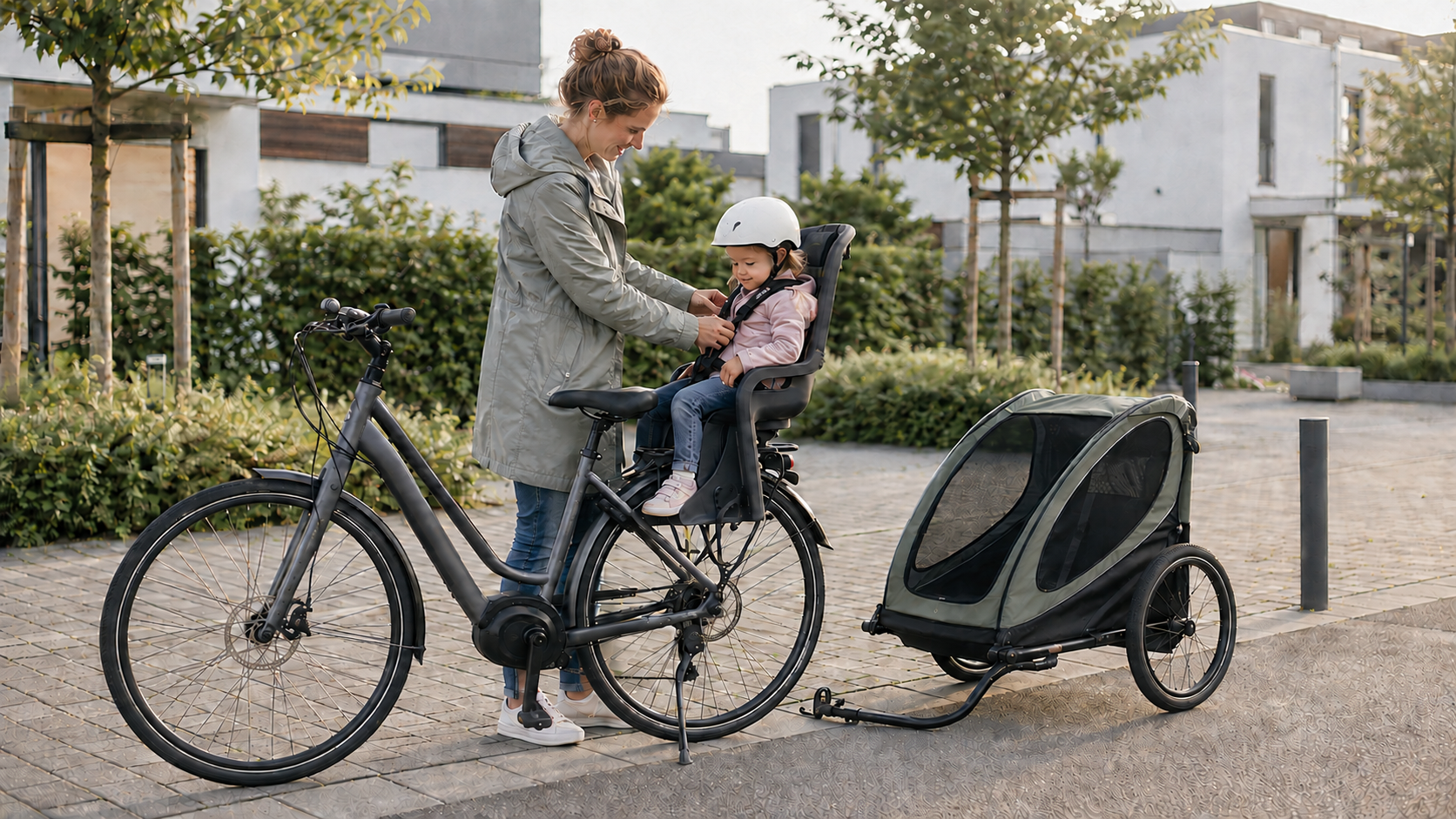
In Germany, children cannot simply ride on any luggage rack or in any transport box. Child seats, child trailers, and cargo bikes designed to carry passengers are subject to common basic rules, but require different practical checks. The decisive factors are age, a suitable seat, protection from the spokes, the manufacturer’s approval, and the permitted gross weight of the entire combination.
Carrying children on a bicycle: the legal essentials
Section 21 (3) of the German Road Traffic Regulations (StVO) requires the person carrying the child to be at least 16 years old. The bicycle must be designed and equipped to carry passengers. Special seats are required for children who have not yet turned seven; in addition, fairings or equally effective devices must prevent their feet from getting caught in the spokes.
Up to two children under the age of seven may be carried in a bicycle trailer equipped for transporting children. The age limit does not apply when transporting a child with a disability. This is a legal exception, but it does not replace the manufacturer’s load and suitability limits.
Child seat, trailer, or cargo bike?
Child seat on the bicycle
A child seat requires an approved mounting system for the specific bicycle. With a luggage-rack mount, it is not only the child’s body weight that matters, but also the rack’s permitted load capacity. With a frame mount, the frame shape, clamping area, and cable routing must be suitable. Loose straps, a damaged seat, or missing spoke protection are reasons to stop.
A two-wheeled bicycle becomes top-heavy when a child gets on or off. An adult must therefore hold the bicycle steady; a child must never be left alone in the seat of a parked bicycle. First check the helmet and clothing, then seat the child, and finally fasten the straps and foot restraints. Do not attach luggage to the seat in a way that allows it to touch the straps or feet.
Child trailer
A trailer can accommodate up to two children if it is expressly designed for this purpose. Check the coupling, safety strap, drawbar, tyres, harnesses, and canopy before every ride. According to the manufacturer, the towing bicycle must be suitable for trailer use. This is particularly important with a pedelec, because not every frame, axle, or hub can accommodate every coupling.
Lighting must also be checked. Section 67a of the German Road Traffic Licensing Regulations (StVZO) requires bicycle trailers to have retroreflectors and, depending on their width or how much they obscure the bicycle’s lighting, additional lights. A large safety flag can improve visibility, but it does not replace a legally required lighting device.
Cargo bike with a child compartment
On a cargo bike, the loading area is not automatically a passenger seat. Children may ride there only if the bike is designed and equipped to carry passengers. The bench, harness system, and protective structure must be designed to work together. Self-installed cushions or a loose box do not meet this requirement.
The following applies to all three solutions: The operating instructions may impose stricter limits on age, height, weight, seating position, and the number of children than the general StVO. A ride that is legally possible is not automatically approved by the manufacturer of the bicycle, seat, or trailer.

Calculating the permitted gross weight in full
A common mistake is to consider only the child’s weight. Depending on the vehicle, the total weight includes the bicycle, rider, child or children, seat or body, luggage, lock, and other accessories. Individual components may also have their own limits, such as the luggage rack, coupling, or bench.
The required values can be found on the bicycle, in the manual, or in the technical documentation. If there is no clear approval, do not continue calculating based on a blanket assumption. The manufacturer or a specialist workshop should clarify whether the combination is permitted. Do not mount a child seat on someone else’s pedelec simply because the clamp fits mechanically around a tube.
The five-minute check before setting off
- Check the vehicle: The brakes, tyres, steering, and lights work; there is no warning message on the pedelec.
- Check the attachment: The seat or coupling is secure without play, the safety catch is closed, and the drawbar is not damaged.
- Secure the child: The harnesses fit snugly, the feet are protected, and loose clothing or cords cannot reach any wheel.
- Check weight and luggage: The manufacturer’s limits are observed, and items are kept separate and securely fastened.
- Perform a test manoeuvre: On an area free of traffic, start slowly, brake, and turn; stop if the combination behaves unstably.
With a child on board, braking distance, cornering behaviour, and the required passage width all change. Approach kerbs, bollards, and narrow chicanes slowly. If in doubt, get off and carefully push the combination.
Getting on and off without a tipping risk
When fastening the harness, the bicycle should be on level ground and held securely by an adult. A kickstand alone is not adequate supervision. Distribute luggage before the child gets on so that the bicycle does not suddenly pull to one side. With a child seat, the child should get on only once the bicycle is fully secured; with a trailer, use the parking brake and designated safety devices as instructed. Only then should the harnesses, foot protection, and canopy be checked one final time.
Babies and very young children
The StVO does not specify a blanket nationwide minimum age in months. This does not mean that every baby may be transported. The ADFC recommends using only expressly suitable infant or hammock seats and following the manufacturer’s instructions precisely. Body position, head control, suspension, and intended use must be compatible.
A baby sling or back carrier worn on the body is not a substitute for a designated seat. In the event of braking or a fall, there is no defined restraint, and manufacturers may also prohibit cycling with such carriers. If approval is unclear, leave the bicycle parked.
Helmet, weather, and breaks
There is no general helmet requirement for children on ordinary bicycles, in seats, or in trailers. Nevertheless, many families choose to use one. In a trailer, there must be enough space behind the child’s head; a headrest must not push the helmet forward. Fit and the manufacturer’s instructions are what matter, not choosing the thickest possible helmet.
A canopy and rain cover do not automatically protect against heat. Keep ventilation openings clear, avoid direct sunlight, and adapt breaks to the children. Cold, wet conditions, and headwind affect a seated child more strongly than the person pedalling. A rigid kilometre limit would therefore be unreliable.
Frequently asked questions about transporting children
Can a seven-year-old still ride in a trailer?
The general exception for child trailers applies to children up to the completion of their seventh year—in principle, only while they are still under seven. The law provides an exception for a child with a disability. Manufacturer limits also apply.
Can I transport two children in one trailer?
Yes, if the trailer is designed to carry children and has two seats, both children meet the statutory age limit, and the weight and harness system are within the manufacturer’s approval.
Are front-mounted child seats allowed on bicycles?
The StVO does not generally require a child seat to be mounted at the rear. What matters is that the bicycle is designed and equipped to carry passengers, that children under seven have a special seat, and that their feet are effectively protected. In addition, the specific front seat must be approved for the bicycle and child and must not impair steering, braking, visibility, or safe operation.
Is a standard luggage rack sufficient as a seat?
No. Small children require a special seat with foot protection. For other passengers too, the bicycle must be designed and equipped to carry people.
Can any child seat be fitted to any e-bike?
No. The frame, luggage rack, battery position, load capacity, and mounting system must be approved. A workshop should check the combination if the documentation or mounting points are unclear.
As of September 5, 2026. The manufacturer’s specifications and the specific vehicle configuration take precedence for installation and loading.
Share:
Bicycle Accidents on the Way to or from Work: When Statutory Accident Insurance Applies
Bicycle helmet requirements in Germany: What applies to bicycles, pedelecs, and S-pedelecs?