

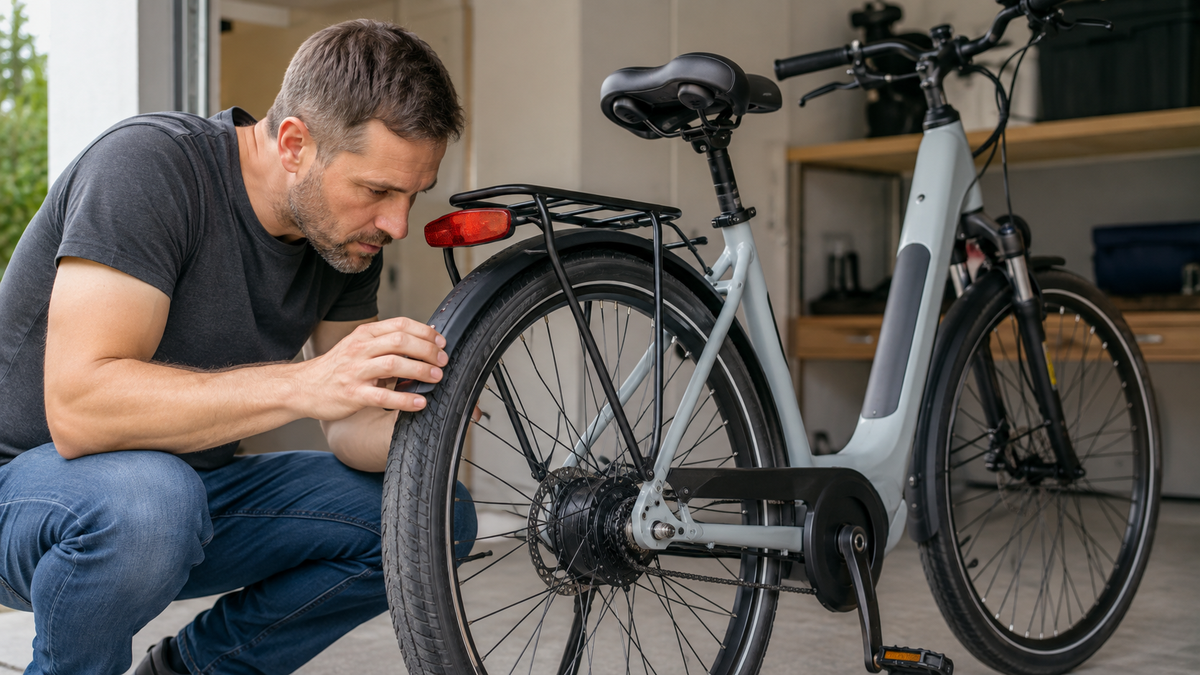
A bicycle tire that is becoming smooth should not automatically be assessed like a car tire. On many road tires, tread depth alone says little, whereas on a mountain bike, rounded knobs can noticeably affect grip. To identify a worn bicycle tire, you therefore need more than a mileage figure: the tread, casing, wear indicator, intended use, and unusual wear patterns all belong together. With this inspection routine, you can make a justifiable replacement decision.
Do not continue riding with these types of damage
End the ride if casing threads or the puncture-protection insert are visible, a bulge forms, a deep cut reaches the load-bearing structure, or the tire does not reliably hold air. A damaged bead, detached material, severe deformation, or a foreign object with unclear penetration depth are also not reasons to ride another test mile. Walk the bike or arrange transportation.
These warning signs are more important than a tread pattern that is still present. A tire may look “good” in places on the outside while being structurally damaged elsewhere. Therefore, inspect the entire circumference and both sidewalls. Depending on the system weight, luggage, and speed, an e-bike can be subjected to high loads; this does not, however, result in a blanket special deadline. What matters is the tire’s approval, condition, and the manufacturer’s instructions.
Why there is no general minimum tread depth
Schwalbe points out that tread has significantly less importance on bicycle tires than on car tires. A road tire may therefore still be usable despite a pattern that appears worn, as long as the load-bearing and protective layers are intact. This simplification does not apply to mountain bike tires: Knobs provide lateral guidance and traction on loose ground, so their shape and height must suit the intended route.
A fixed mileage limit is also unreliable. Tire pressure, total load, asphalt, gravel, temperature, braking proportion, drivetrain, and riding style affect abrasion. Manufacturer information on typical mileages describes specific product families and conditions, not your individual replacement date. Use the mileage as a reminder to inspect, not as the sole proof.
The wear indicators at a glance
| Finding | Classification | Decision |
|---|---|---|
| Tread shallower, continuous rubber layer present | Not automatically at the end of its service life for road tires | Check the overall condition and the manufacturer’s instructions |
| Casing threads or puncture-protection layer visible | Tread worn out | Replace the tire and do not continue riding |
| TWI marking reached | Model-specific wear limit | Follow this tire’s instructions |
| Knobs rounded, cracked, or broken off | Grip off-road may decrease significantly | Replace according to intended use |
| One-sided or patchy wear | Possible cause related to pressure, wheel clearance, brake, or load | Clarify the cause as well |
| Bulge, deep cut, or separated material | Possible structural defect | Take out of service immediately |
Five minutes for a complete visual inspection
- Clean the tire with water and a soft cloth so that dirt does not conceal any cracks.
- Set the tire pressure permitted by the tire, rim, and bicycle manufacturers; the narrowest permitted range is decisive.
- Slowly rotate the unloaded wheel and inspect the center of the tread around the entire circumference.
- Check both shoulders and sidewalls in good light for cuts, threads, bulges, and abrasion.
- Look for TWI points only if the manufacturer states that your tire has such markings.
- Compare the front and rear wheels as well as the left and right sides, and document any noticeable differences.
Do not press pointed tools into cracks, and do not remove a deeply embedded foreign object while out and about as long as it is unclear whether the tire will immediately lose air afterward. A photo with a chalk mark next to the damaged area makes it easier to check again; do not write on the contact surface or cover any manufacturer information.
Read the TWI only on the correct tire
Some tires have Tread Wear Indicators, or TWI for short. On certain Schwalbe Pro-One models, small recesses in the tread indicate wear, while arrows labeled T.W.I. on the sidewall show their position. Other models use different shapes or no indicator at all. A random recess is therefore not automatically a wear indicator.
Check the product page or manual for the specific tire. If an intended marking is no longer visible, follow the replacement rule stated there. If there is no TWI, assess the tire based on the visible layers, damage, and intended use. Never cut a “measurement groove” into the tread yourself.

Worn tread on city, road, and mountain bikes
On asphalt, lateral grip is provided primarily by the rubber and contact patch, not by deep water channels as on a car. A smooth or lightly treaded road model may be designed that way. In the rain, the right rubber compound, a clean and undamaged condition, correct pressure, and a cautious speed are important. Appearance alone does not indicate approval for wet cornering.
On a mountain bike, knobs grip loose terrain. If the center knobs are flattened, the tire rolls differently; rounded or torn side knobs can reduce cornering grip. Decide based on the terrain and the manufacturer’s criteria before the casing becomes visible. A commuter e-bike on asphalt has different requirements than an e-MTB on wet roots.
Uneven wear is a diagnostic issue
If the tire is more worn on the left than on the right, or shows two worn tracks alongside a less affected center, simply replacing it is not enough. Insufficient pressure causes the tire to flex more and puts additional strain on the side areas. Schwalbe describes these flex and wear marks as a typical consequence of consistently inadequate tire pressure. A rubbing brake pad, a misaligned wheel, or unusual load distribution should also be considered for inspection.
Measure the pressure with a suitable pressure gauge, not just your thumb. The permissible range is stated on the tire and in the instructions for the tire, rim, and bicycle. For the system weight and intended use, a manufacturer may specify additional limits. Do not use a universal online table if it conflicts with the specific approval.
Distinguishing aging cracks from acute damage
Many small surface cracks may be related to aging; a few larger cracks and pronounced flex marks may indicate prolonged use with insufficient pressure. Without an inspection, the transition cannot always be identified with certainty. As soon as fabric becomes visible, material detaches, or a bulge develops, the decision is clear: take it out of service.
Storage affects condition. A mounted tire should not remain completely flat under the weight of the bicycle for a long time. Unmounted tires stored in a cool, dry, dark place age differently from tires exposed to sunlight, ozone, heat, and load. A printed production date alone does not replace a condition inspection.
The replacement must be compatible with the tire, rim, and bicycle
Do not rely solely on a colloquial inch measurement. What matters is the complete size designation, the permitted combination with the rim, the construction, load capacity, and the bicycle’s approvals. Note the ETRTO size and product designation from the sidewall. The article ETRTO for bicycle tires explains how to read the size specification.
In the event of structural damage, replacing the inner tube is not a tire repair. Tubeless sealant can seal small punctures, but it cannot make an exposed casing, damaged bead, or bulge load-bearing again. Installation, direction of rotation, pressure, and seating follow the instructions for the new system. Checking that the bead is seated correctly is a separate issue and cannot be inferred from a wear photo.
Organizing the inspection interval in practice
Schwalbe recommends checking the pressure of its tires with a pressure gauge at least once a month. A visual inspection is also worthwhile before longer rides and after a hard impact, puncture, or unusual wear. Record the date, mileage, pressure, use, and photo location in the maintenance log. This makes it easier to notice whether one area is changing quickly.
A new tire does not automatically wear evenly. Check it again after the first few rides, especially if the size, rim, or pressure range has changed. Dispose of the old tire according to local regulations, or ask a participating specialist retailer about a take-back scheme. Do not assume that every retailer offers free nationwide collection.
Frequently asked questions about worn bicycle tires
Is a bicycle tire without visible tread automatically worn out?
No, appearance alone does not follow the same logic as a car tire. A road tire may have little tread by design. However, visible casing, puncture protection, structural damage, or a model-specific wear indicator that has been reached requires replacement.
How many miles does a bicycle tire last?
A fixed figure would be misleading. Pressure, load, surface, temperature, braking, drive system, and riding style greatly affect service life. Use mileage only as a reminder and assess the tire's actual condition.
Can I still ride home on a tire with visible threads?
No. Visible casing threads or puncture-protection inserts are criteria for removing the tire from service. Push the bicycle or arrange transport instead of risking sudden pressure loss.
Why is my rear tire wearing out faster?
The rear wheel often bears more load and driving force. Nevertheless, severe uneven wear or surprisingly rapid wear should be checked for correct pressure, brake issues, wheel alignment, load, and suitable tire specifications.
Conclusion: Layers and damage matter more than a number
You cannot identify a worn bicycle tire by a universal tread depth or mileage limit. Check the entire circumference, any TWI indicators, the casing, puncture protection, sidewalls, and the wear pattern. Visible fabric, bulges, and deep structural damage mean the tire must no longer be used. If the road tread is merely shallower, the decision depends on the specific tire, its use, and the manufacturer's guidelines. This way, you avoid replacing it unnecessarily early or dangerously late.
As of: September 6, 2026. Size, pressure, wear, and installation specifications depend on the specific tire, rim, and bicycle.
Share:
Bicycle helmet after a crash: inspect, retire, replace
Bicycle Brake Pads Worn Out: How to Safely Recognize Wear