

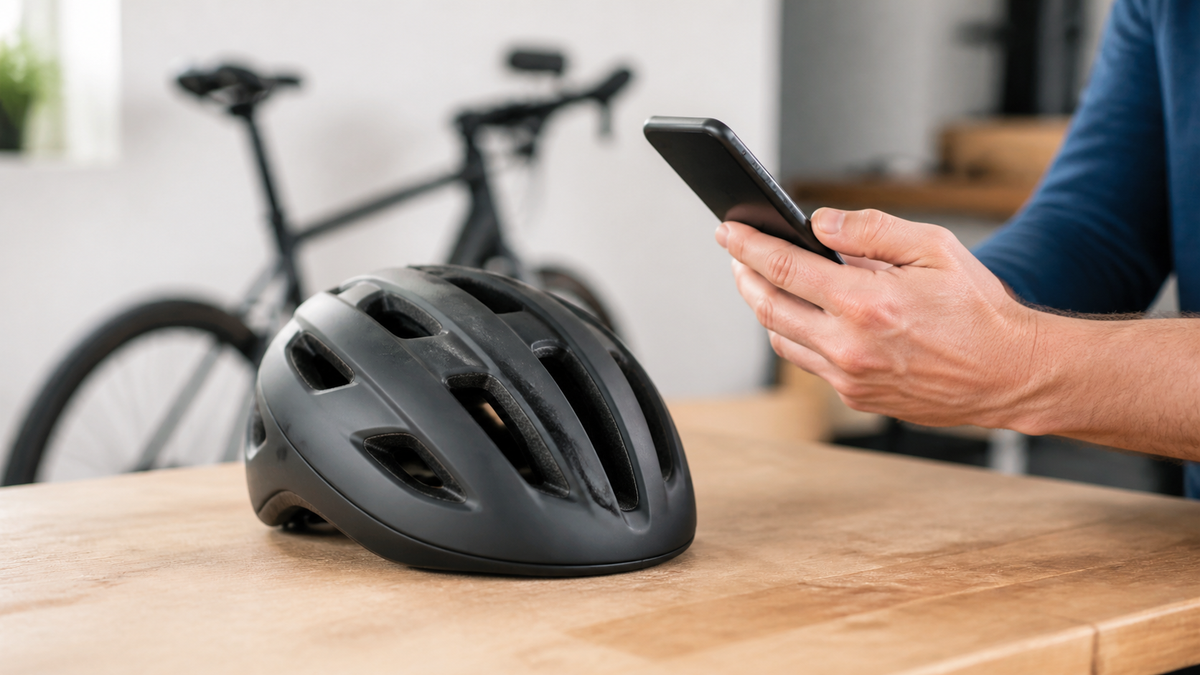
After a fall, the first thing people often look for is scratches and scuffs. However, a smooth outer shell on a bicycle helmet is not sufficient proof of safety. The impact-absorbing structure may have absorbed impact energy without a clear crack appearing on the outside. Manufacturers such as uvex therefore require replacement after a fall or impact. This guide explains how to take a bicycle helmet out of service after a fall, document it, and replace it with a suitable new helmet.
Take care of people first, not equipment
Secure the accident scene without putting yourself at risk, and check consciousness and breathing. If the person is unconscious, not breathing normally, seriously injured, or in immediate danger, call 112 and follow the dispatcher's instructions. The German Red Cross provides up-to-date first-aid procedures for this purpose. Inspecting the helmet must not delay necessary medical assistance.
Whether and how a helmet should be removed from an injured person depends on their condition and the first aid required. Act according to your training and the instructions of the emergency medical dispatch center. This article is not medical guidance; it begins with the equipment decision once the person has been cared for.
Do not use again after an impact while worn
If the helmet was on your head during the fall and hit the ground, a vehicle, or an object, do not put it back on for a test ride. uvex explains that a helmet must always be replaced after a fall or impact because forces acting on the head may have been absorbed and the protective function may be impaired in another impact. This explicitly applies even if there is no visible damage.
A strong impact to a worn helmet, even without a typical bicycle crash, counts as an impact event. Immediately mark the helmet as discarded and store it separately from usable equipment. Children, roommates, or colleagues should not accidentally use it again.
Decision table by event
| Event or finding | Classification | Safe decision |
|---|---|---|
| A worn helmet hits the ground in a fall or accident | Impact energy may have been absorbed | Discard and replace |
| Crack, dent, soft spot, or detached shell | Visible structural or composite damage | Do not wear it again |
| Strap torn, frayed, or detached from the anchor point | Retention system not reliable | Ask the manufacturer or replace the helmet |
| Helmet falls empty from a shelf | Not automatically identical to an impact with a head inside. | Review the event and the instructions; if in doubt, ask the manufacturer. |
| Unknown history when buying used. | Previous impact cannot be verified. | Do not rely on appearance alone for protective use. |
A visual inspection documents damage; it does not clear the helmet for use.
- Photograph the helmet from the front, back, both sides, inside, and at the suspected impact point.
- Check the outer shell and edge for cracks, dents, abrasion, deformation, and separation.
- In good lighting, inspect the impact-absorbing liner for fracture lines, indented areas, or unusually soft areas.
- Check the straps, anchor points, buckle, and adjustment system for cracks, pull-out, and blocked operation.
- Record the model, size, date of manufacture or start of use, date of the accident, and a brief description of the event.
- Set the helmet aside and clarify the manufacturer’s, retailer’s, or insurer’s process before rendering it unusable.
The inspection provides evidence for advice, a complaint, or a damage report. It cannot confirm an invisible material condition. Even if you find no dent and the buckle still closes, the manufacturer’s rule following an impact while worn remains decisive.
Why small external marks can be misleading
A bicycle helmet distributes and absorbs forces through its shell, impact-absorbing material, fit, and retention system. The material may deform locally in the process. The outer shell may spring back or conceal fine damage. A second impact may hit material that has already been stressed. That is precisely why “it still looks good” is not a reliable clearance for use.
Do not try to test the protective performance by pressing, bending, tapping, or applying weight. Such home tests are neither standardized nor proven to be nondestructive. A workshop can identify visible damage, but even it cannot guarantee that a structure that has already been subjected to impact is sound without the manufacturer’s specified procedure.

What applies if the helmet falls without a head inside?
An empty helmet falling from a low shelf experiences different mass and loading conditions than a worn helmet in an accident. Nevertheless, this does not constitute general clearance for use: the height, surface, edge struck, additional objects, and helmet design differ. Check the user information from the specific manufacturer and describe the event precisely.
A helmet must not be worn if it has a crack, dent, detached shell, damaged strap, or signs of an unclear severe impact. If its condition remains unclear, send photos and model details to the manufacturer or a specialist retailer. A blanket statement that “a fall from a table is always harmless” would be just as unsubstantiated as claiming that every minor empty fall is equivalent to an accident involving head impact.
Do not glue, heat, or repaint
Adhesive, solvents, paint, and intense heat can damage the shell or impact-absorbing material. Do not glue a crack shut or reshape a dent with a hair dryer or hot water. Replace safety-relevant straps, buckles, or adjustment systems only if the manufacturer offers an approved original part and clear instructions for doing so.
Removable comfort pads are not equivalent to the load-bearing impact-absorbing structure. New pads do not make a helmet that has sustained an impact safe again. Clean a helmet that has been taken out of service only if a retailer or insurer requires it; it must not thereby return to use.
Proof for retailers, manufacturers, and insurers
Keep the proof of purchase, model designation, and photos. Note the location, date, course of the accident, and whether the helmet touched the ground or an object. Some manufacturers or retailers offer a voluntary replacement solution, and some insurers require proof before disposal. Conditions, deadlines, and eligibility are provider-specific; do not assume that you will automatically receive a free replacement.
Only share serial or policy numbers through designated private channels. If another road user was involved, document the helmet as a potentially damaged item without preempting any medical or legal assessment. In disputes over claims, an objective incident record is more useful than a shell altered after the fact.
Choosing a replacement helmet: three checks instead of relying on the brand
The new helmet must be intended for the planned activity, fit your head size and shape, and be adjusted according to its instructions. Try on several models. It should sit level, not shift easily when fastened, and neither press uncomfortably nor obstruct your vision or movement. The article How to adjust a bicycle helmet correctly guides you through sizing, positioning, and straps.
Check the labeling, user information, and production date of the specific product. Replacement intervals vary by manufacturer and use. uvex and ABUS specify certain periods for their own products, which do not automatically apply to every brand. The decisive factors are your helmet’s instructions, aging, care, and visible damage.
Clearly take the old helmet out of service
First clarify whether the manufacturer, retailer, or insurer wants to inspect the helmet in its unchanged condition. Then make it unusable so that no one accidentally wears it again, for example by cutting through the straps after completing all required documentation. Remove personal contact details or registered sensors according to the instructions.
Disposal depends on the material mix and municipal regulations. Ask your local recycling center or waste disposal service instead of automatically assigning the helmet to a plastics recycling stream. Electronic attachments, lights, or sensors may require separate return channels.
Frequently asked questions about bicycle helmets after a crash
Does a bicycle helmet have to be replaced after every impact sustained while wearing it?
Follow your manufacturer's instructions. uvex always requires replacement after a fall or impact, even when there is no visible damage. This conservative rule prevents an already stressed impact-absorbing structure from being used again.
Can a specialist retailer clear my helmet for use?
A specialist retailer can check for visible damage and review the manufacturer's options. However, a visual inspection alone does not prove that the internal structure remains unchanged. Continued use depends on the manufacturer's explicit instructions.
Is it enough to replace only the damaged pad?
No, if the helmet has experienced an impact. Comfort pads primarily determine fit and wearing comfort. They replace neither the outer shell nor the impact-absorbing structure, and they do not restore their protective function.
Should I buy a used helmet?
If the helmet's history is unknown, you cannot reliably rule out previous impacts, improper storage, or aging. For personal protective equipment, a demonstrably new helmet in the right size and with the relevant documentation is the more reliable choice.
Conclusion: discard after an impact; don't judge it by its appearance
A bicycle helmet that has been worn in a crash is not cleared for further use merely because its surface is free of scratches. First attend to anyone who is injured, remove the helmet from service, and document the incident, model, and condition. Visible damage confirms that the helmet must be discarded; the absence of visible damage does not disprove that it was subjected to an impact. Clarify the required documentation and replacement with the manufacturer or retailer, and carefully adjust the new helmet.
As of September 6, 2026. Replacement, service life, spare parts, cleaning, and disposal are governed by the current user information for the specific helmet and local requirements.
Share:
E-bike charger gets hot: how to assess the heat safely
Bicycle Brake Pads Worn Out: How to Safely Recognize Wear