

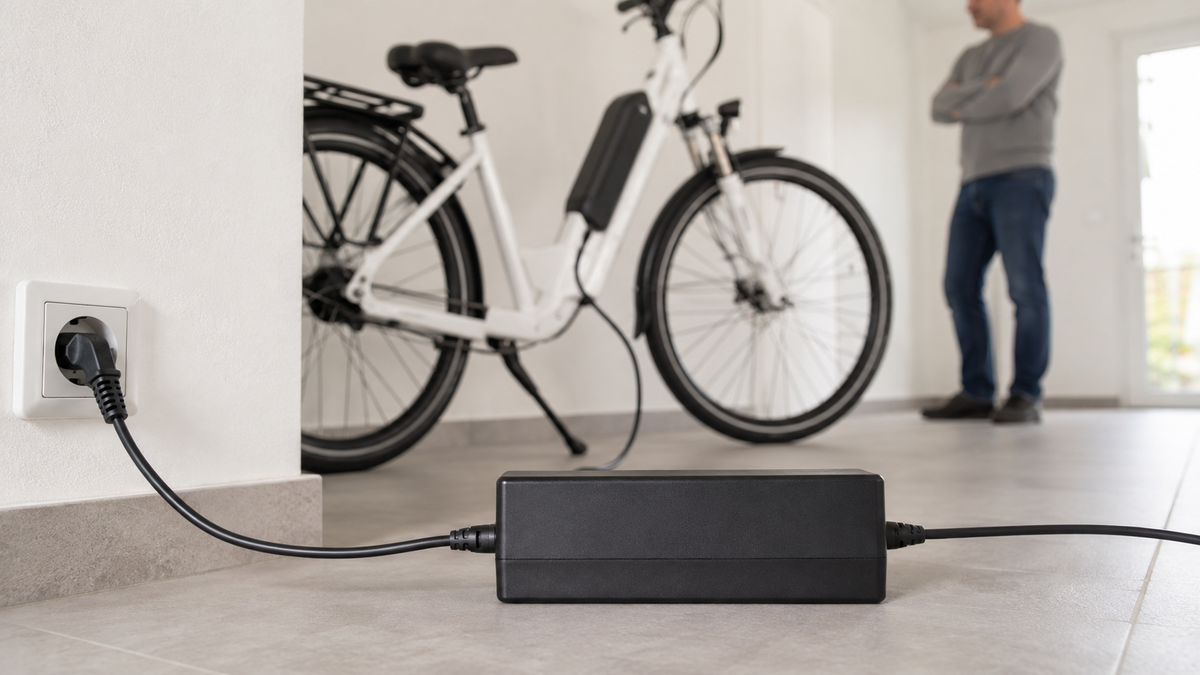
An e-bike charger giving off heat while charging may be intended for some systems. However, “very hot” is a subjective impression and not a reliable measurement. What matters is the manual for the specific charger, the surroundings, and any accompanying warning signs. If the e-bike charger becomes hot, do not open it or test it with an incompatible battery. This guide distinguishes normal heat generation from situations in which charging must stop immediately.
Smoke, smell, or deformation: keep your distance instead of diagnosing
If there is smoke, hissing, a pungent smell, sparks, leaking fluid, melted plastic, significant deformation, or unusually intense heating, stop using the device. Disconnect it from the mains only if this can be done safely without approaching smoke, heat, or damaged parts. Warn others, move away, and call 112 in the event of an immediate fire or smoke hazard. Do not move a suspicious battery or hot charger yourself.
A damaged cable, loose mains plug, scorched socket, or damp connection also means you must stop. In its system documentation, Shimano requires regular inspection of the cable, plug, and housing and prohibits continued use of damaged chargers or adapters until they have been repaired. A second charging attempt is not troubleshooting here.
Warm may be normal—but only in the system described
A current Shimano STEPS user manual states that a charger may become warm after charging several batteries continuously and should cool down before being used again. The same troubleshooting table treats a battery and charger becoming hot as a possible indication that the operating temperature has been exceeded: stop charging, wait, and only charge again as instructed. This is a system-specific statement, not a blanket approval for every power supply.
Do not assess heat by holding the device for a long time. The housing shape, material, and measuring point affect how it feels. Do not invent a temperature limit or stick a household thermometer onto ventilation openings. If your manual does not provide a clear assessment, or if the heat has increased significantly compared with before, keep the device out of operation until the dealer or manufacturer has clarified the finding.
Quick assessment without touching
| Observation | Assessment | Safest next step |
|---|---|---|
| Housing becomes evenly warm, with no other abnormalities | May be normal during operation in an approved system | Check the manual and allow it to cool down in a well-ventilated place |
| Temperature suddenly increases sharply | Deviation from previous behavior | Safely end the charging process and contact service |
| Plug or socket discolored, loose or smells burnt | Possible electrical contact fault | Do not continue using; have it inspected by a qualified professional |
| Battery and charger become hot | Possible operating-range exceedance or defect | Stop, keep your distance, follow the manufacturer's instructions |
| Smoke, hissing, liquid or deformation | Acute danger possible | Keep your distance; call 112 in case of fire or smoke |
Before the next normal charging process
- Identify the battery, charger and any required adapter by their model designations.
- Confirm in the current original manual that this exact combination is approved.
- With the power plug disconnected, inspect the housing, cable and plug externally for damage, moisture and contamination only.
- Select the prescribed dry charging location and place the charger level and unobstructed so that it is not covered or knocked over.
- Bring the battery and charger into the permitted temperature range without active heating or cooling.
- Connect everything in the order specified in the system instructions and observe the LED, noise and heat development from a safe distance.
- Stop the attempt at any new irregularity and document the time and circumstances.
The right charger is not just a matter of the plug
The battery, charger and adapter must be electrically and software-compatible. Shimano requires the specified combination and prescribed charging conditions for its system; otherwise, the battery may overheat, burst or catch fire. A mechanically compatible plug does not prove approval. A device with a similar output voltage is not a safe replacement either.
Do not use a universal power supply or an adapter from an unknown source. Do not open the charger or replace a cable if it is permanently attached to the device. For a replacement, provide the dealer with the model numbers of the battery, charger and bicycle. Only transmit serial numbers through a private support channel.
Charging location, air and surface
The specific instructions determine the charging location. In the manual reviewed, Shimano requires a level surface and warns against high humidity or charging outdoors. A battery mounted on the bicycle requires the bike to be parked securely so that no one trips over the cable and the bicycle does not fall over. The charging port and plug must be dry.

Do not cover the charger with clothing, a bag, or a blanket, and do not place it between cushions. Keep the designated ventilation areas clear. Direct sunlight, a hot car, and radiators are unsuitable. Do not charge in an escape route. Refer to the device manual rather than a general recommendation to determine whether a particular wall mount or surface is permitted.
Observe the charger, battery, and outlet separately
Note which part is getting warm. If only the charger heats up evenly, without any smell, noise, or interruption in performance, this may be part of normal operation. If the battery becomes unusually hot, deforms, or develops an unusual smell, it is time to have it inspected by a service provider. For a battery that is too hot to touch, Shimano points to a possible battery problem. This is a warning description, not an invitation to perform a touch test.
If the heat is concentrated at the power plug or outlet, the cause may lie outside the e-bike system. Discoloration, a loose fit, crackling, or a burning smell require an electrician. Do not continue using this outlet. Power strips, extension cords, or timers should be used only if the device and electrical installation are suitable and the system manufacturer has not excluded them.
What applies after several consecutive charging cycles
Anyone who charges several batteries in succession increases the charger's operating time. The Shimano manual cites continuous charging as a possible cause of heating and recommends waiting before using it again. The length of this pause cannot be defined across manufacturers. Wait at least as long as the instructions require, and do not start while the device or surroundings appear unusual.
A fan, cold pack, or cold floor is not an intended repair. Condensation and localized temperature differences can create additional problems. If a charger only works with improvised cooling, take it out of service.
Heat or charging error?
If charging stops, an LED flashes, or it remains off, document the pattern precisely without transferring a code from another system. Check only the external points permitted by your manual. The article E-bike battery not charging covers safely disconnecting the power outlet, connection, temperature, and a possible system fault.
Repeated interruptions combined with unusual heat are a stronger reason to contact service than a one-time occurrence after an unfavorable ambient temperature. Send the retailer the model, approximate state of charge, surroundings, charging time until the issue occurred, and LED behavior. Do not package or ship a potentially damaged battery without prior instructions; lithium-ion batteries are subject to special transport regulations.
What you should never attempt
- Open, drill into, solder, or bridge the charger or battery.
- Test a third-party charger solely because it has a compatible plug.
- Place hot parts in water, cool them with spray, or carry them in a closed container.
- Continue using damaged cables with tape as a permanent repair.
- “Test” a suspicious outlet by pressing the plug in firmly or plugging it in repeatedly.
- Confirm odor, smoke, or deformation by charging it fully again.
Frequently asked questions about hot e-bike chargers
May an e-bike charger get warm?
For some approved systems, yes. Shimano describes heating after continuous use as possible. Whether your device is operating normally in this condition is determined by its instructions and the absence of other warning signs.
How hot is too hot?
There is no safe universal value for all housings and systems. Use the manufacturer's limit if one is specified. Significantly changed behavior, heat at the battery or outlet, as well as odor, noise, smoke, and deformation are reasons to stop.
Should I put the charger in the refrigerator to cool it down?
No. Condensation and unsuitable temperatures can cause damage. Disconnect it only if it is safe to do so, let it cool on a designated clear surface, and follow the instructions.
Can I compare it with another charger?
Only if the manufacturer explicitly approves this exact combination. A compatible plug or the same rated specification is not enough. A workshop can separate the battery and charger using suitable test equipment.
Conclusion: Document deviations and take warning signs seriously
A warm e-bike charger may be normal for a particular system; unusual heat is not automatically normal. Check compatibility, charging location, cable, and surroundings without touching or opening the device. If there is a sudden change, stop the attempt and provide the service team with precise details. In the event of smoke, odor, deformation, or liquid, keep your distance and focus on hazard prevention rather than further diagnosis.
As of September 6, 2026. Permitted combinations, temperature ranges, LED meanings, charging location, and waiting time are governed by the current instructions for the specific battery and charger system.
Share:
Bicycle helmet after a crash: inspect, retire, replace
Bicycle Brake Pads Worn Out: How to Safely Recognize Wear