

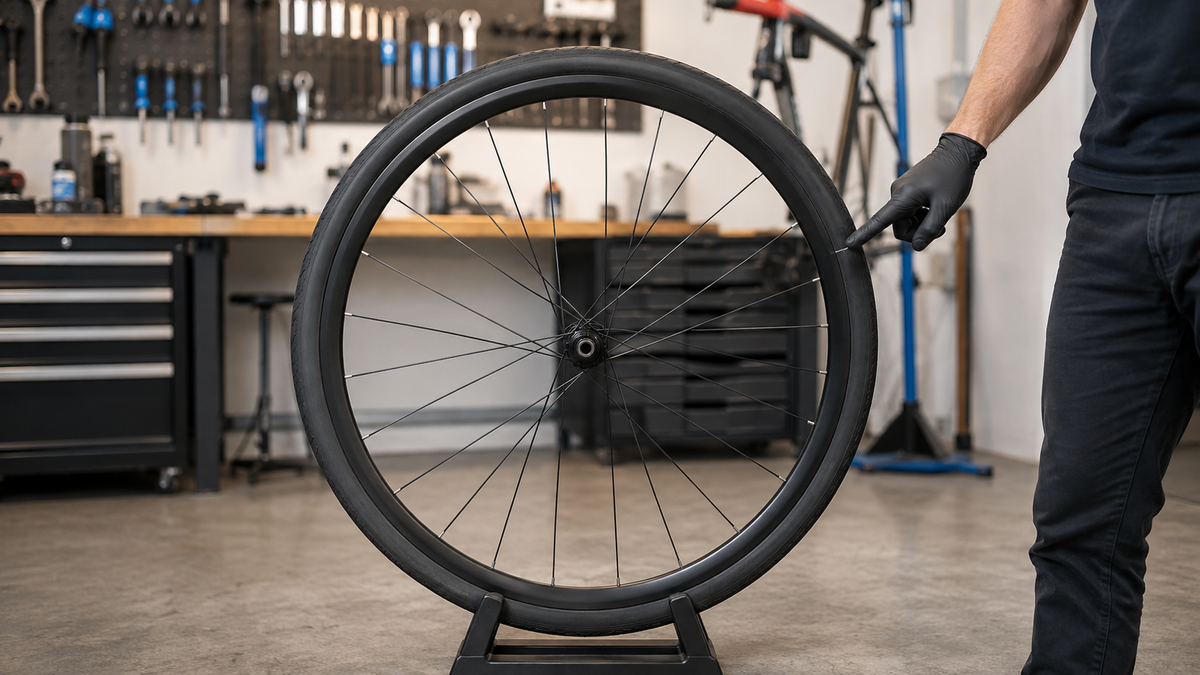
A bright streak, a deep cut, or a noticeable bulge on the tire sidewall raises the same question: Can I still ride it? The safe answer depends not only on the length or appearance of the damage. What matters is whether only the outer rubber layer is affected or whether the load-bearing carcass may have lost its shape and strength. If in doubt, do not put any load on it; have the tire and wheel inspected by a qualified professional.
Why the sidewall is safety-relevant
The sidewall is not merely weather protection. Beneath the rubber is the carcass, the tire’s textile framework. It connects the tread and bead, maintains the tire’s shape under air pressure, and transfers forces between the road and the rim. The Schwalbe overview of tire construction describes the carcass, bead core, and tread as the basic elements of a bicycle tire.
If the fabric is cut, overstretched, or separated from the rubber, the remaining load-bearing capacity cannot be reliably calculated from the outside. The damage may become larger under pressure and changing loads. A sudden loss of pressure is particularly risky when cornering, braking, or carrying luggage. An apparently normal pressure test while stationary is therefore not clearance to ride.
The immediate decision: these signs mean stop riding
- A bulge or localized protrusion changes the round contour of the sidewall.
- A cut gapes open, reaches visible threads, or exposes the fabric.
- The tire loses air, sits unevenly, or visibly separates into layers.
- The bead near the rim is torn, deformed, or has moved out of its seat.
- After an impact, the rim, inner tube, or wheel is also damaged.
If you find any of these conditions, get off the bike. Switch off the e-bike drive, park the bike securely, and arrange to walk it, have it collected, or transport it. Do not inflate a damaged tire to maximum pressure as a test, and do not press on a bulge. Keeping your face and hands away is sensible if the tire is still pressurized.
A crack, cut, and bulge are not the same
Cracks can have many causes. The Schwalbe guide to tire wear shows a few larger fatigue cracks as a typical result of persistently low air pressure, while small cracks distributed across the sidewall may indicate aging. This helps investigate the cause but does not replace an assessment of the specific tire. The transitions are gradual, and a photo does not show how deep a crack extends.
Cuts are often caused by sharp edges, broken glass, stones, contact with components, or incorrect installation tools. A superficial scratch in the rubber may need to be assessed differently from an open cut in the carcass. As soon as fibers are visible, separated, or bulging, the tire must be taken out of service. The inside must also be inspected.
Bulges should be taken particularly seriously. A localized protrusion may indicate that the carcass threads have given way, that the inner tube is sitting incorrectly, or that the tire is not seated correctly on the rim. Without deflating and removing the tire, the cause cannot be determined reliably. Continuing to ride with a bulge or increasing the pressure is therefore not a sensible test.
What you can safely check on the road
- Stop away from traffic and prevent the bicycle from tipping over.
- Remember whether the damage appeared after an impact, puncture, transport, or gradually.
- Inspect the entire sidewall on both sides, as well as the tread, bead, and rim edge.
- Without inflating further, check whether air is escaping or the contour is uneven.
- Photograph the area without load, both up close and from a distance, for the dealer or workshop.
Turn a lifted wheel slowly by hand and only if this can be done safely. Keep fingers and clothing away from the spokes, brake disc, and drivetrain. A thumb test, the sound when tapping, or measuring the size with a coin provides no reliable limit for the remaining strength.

Why sidewall patches are not a universal solution
A small puncture in the tread and carcass damage on the sidewall are different problems. According to the Schwalbe puncture protection FAQ, sealant can seal small punctures; larger damage such as cuts or so-called snake bites cannot be repaired with it. Stopping the air loss also does not prove that the load-bearing structure is intact.
A tire boot, patch, or inserted material may be intended as a temporary puncture measure in certain systems. Whether this is permitted for your tire is determined by the manufacturer’s instructions, the damage, and the system comprising the tire, inner tube, or tubeless setup. This article does not authorize riding in such cases. Visible carcass damage and bulges indicate replacement rather than experimentation.
Have the rim and rim tape inspected as well
Sidewall damage may be accompanied by a pothole impact, a sharp rim edge, a pinched inner tube, or damaged rim tape. Installing only a new tire without looking for the cause can lead to the next defect. Have the rim flange, rim bed, rim tape, inner tube, valve area, wheel seating, and sufficient clearance from the mudguard or frame inspected.
The Continental installation and care instructions require undamaged, evenly seated rim tape, an inner tube installed without folds, and an even distance between the tire wear indicator ring and the rim flange. They also warn against damaging foreign objects and sharp areas. After sidewall damage, these points are part of a complete inspection.
Low air pressure can overload the sidewall
Persistently low pressure causes the tire to flex more. This can fatigue the sidewall and produce typical abrasion or crack marks. Nevertheless, you must not infer a definitive diagnosis from a crack pattern alone: age, load, surface, tire construction, heat, storage, and mechanical contact may also play a role.
After replacing the tire, set the pressure with a pressure gauge within the limits of the tire and rim. There is no universal bar value. The Schwalbe air pressure information identifies tire width, weight load, luggage, and desired riding characteristics as factors. Minimum and maximum limits and the manufacturer’s instructions must not be exceeded or disregarded.
How to prepare for tire replacement
Record the complete size specification, tire type, rim designation, and the approvals from the bicycle and wheel manufacturers. For an e-bike, also consider the permissible total weight and, where applicable, the tire’s stated e-bike approval. This does not result in a blanket product recommendation; what matters is a demonstrably compatible combination.
During installation, have the wheel and axle checked for correct seating, make sure the tire runs true, and ensure that the brake is clear. After work on the wheel, perform a stationary brake test and a short, controlled test ride in an area with little traffic. If a bulge, imbalance, scuffing, or pressure loss occurs again, stop riding immediately.
Frequently asked questions
Can I continue riding with small cracks in the sidewall?
Size alone is not enough to approve continued use. Fine, distributed cracks may develop differently from deep, isolated fatigue cracks, but the depth and condition of the carcass remain uncertain from the outside. Have the tire inspected according to the manufacturer’s criteria before applying any further load.
Can I glue a sidewall cut?
A glued area does not automatically restore the original carcass strength. If there is an open cut, visible fibers, a bulge, or air loss, replacement is the safe decision. For system-specific puncture measures, only the manufacturer’s approval applies.
Could a bulge simply be caused by an incorrectly seated inner tube?
That is possible, but not certain. Carcass damage or an incorrectly seated tire can also change the contour. Deflate the wheel and have the tire, inner tube, bead, and rim inspected instead of continuing to inflate the area.
Does the inner tube also need to be replaced after sidewall damage?
That depends on the system and its condition. The inner tube may be pinched, cut, or overstretched even if it still holds air. The workshop and the manufacturer’s instructions determine which parts need to be replaced after inspection.
Conclusion
A damaged tire sidewall is not something to take a chance on. A bulge, open cut, visible carcass threads, bead damage, or air loss means stop riding. Unclear cracks also require inspection because the external appearance does not reveal the remaining strength. If the tire is replaced, the rim, rim tape, inner tube, seating, and pressure setting should be included in the same inspection. This way, the next ride is based on an intact system rather than a provisional assumption.
Updated: September 6, 2026. The instructions and approvals of the tire, rim, and bicycle manufacturers, as well as an inspection by a qualified specialist workshop, are authoritative.
Share:
Headset loose? Check your bike for play safely
Crossing tram tracks by bicycle: angle, wet conditions, and a safe line