

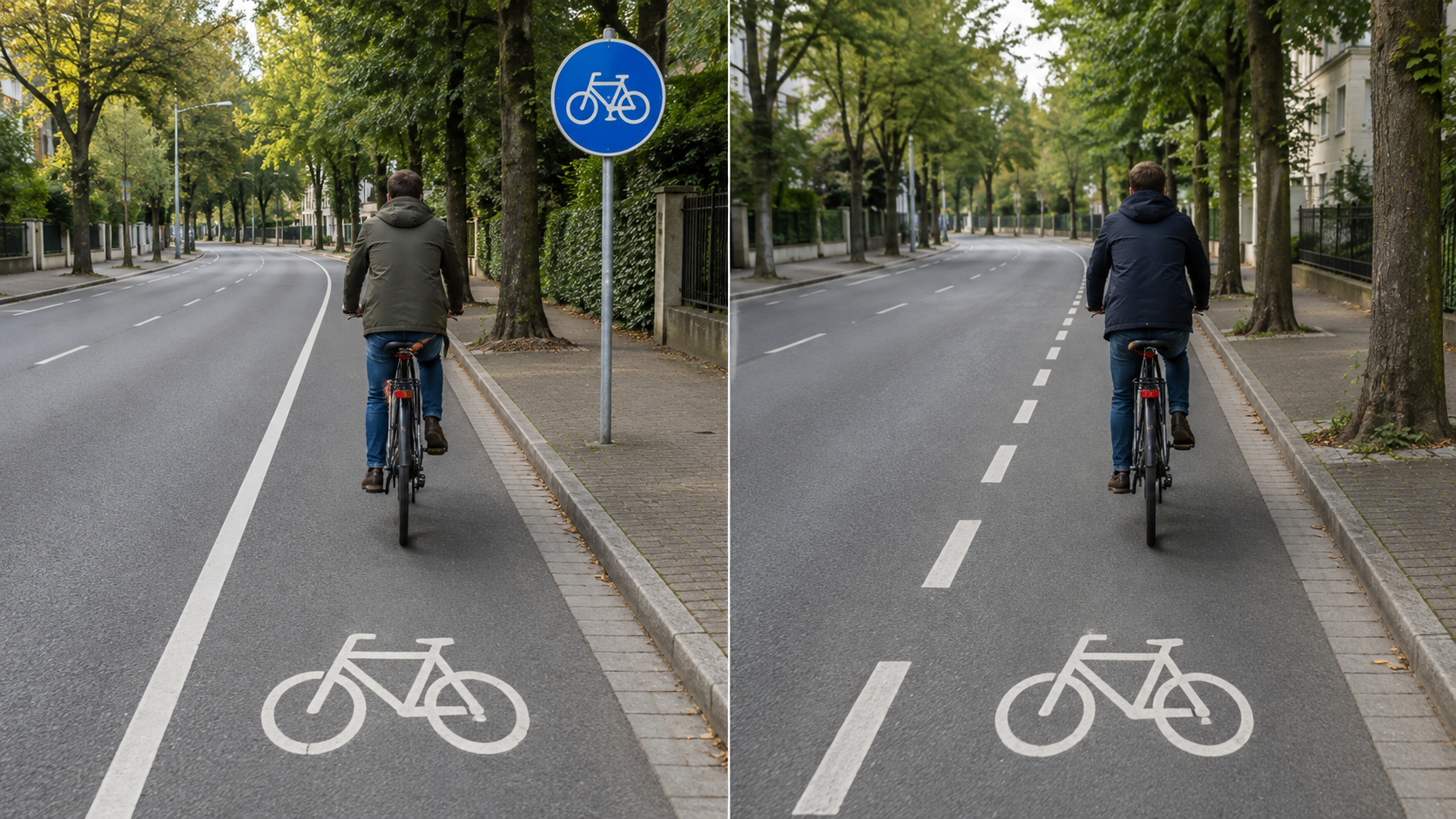
Cycle lanes and advisory cycle lanes are often located directly next to each other in urban traffic and look similar at first glance. Legally, however, they are not the same. What matters is the line, the signage and whether the area is a separate facility or part of the carriageway. Recognizing these features helps you better assess your position on the road and avoid typical conflicts when overtaking, turning and stopping.
The short answer
A cycle lane is generally separated from the carriageway by a solid line and marked with sign 237 as a cycle path. An advisory cycle lane remains part of the carriageway; it is marked by a broken guide line and recurring bicycle symbols. Motor vehicles may cross an advisory cycle lane only when necessary and must not endanger cyclists in doing so. As a general rule, stopping is not permitted on an advisory cycle lane.
How to recognize both types
| Feature | Cycle lane | Advisory cycle lane |
|---|---|---|
| Line | Solid, sign 295 | Broken, sign 340 |
| Legal classification | Separate facility for cyclists | Marked part of the carriageway |
| Marking | Typically sign 237 plus bicycle symbols | Bicycle symbols at regular intervals |
| Use by motor vehicles | Not a normal traffic lane; crossing permitted only in regulated exceptional cases | Only when necessary and without endangering cyclists |
| Stopping | No stopping or parking space for motor vehicles | Stopping is prohibited, and therefore parking is prohibited as well |
Color alone is not decisive. Red or green surfacing can increase visibility, but it does not replace traffic signs or markings. A single bicycle pictogram does not by itself turn an arbitrary area into a mandatory cycle path. Therefore, always consider the overall picture of the sign, line and direction of travel. The same applies to short marked sections before an intersection.
When must the cycle lane be used?
Under Section 2(4) of the German Road Traffic Regulations (StVO), use of a cycle path is mandatory only when this is ordered by sign 237, 240 or 241. On a typical cycle lane, sign 237 is used; cyclists must then travel in the designated direction on the lane. Other vehicles may not simply drive over the solid boundary line as if it were an additional lane. Annex 2 to the StVO specifies only narrowly defined crossings, for example to access driveways or parking spaces that cannot otherwise be reached, without endangering or obstructing the separate facility.
If the route is genuinely unusable, you should not suddenly move into flowing traffic. Reduce your speed, check traffic behind you and change lanes only in a controlled manner. Whether a specific obstruction removes the obligation to use the facility depends on the individual circumstances. Convenience, a slower cyclist or a brief detour do not constitute a blanket exception.
What applies on an advisory cycle lane?
The rules for sign 340 are set out in Annex 3 to the StVO. Drivers of other vehicles may cross the advisory cycle lane marked by guide lines only when necessary, particularly to avoid oncoming traffic. No one may be endangered while cycling. The phrase “when necessary” is not permission to use the lane permanently as a normal car lane.

For cyclists, the broken line likewise does not guarantee a protected area. At side roads, expect turning vehicles, and beside parking spaces, watch for opening doors. Ride predictably and maintain an appropriate distance from obstacles. The keep-right rule does not require you to ride in the gutter or directly alongside parked cars. An advisory cycle lane is also not an invitation to squeeze past moving traffic on the right.
Markings at intersections and side roads
A cycle marking may end before an intersection, continue in an offset position or cross the side road as a cycle crossing. This alone does not establish a general right of way. Pay attention to traffic lights, priority signs and turning vehicles. Do not automatically continue straight ahead just because the surface is colored. The blind spot remains dangerous, especially beside large vehicles; do not remain directly alongside the cab or trailer for any length of time. If you cannot tell for sure whether a driver has seen you, reduce your speed and create more space.
The lateral clearance requirement still applies
A line does not replace a safe overtaking distance. Section 5(4) of the StVO requires motor vehicles overtaking cyclists to maintain at least 1.5 meters of clearance in built-up areas and at least 2 meters outside built-up areas. This applies directly on the carriageway and therefore also at an advisory cycle lane. A cycle lane, by contrast, is a separate facility; the required safe distance there does not follow directly from the numerical rule in Section 5, but from the duty of consideration and prohibition of endangerment in Section 1 of the StVO. ADFC and ADAC likewise use 1.5 and 2 meters respectively as safety benchmarks for this situation. If there is not enough safe space, the motor vehicle must remain behind the bicycle rather than squeezing past it.
These distances concern overtaking by motor vehicles. For the cyclist, maintaining a personal safety margin remains important: keep clear of the curb, drains, bollards and doors, maintain a controllable line and leave enough room for small evasive movements. A marking justifies neither close overtaking nor dangerous evasive action.
How to read four situations correctly
- Solid line and blue cycle-path sign: Use the cycle lane in the direction of travel, provided it is genuinely usable. Motor vehicles may not use it as a regular lane.
- Broken line with bicycle symbols: This is typically an advisory cycle lane. Motor vehicles may cross it only when genuinely necessary and without endangering cyclists.
- Delivery van on the marking: Do not move blindly into the traffic lane. Slow down, check over your shoulder, signal with your hand and wait for a safe gap; if the situation is unclear, stop.
- Turning vehicle crosses your route: Eye contact is no substitute for being ready to brake. Choose a speed that allows you to react to a bicycle or car that has been overlooked.
Frequently asked questions
May cars drive on an advisory cycle lane?
Only when necessary and only if cyclists are not endangered. Permanent use as an additional traffic lane is not covered by this exception.
Is every marked cycling area mandatory to use?
No. Section 2 of the StVO links the obligation to use a cycle facility to signs 237, 240 or 241. An advisory cycle lane with sign 340 is not such a cycle-path sign.
May you stop briefly on an advisory cycle lane?
No. Annex 3 to the StVO prohibits stopping there; bicycles and electric mobility scooters are exempt to the extent specified there.
Is the broken or solid line itself sufficient clearance when overtaking?
No. The numerical rule in Section 5 applies directly at an advisory cycle lane. Beside a cycle lane operated as a separate facility, Section 1 likewise requires sufficient clearance without endangering anyone; the line alone is never the measure.
As of: September 5, 2026. This article explains general rules for Germany and does not replace legal advice. Local signs, temporary traffic arrangements and police instructions take precedence.


Share:
Headphones and smartphones while cycling: What is permitted
Oil your bicycle chain: apply precisely and protect the brakes