

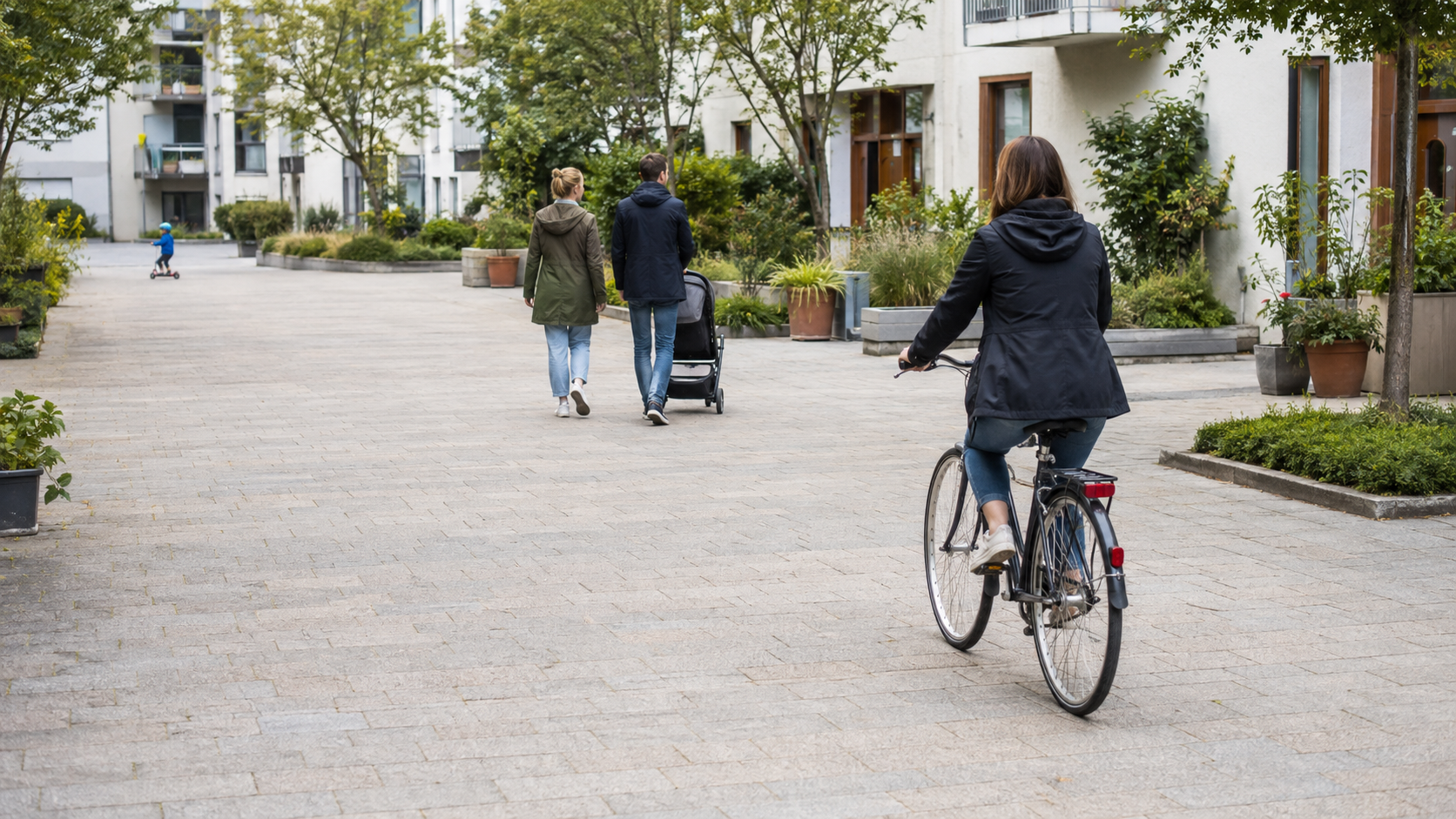
A traffic-calmed area is often called a “play street” in everyday language. Legally, however, these are two different things. Anyone entering the blue-marked area by bicycle must travel at walking pace, give pedestrians particular protection, and observe an important right-of-way rule when exiting. A genuine play street, on the other hand, is closed to vehicles; bicycles must be walked there.
Traffic-calmed area: speed without a fixed number
Sign 325.1 marks the beginning of a traffic-calmed area. Under the rules in Annex 3 to the German Road Traffic Regulations, all vehicles must travel there at walking pace. This applies equally to cars, motorcycles, and bicycles. The wording of the law does not specify a uniform nationwide km/h value. Court interpretations are not identical in every case; a single figure such as 7 or 10 km/h is therefore not a general wording of the law.
For cyclists, the practical standard is clearer than any number: The speed must be low enough to react immediately to playing children, people crossing, or a driveway that suddenly opens. Anyone who has difficulty maintaining balance while riding extremely slowly may also dismount for better control. This does not change the fact that riding through quickly is not permitted.
What rules apply within the area?
Pedestrians may use the entire width of the road, and children may play anywhere. Drivers must neither endanger nor obstruct them and must wait if necessary. At the same time, pedestrians must not unnecessarily obstruct vehicle traffic. This is not a blanket rule that “everyone has exactly the same rights,” but a deliberately slow-speed area with different obligations.
Parking is generally permitted only in designated spaces. Exceptions are getting in or out, as well as loading or unloading. Anyone leaving their bicycle should also keep emergency access routes, building entrances, and maneuvering areas clear. The parking rule is no reason to leave the bike in the middle of a narrow passage.
Additional traffic signs, road markings, or a particular structural layout may also be relevant within the area. The color of the paving, play equipment, or wide spaces alone is not enough to determine right of way. Before an intersection, therefore, read the specific signs and layout instead of automatically assuming “priority to the right.”
Organize yourself in three phases: entry, area, exit
| Phase | What you pay attention to | Safe action |
|---|---|---|
| Entry | Begins beyond sign 325.1, people and play areas | Reduce your speed to walking pace before the sign |
| In the area | Pedestrian traffic across the entire width, children playing, driveways | Do not endanger or obstruct anyone; wait if necessary |
| Exit | End at Sign 325.2 and traffic on the other road | Under Section 10, rule out any danger and yield the right of way |
Slow down before entering. Anyone who brakes only after passing the sign brings unnecessary speed into this sensitive area. Within the area, it is advisable to maintain a steady line with a safe distance from doors, parked vehicles, and corners of buildings. Eye contact is helpful but not guaranteed; children are not required to correctly assess the intentions of someone riding.

Why “priority to the right” does not simply apply at the exit
The end is indicated by Sign 325.2. When exiting, Section 10 of the German Road Traffic Regulations applies: Anyone entering the road from a traffic-calmed area must do so in a way that rules out any danger to other road users. This particular duty of care means that you cannot invoke the general rule “priority to the right.”
For cyclists, this means braking in good time, checking both directions, taking pedestrians and cyclists on adjacent paths into account, and entering only a clearly identifiable safe gap. If the end sign is positioned slightly before the actual edge of the carriageway, the exit must still be assessed as one complete maneuver. A clear view in one direction is not enough.
Traffic-calmed area or genuine play street?
The colloquial term can easily lead to mistakes. A traffic-calmed area is marked by Sign 325.1 and may be used by vehicles at walking speed. In contrast, a play street in the strict sense is marked by Sign 250, “No vehicles of any kind,” together with an additional sign permitting children to play. The relevant sign system can be found in Annex 2 to the German Road Traffic Regulations and in the official traffic sign catalogue.
Sign 250 prohibits vehicle traffic but expressly permits bicycles to be pushed. In a genuine play street, you must therefore dismount and walk. An additional sign mounted below the main sign may specify exceptions; the specific combination of signs at the location is decisive. The term used on a map or in a property listing does not replace the signage.
Common mistakes when cycling in a residential neighborhood
- Braking too late: Walking speed applies from the beginning of the area, not only once children are visible.
- Ringing as a signal to clear the way: A warning signal does not establish priority; in confined spaces, wait.
- Relying on the paving: Color and material do not replace traffic signs.
- Treating the exit like a normal intersection: Section 10 requires eliminating any risk of danger.
- Understanding “play street” as a blanket term: Only the combination of signs shows whether cycling or walking the bicycle is permitted.
A short checklist for passing through
- Read all signs at the entrance, including supplementary signs.
- Reduce your speed to walking pace before entering.
- Expect people to use the entire area, including children at play.
- If there is not enough space, wait instead of passing closely.
- Park only in designated areas, unless you are briefly picking up or dropping off passengers or loading.
- When leaving under Section 10, yield safely to everyone else.
Handling encounters in confined spaces calmly
If a delivery vehicle, stroller, and playing children are all blocking the way at the same time, a narrow remaining gap is not automatically passable. Stop at a safe distance and wait until the situation is clear. A bicycle bell may warn of an identifiable danger, but it does not give you a right to pass. Someone must be able to step out at any time, especially around house corners and between parked vehicles.
Even when the road is clear, walking speed still applies. The rule does not depend on whether pedestrians are currently visible. This leaves enough time to react if a door opens, a ball rolls into the road, or a vehicle reverses out of a driveway. Predictable, calm riding is more important here than leaving the residential area as quickly as possible.
Frequently asked questions
How fast is walking speed?
The StVO does not specify a uniform numerical value for this. What matters is a very slow speed at which you can react and stop immediately. Individual values established by courts are not a statutory figure prescribed nationwide.
Are children allowed to play in the street in a traffic-calmed area?
Yes. The rules allow children to play anywhere there. Cyclists and other vehicle drivers must expect this and may not endanger or obstruct pedestrian traffic.
Do I have the right of way when exiting if I am coming from the right?
No. When exiting the traffic-calmed area, the special duty of care under Section 10 of the German Road Traffic Regulations (StVO) applies; there is no automatic right of way under the “priority to the right” rule.
Am I allowed to ride a bicycle in a genuine play street?
With sign 250, vehicle traffic is prohibited. The bicycle may be walked. Additional exceptions arise only from the complete signage on site.
As of September 5, 2026. The current signage and the specific traffic situation are decisive. This article does not replace legal advice in individual cases.
Share:
Bicycle in a roundabout: entering, circulating, and exiting
Bicycle Bell: Legal Requirement, Inspection, and Proper Warning Usage