

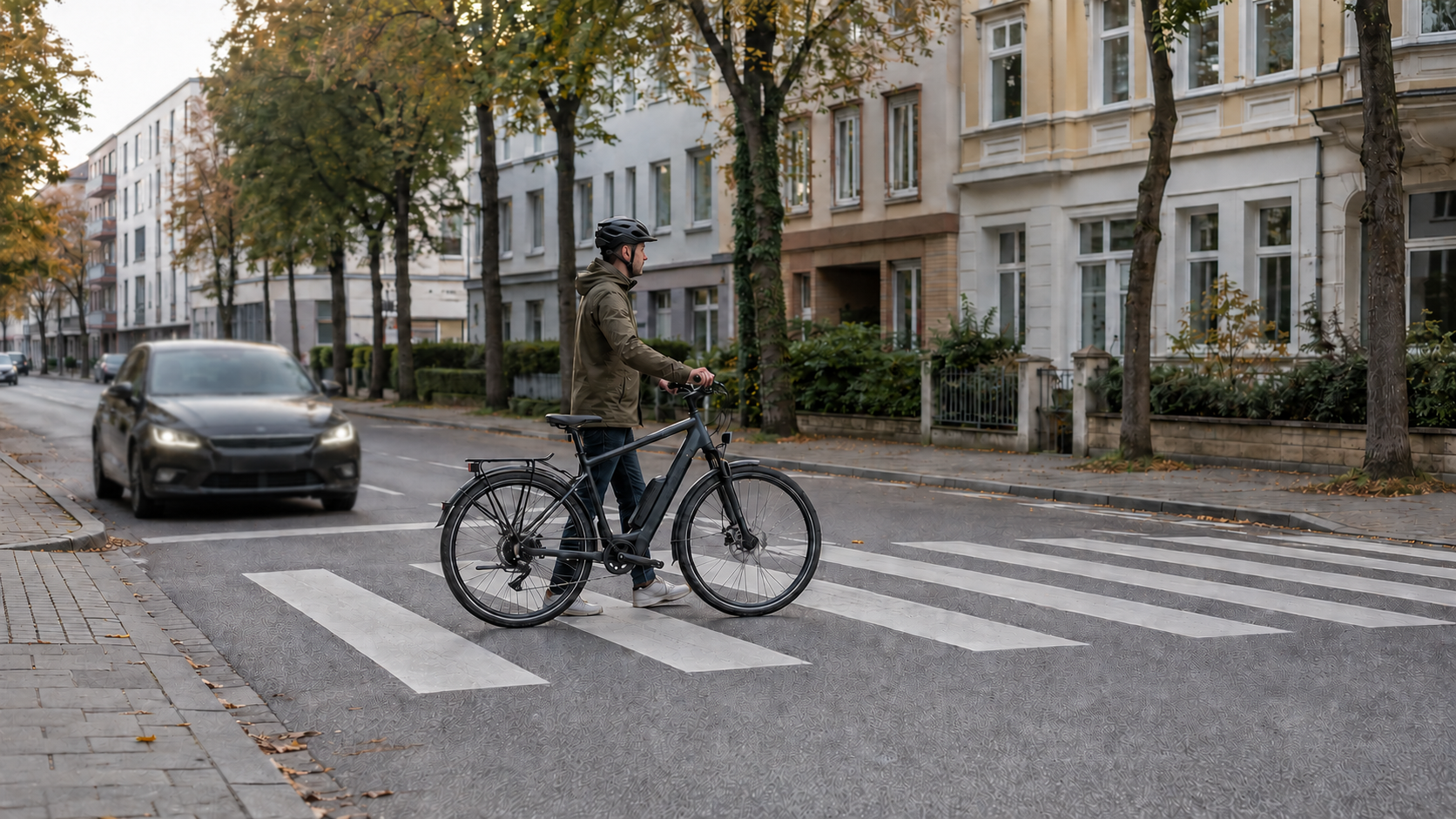
The zebra crossing itself does not prohibit crossing by bicycle. However, whether you are allowed to cross while riding from your route depends on the access, the traffic layout and any additional signs. The white stripes alone do not give you any special priority over crossing traffic. If you want to use the protection provided by the pedestrian crossing, dismount completely and push your bike.
What the zebra crossing actually protects
The official term is pedestrian crossing. Under Section 26 of the German Road Traffic Regulations (StVO), vehicles—with the exception of rail vehicles—must allow pedestrians and people using wheelchairs or mobility scooters to cross if they clearly intend to use the crossing. Vehicle drivers may then approach only at a moderate speed and must wait if necessary.
Anyone who is seated on and riding a bicycle does not belong to this protected group. The white stripes do not turn a bicycle crossing into a cycle crossing and do not, by themselves, give cyclists priority. Other traffic lights, priority signs or a separately routed cycle facility may also regulate the situation; these must be interpreted separately.
Riding or pushing: the crucial difference
| Situation | Legal status | What applies at the zebra crossing |
|---|---|---|
| You ride over the stripes while seated | Vehicle driver | The zebra crossing alone does not give you priority |
| You dismount completely and push your bike | Pedestrian | Vehicles must allow the clearly recognisable crossing |
| You are scooting with one foot on the pedal | Legally prone to unnecessary disputes | Do not treat it as a safe shortcut; it is better to dismount completely |
| A traffic light controls the crossing | The signal and traffic layout decide | Observe the traffic signal that applies to you |
The ADFC summarises the effect of the crossing as follows: The zebra crossing itself does not give cyclists priority; to receive protection as a pedestrian, you must dismount and push your bike. Whether you are allowed to enter it while riding also depends on the specific traffic layout. Dismounting completely also avoids the uncertain debate over whether “scooting” with one foot on a pedal still counts as riding or already as walking.
How to cross safely as a cyclist
- Reduce your speed early: Approach in such a way that you can stop before the carriageway without swerving onto the pavement or into crossing traffic.
- Read the traffic guidance: Check traffic lights, priority signs, cycle path markings, and possible obstructions to visibility. The zebra crossing alone does not give you priority while riding.
- Watch both directions: Also look out for turning vehicles, bicycles on a cycle path, and rail traffic. Rail vehicles are exempt from the obligation to wait under Section 26.
- Wait for a genuine gap: Proceed only when you can cross without causing others to brake or swerve. Eye contact is helpful, but it does not replace a clear traffic situation.
- Cross in a straight line and predictably: Avoid sudden changes of direction. Continue watching the traffic throughout the crossing.
If a car stops voluntarily, this is not a signal to set off blindly. On a multi-lane road, a vehicle may continue in the second lane; visibility may be restricted behind a van. Make sure that all relevant lanes are safe.
How to exercise priority when pushing a bicycle
Dismount completely in good time before reaching the edge of the carriageway. Stand beside the bicycle, keep it under control, and clearly indicate through your position and movement that you intend to use the crossing. Vehicles must allow you to cross, but you should not step onto the carriageway without warning. A quick safety check is essential, especially in wet conditions, darkness, and on roads with multiple lanes.
Push the bicycle briskly, without running. A heavy e-bike needs more space and can tip over when starting; therefore, hold it with both hands and choose a side that still allows you to see the traffic. When crossing, focus on controlling the bicycle safely, not on your smartphone.
Duties for car, motorcycle, and bicycle users
The obligation to wait under Section 26 applies to vehicles. This means that cyclists approaching a zebra crossing along the direction of travel must also let people pushing bicycles or other protected road users cross. If the markings run across a cycle path or another part of the road, the provisions apply accordingly. Ringing your bell, passing closely, or weaving through is not a permissible alternative to waiting.

You must not overtake at a pedestrian crossing. If traffic is backed up, a vehicle must not drive onto the marked stripes if it would have to wait there. These rules protect visibility and keep the crossing clear. If someone brakes unexpectedly because of a moving bicycle, this does not subsequently change the priority situation; what matters is whether crossing was begun safely and in accordance with the rules.
Special case: roundabout and parallel cycle path
If a zebra crossing is located at an entrance or exit of a roundabout, two questions must be distinguished. People walking their bicycles benefit from the protection of the pedestrian crossing. For cyclists who are riding, however, priority is determined not by the zebra crossing but by the specific cycle-path layout, priority signs and the turning situation. An adjacent cycle crossing may have its own markings or signs.
Therefore, do not rely on either the roundabout or the white stripes as a blanket justification. Reduce your speed, make eye contact and check which route actually has priority. If the layout is contradictory or visibility is obstructed, dismounting and walking your bicycle is the simplest safe decision.
Children and accompanying adults
Children under the age of eight must, and children under the age of ten may, use the sidewalk under the statutory conditions. If a sidewalk is used before crossing a road, Section 2(5) of the German Road Traffic Regulations (StVO) requires these children and the accompanying authorized person to dismount. At a zebra crossing, this is also the clear way to make use of pedestrian priority.
Common mistakes
- Ride onto the crossing from the sidewalk or cycle path without changing speed.
- Infer a general right of way from a vehicle stopping voluntarily.
- Check only the first lane and overlook obscured traffic.
- Roll along while standing on the pedal and consider yourself safely a pedestrian.
- Treat a cycle crossing, a pedestrian crossing and a zebra crossing as equivalent.
- As a cyclist, do not make pedestrians crossing the cycle path wait.
Frequently asked questions
Are you allowed to ride a bicycle across the zebra crossing?
Yes, riding is not prohibited solely because of the zebra crossing. However, you do not have any special priority and must not force crossing traffic to brake or swerve.
Do I always have to dismount?
No. You must dismount if you want to use the zebra crossing as a pedestrian with pedestrian priority, or if another regulation requires it. If you are riding, you need a safe crossing option that is permitted under the other applicable rules.
Is it enough to roll along with one foot on the pedal?
You should not rely on that. The legal classification is prone to dispute and difficult for others to recognize. Dismount completely and walk your bicycle if you want to cross clearly as a pedestrian.
Do cars always have priority over cyclists who are riding?
No. The zebra crossing does not give a cyclist who is riding a special right of way. A traffic light, priority road, cycle route or turning situation may independently establish different rights and duties.
Share:
Headphones and smartphones while cycling: What is permitted
Oil your bicycle chain: apply precisely and protect the brakes