

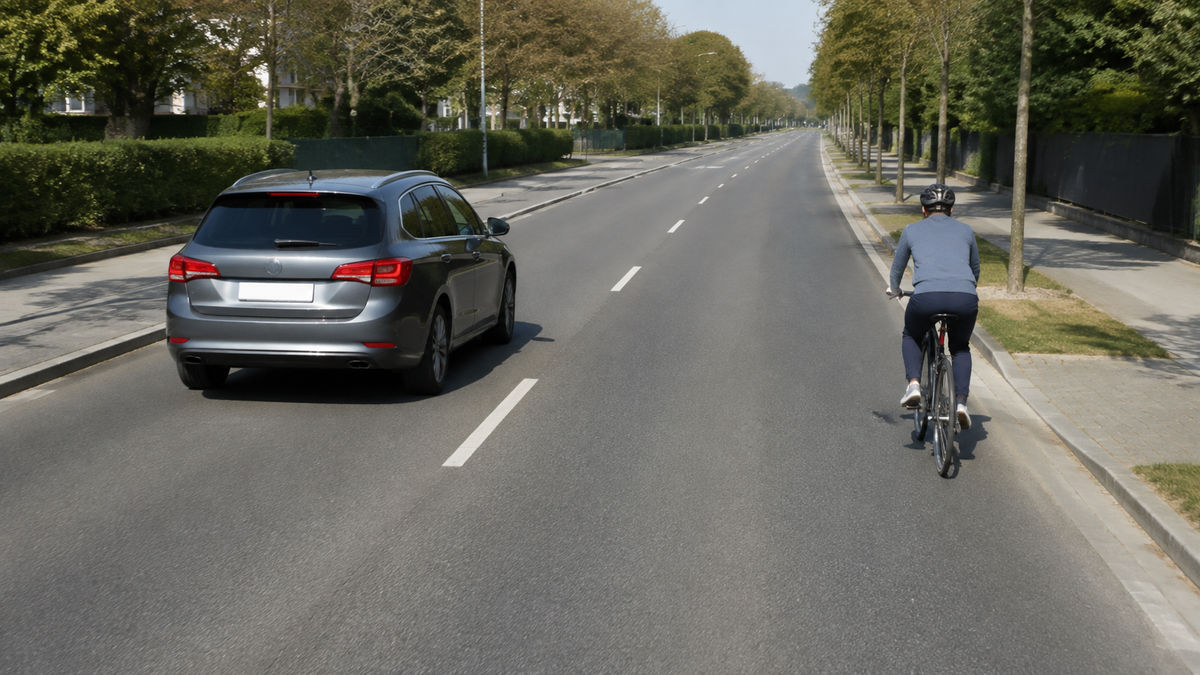
When overtaking a bicycle, lateral clearance is not the only factor. There must also be a clear view, no oncoming traffic, a sufficient speed difference, and enough space all the way until it is safe to merge back in. For motor vehicles, the Road Traffic Regulations specify clear minimum distances: 1.5 meters within built-up areas and 2 meters outside built-up areas. If this space cannot be maintained throughout the entire maneuver, overtaking must not begin.
1.5 Meters Within Built-Up Areas, 2 Meters Outside Built-Up Areas
Section 5(4) of the Road Traffic Regulations requires drivers of motor vehicles overtaking pedestrians, cyclists, and electric micro-vehicles to maintain a lateral clearance of at least 1.5 meters within built-up areas and at least 2 meters outside built-up areas. These figures are minimums, not targets. Crosswinds, a child on the bicycle, a trailer, or a visibly unsteady line may require more space.
The clearance is not needed only at a single moment. It must be maintained while passing, until the motor vehicle has completely passed the bicycle and can return to its lane without cutting in. Anyone who moves back in too early negates the initially large clearance at the rear.
Who the Fixed Values Apply To
| Situation | A Fixed Minimum? | What Still Applies |
|---|---|---|
| Motor Vehicle Overtakes Bicycle Within Built-Up Areas | At Least 1.5 m | Only with a Clear View and a Safe Maneuver Overall |
| Motor Vehicle Overtakes Bicycle Outside Built-Up Areas | At Least 2 m | Take Oncoming Traffic and a Significantly Higher Speed into Account |
| Bicycle Overtakes Bicycle | Not a Blanket 1.5/2 m | Sufficient, Situation-Appropriate Lateral Clearance |
| Bicycle Passes Waiting Vehicles on the Right | Narrowly Defined Special Rule | Only with Sufficient Space, Moderate Speed, and Particular Caution |
| Oncoming Traffic | No Automatic Application | General Duty of Care and Safe Riding |
The figures must therefore not be used as a general distance formula for every encounter. When two cyclists overtake one another, sufficient lateral clearance is still required, but the Road Traffic Regulations do not automatically assign the same 1.5 or 2 meters to this case. The same applies to simply passing one another or passing a stationary obstacle.
When Overtaking Remains Prohibited Despite Sufficient Width
Under Section 5(2), overtaking is permitted only if it can be ensured that oncoming traffic will not be obstructed throughout the entire maneuver. In addition, the overtaking vehicle must be traveling significantly faster. Paragraph 3 rules out overtaking when the traffic situation is unclear. Therefore, a clear space next to the bicycle is not sufficient if oncoming traffic may appear behind the bend or if there is not enough road ahead before a crest.
Markings do not make the minimum clearance smaller either. If a road is too narrow to pass legally and safely, the motor vehicle must remain behind the bicycle. The same applies if maintaining the clearance would require violating another traffic rule or would force an oncoming vehicle to brake. Patience here is not a courtesy but part of safe traffic flow.
The right time to move back into the lane
The view must not be directed only ahead. Anyone overtaking must also recognize when the bicycle is completely clear in the rear area. Only then should they move back into the lane with sufficient longitudinal clearance. Especially with a bicycle and trailer, a cargo bike or a small group, the unit being overtaken is longer than expected. Cutting in closely in front of the front wheel creates pressure and can trigger an evasive reaction.

What cyclists can do for their own safety
Under Section 2 of the German Road Traffic Regulations (StVO), cyclists must generally ride as far to the right as possible. This does not mean forcing yourself into the gutter, over damaged edges or into the door-opening area of parked cars. A situation-appropriate safety margin from the edge of the road and a predictable line are more helpful than suddenly swerving. The provision discussed here does not specify a fixed nationwide distance in centimeters for this clearance.
If you hear a vehicle behind you, remain predictable and check the road ahead. A quick glance behind can clarify the situation, but must not cause you to swerve. At a suitable wide spot, you can let a line of vehicles pass if this is possible without stopping abruptly or making a risky evasive maneuver. However, you are not required to force yourself into a dangerous edge area so that someone can overtake despite insufficient lateral clearance.
Groups, children and bicycles with trailers
When passing multiple cyclists, the overtaking driver must allow for the length of the entire group. A gap between two people is not automatically a safe place to merge back in. Children cannot yet hold their line as consistently as experienced adults; a bicycle trailer is wider and longer than the towing bicycle. Such obvious circumstances call for more space and a longer clear stretch. If the maneuver cannot be completed without putting pressure on everyone involved, the motor vehicle must remain behind.
Cyclists should also briefly check before overtaking within a group whether the person ahead has noticed their approach. An unobtrusive audible signal can serve as a warning, but it does not grant priority. Only pass once there is a sufficiently wide, clear line, and do not move back in immediately in front of the front wheel.
Passing waiting vehicles on the right
Section 5 (8) allows cyclists to overtake vehicles waiting in the right-hand lane on the right at a moderate speed and with particular caution, provided there is sufficient space. The numerical minimum lateral distance does not apply to precisely this intersection situation referred to in subsection 4. This does not create a general right to move through every narrow gap.
Expect opening doors, pedestrians crossing, vehicles pulling away, and turning trucks in a stationary queue. If there is no clearly identifiable safety margin, stay behind. The word “sufficient” must practically allow room for a stable line, small movements, and a controlled reaction.
Three checks before every overtaking maneuver
- May I begin? Visibility, oncoming traffic, road markings, and the difference in speed must allow the entire maneuver.
- Can I maintain the required distance? Plan for at least 1.5 meters within built-up areas or 2 meters outside built-up areas when a motor vehicle overtakes a bicycle, and more if a greater distance is clearly necessary.
- Can I complete the maneuver safely? There must be enough space to move back in only after fully passing with sufficient clearance.
Frequently asked questions
May a car always overtake with a distance of 1.5 meters?
No. Within built-up areas, this distance is only a minimum requirement. If the situation is unclear, oncoming traffic is at risk, there is no sufficient difference in speed, or the available distance is too short, overtaking remains prohibited.
Is 2 meters always required outside built-up areas?
When a motor vehicle overtakes a bicycle outside built-up areas, a minimum distance of 2 meters must be maintained. Special circumstances may require an even greater distance.
Do cyclists have to ride right at the edge?
They should ride as far to the right as possible, but at a safe, passable distance from edges, obstacles, and open doors. The general duty of consideration under Section 1 of the German Road Traffic Regulations (StVO) applies to everyone involved.
Does the 1.5-meter distance also apply between two bicycles?
The specific distances of 1.5 and 2 meters in this provision apply to motor vehicles overtaking the aforementioned vulnerable road users. A sufficient lateral distance is still required between bicycles, but without this blanket figure.
As of September 5, 2026. This article explains general rules in Germany and does not replace a legal assessment of a specific incident.
Share:
Read the “Cyclists Dismount” Sign Correctly
Turning left by bicycle: directly or indirectly?