

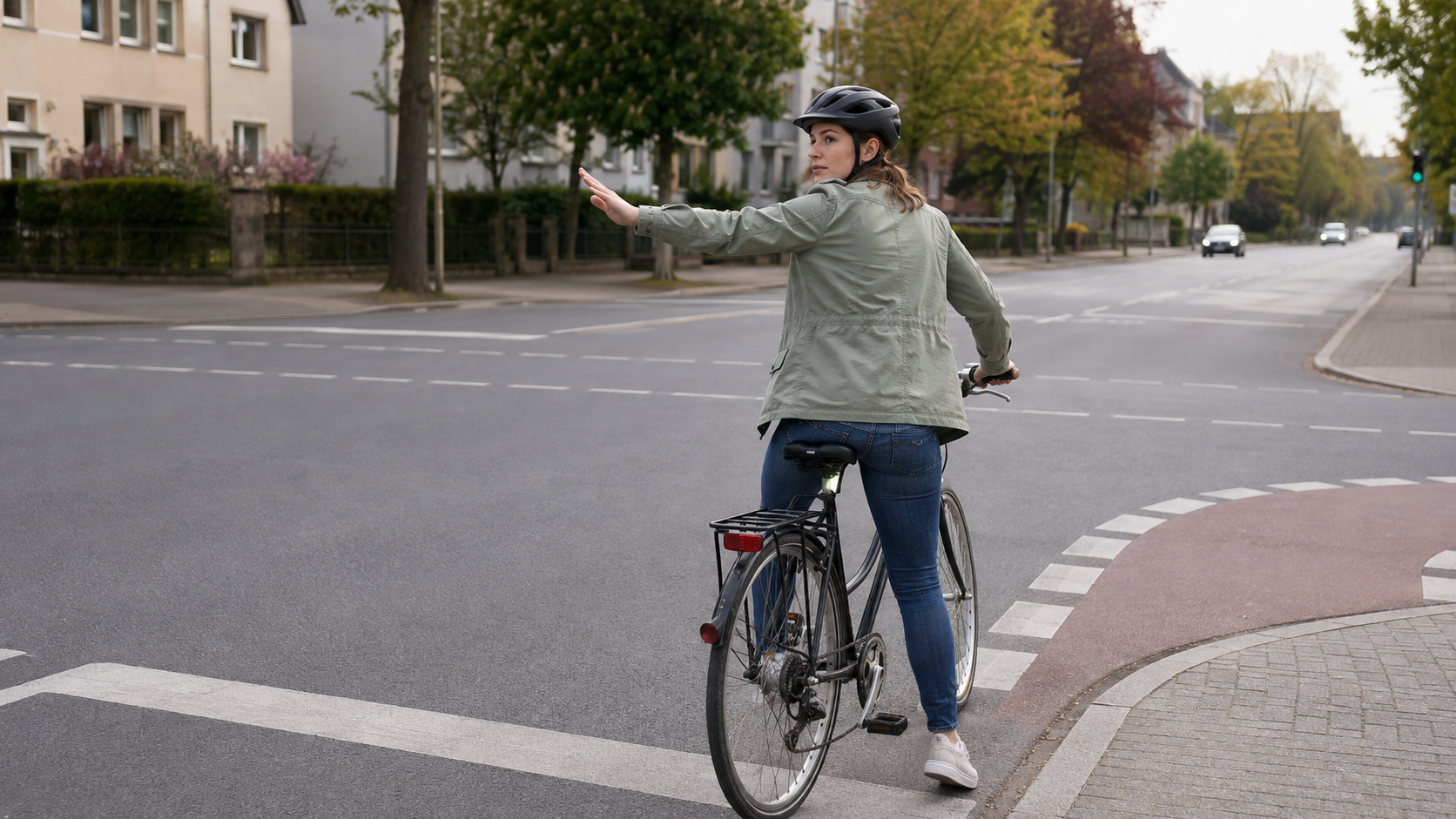
Turning left by bicycle may seem easy at a quiet intersection, but quickly becomes challenging with multiple lanes, tracks, or heavy traffic. The German Road Traffic Regulations allow two basic options: turning directly from the appropriate road position or turning indirectly via the right edge of the intersection. What matters is not which option seems more athletic, but which route is intended at the specific location and which one you can carry out in a controlled manner.
Direct or indirect: the quick decision
When turning left directly, move into position in good time, observe the traffic behind you, clearly signal your intention, and let oncoming traffic pass. When turning left indirectly, first ride straight across the intersection, position yourself on the right in a safe waiting area, and cross only in a second step. According to Section 9 (2) of the German Road Traffic Regulations, you must observe traffic from both directions. The second stage therefore does not automatically give you priority.
How direct left turns work
Start observing early. A shoulder check shows whether a vehicle is already beside you or approaching quickly. Only when the situation is clear should you clearly signal the change of direction with your left arm. You then need both hands again for a stable line and safe braking. The hand signal must be clearly visible; the German Road Traffic Regulations do not require you to keep your arm extended throughout the entire turn.
Then move into the appropriate position in good time and according to the road layout. On a simple road, this position is usually toward the center of the roadway. Where there are marked lanes, turn lanes, or special cycling infrastructure, follow the local markings and signs. Before actually turning, look over your shoulder again. Then let oncoming vehicles, trams, and other road users with priority pass, and watch out for pedestrians when crossing.
Direct turning is particularly suitable when you can safely assess traffic behind you, move into position without a hectic lane change, and maintain a good overview of oncoming traffic. If a rapid lane change would be necessary, visibility is poor, or you feel pressured, waiting or turning indirectly is often the more sensible safety decision.
How indirect left turns work
With the indirect method, you initially stay to the right and cross the intersection in your current direction of travel. After the intersection, stop at a point where you block neither cyclists traveling straight ahead nor sidewalks, crossings, or side roads. Position the bicycle for the new direction of travel and now check both directions of traffic. Only when the signal, right of way, and a safe gap allow it should you ride through the second section.

This procedure avoids moving between moving motor vehicles, but it consists of two separate traffic maneuvers. A green signal from the first direction of travel does not automatically apply to the second section. Likewise, waiting at the right edge does not give you priority. If a waiting area is marked, you should observe its orientation and the associated signal; if there is no safe position, you must not create a makeshift waiting zone in the middle of pedestrian traffic.
Both options compared
| Question to check | Direct left turn | Indirect left turn |
|---|---|---|
| Position | Move into the intended turning position in good time | First go straight ahead, then position yourself safely to turn right |
| Observation | Check behind you before moving into position and again before turning | After positioning yourself, check both directions of traffic again |
| Requirement to wait | Let oncoming traffic and other road users with priority pass | Reassess the signal and right of way for the second section |
| Typical advantage | Direct, smooth route when traffic conditions are clear | No need to move into a left-hand lane position |
| Typical risk | Merging too late and without control | Incorrect assumption that you automatically have priority after the first crossing |
Cycling facility and traffic light take precedence
An existing cycling facility can determine the route through the intersection. Under Section 9(2), this route must be followed when turning at the intersection. It may include marked crossings, waiting areas, or a guided curve. Therefore, do not decide based solely on habit; read the road markings and traffic signs before the intersection.
Traffic lights also change how the maneuver proceeds. Section 37 of the German Road Traffic Regulations (StVO) specifies which signal applies. If a dedicated bicycle traffic signal is provided on a separate cycling facility, that signal is decisive. If there is no such signal, a different signal may apply depending on the facility. This must be clarified on site; a green light does not replace a shoulder check or checking crossing traffic.
Tracks, buses, and multilane roads
At tram tracks, the turning line must not cross the track at an acute angle if this could trap a wheel. At the same time, you must remain aware of trams and oncoming traffic. If a safe line is not possible, dismount at a suitable point or choose another crossing. Making a sudden evasive maneuver between the track and a vehicle is not a good alternative.
On roads with multiple lanes, deciding early is particularly important. If you could only reach the correct lane immediately before the intersection, you should not cut across a continuous line of vehicles. Continue on, stop at a safe place, and use an understandable alternative. A small detour takes less time than a forced lane change.
When the decision comes too late
If you miss the correct position, do not cut diagonally across several lanes at the last moment. Initially stay in your safe line and continue until you reach a suitable place to stop or turn around. Even a hand signal that has already been given does not oblige you to carry out the maneuver when traffic conditions have changed. Withdraw the signal, stabilize the bike, and restart the procedure later. This clear correction is more predictable for others than a hesitant lane change.
A practical procedure before every intersection
- Read the road layout: Are there turning lanes, cycle crossings, waiting areas, signals, or prohibitions?
- Choose the option: Can you position yourself in a controlled manner, or is the two-stage route clearer?
- Indicate your intention: Give a clear hand signal without unnecessarily giving up control of the bike for too long.
- Check again: On the direct route, check behind you; on the indirect route, check both directions.
- Observe right of way: Let oncoming traffic, trams, and other road users with priority pass.
- You may abort: If the situation changes, wait. A plan that has already begun does not have to be completed under time pressure.
Frequently asked questions
Can I always turn left indirectly?
The German Road Traffic Regulations generally provide for this procedure. However, you must observe any existing cycle-route guidance, signals, prohibitions, and the specific design of the intersection. A safe waiting position must not obstruct others.
Do I automatically have priority after continuing straight ahead?
No. Before crossing for the second time, you must reassess traffic from both directions and the signals or right-of-way rules that apply in that direction.
Does the arm have to remain extended until the end?
No. Your intention to turn must be clearly indicated in good time. You can then put your hand back on the handlebars if necessary for safe steering and braking.
Which option does the ADFC recommend?
The ADFC explains both options. The appropriate choice depends on the road layout, traffic conditions, and your own control; neither option is categorically safer everywhere.
As of September 5, 2026. This article describes general rules in Germany and does not replace a legal assessment of a specific traffic situation.
Share:
Read the “Cyclists Dismount” Sign Correctly
Overtaking a bicycle safely: 1.5 m, 2 m, and the obligation to wait