

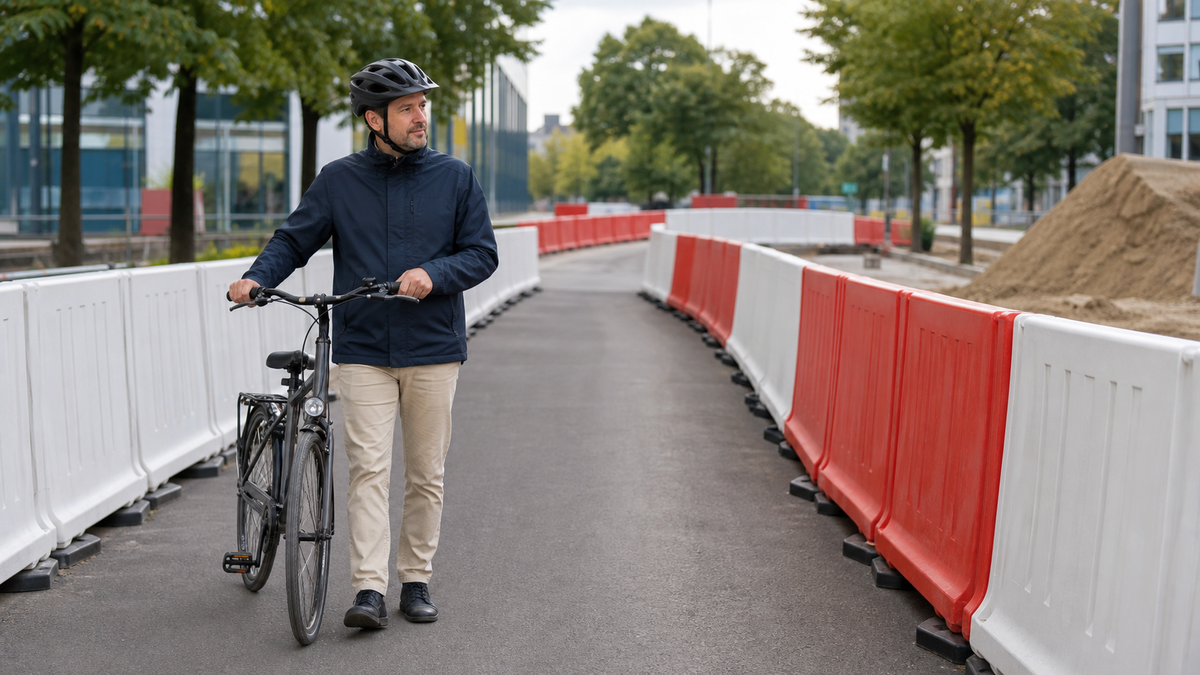
The supplementary sign “Cyclists dismount” is often placed at construction sites, narrow sections, or provisional routes. Read on its own, the message seems clear. Legally, the situation is more nuanced: Sign 1012-32 is classified in the official traffic sign catalogue as a notice expressed in words, not as an independent mandatory sign. Whether you may continue riding must be assessed together with the main sign, the barrier, signals, and markings.
The short answer
According to the ADFC's current classification, supplementary sign 1012-32 does not, by itself, require cyclists to dismount. It recommends or indicates a special situation. However, this does not mean you have the right to ride through every construction site. A main sign above it may prohibit cycling, a barrier may close the path, and a specific hazard may make slowly walking the bike the only responsible option.
Always read supplementary signs together with the main sign
Section 39(3) of the German Road Traffic Regulations (StVO) describes supplementary signs and generally places them directly below the traffic sign to which they refer. The assessment therefore starts at the top. First determine the legal meaning of the main sign, then interpret the supplementary sign as additional information. Anyone who photographs only the lower sign or reads it out of context may overlook the actual rule.
The same applies when several signs are mounted on one post. A prohibition, a footway designation, a diversion, or an authorization may have a different regulatory meaning from a mere notice to dismount. The beginning and end of a construction route must also be recognizable. Do not automatically continue where the sign ends if the closure or another main sign remains in force.
Correctly interpreting typical combinations
| Main sign or situation | Legal basis | Practical decision |
|---|---|---|
| Only supplementary sign 1012-32 | Notice only, not an independent mandatory sign | Check for hazards and whether it is safe to ride; if in doubt, walk the bike |
| Sign 239: Footway with no permission for cyclists | Other vehicle traffic is excluded | Do not ride the bicycle; walk it as a pedestrian |
| Sign 250: No vehicles of any kind | Cycling prohibited; bicycles may be walked | Dismount and only walk the bike through if the path is not additionally closed |
| Mandatory cycle path with construction notice | Check the main sign and actual usability together | Follow the provisional route; do not automatically switch to the carriageway |
| Physical road closure | The closed area must not simply be bypassed | Stop and look for a legally signposted diversion |
Footpath: Dismounting changes your status
Sign 239 indicates a footpath. Without a supplementary sign expressly permitting cycle traffic, you may not ride there. If you dismount and push the bicycle, you are treated as a pedestrian accompanying a vehicle. Section 25 of the German Road Traffic Regulations is relevant here. Make sure not to block the remaining footpath with your handlebars, bags, or trailer.
If the temporary footpath is so narrow that a bicycle and oncoming traffic cannot pass side by side, wait at a wider point. The supplementary sign does not create a priority lane for a bicycle being pushed. People using wheelchairs, prams, or walking aids, or people with limited vision, need sufficient space. If in doubt, walk one behind the other and let others pass first.
Sign 250: Riding prohibited, pushing expressly permitted
Sign 250 prohibits vehicles of all kinds. However, the explanation in Annex 2 to the German Road Traffic Regulations permits bicycles and motorcycles to be pushed. This is a specific rule of the main sign and not the effect of the “cyclists dismount” sign. Additional barriers, a prohibition on entering, or instructions from construction-site personnel must still be followed.

Construction-site markings: yellow takes precedence over white
At construction sites, yellow lines may indicate a temporary route. Under Section 39(5), temporary yellow markings take precedence over white markings. Therefore, do not follow the familiar old line when a yellow route clearly specifies something different. At the same time, look for traffic lights, barriers, diversion arrows, and the usable width.
A yellow line alone does not answer every question. It may be interrupted by an obstacle, designated for another type of traffic, or regulated together with signals. Reduce your speed early and stop before the unclear section instead of changing direction within a narrow passage.
Are you allowed to move onto the carriageway when a cycle-path route is blocked?
Supplementary sign 1012-32 does not automatically permit you to leave the cycle path and enter the carriageway. Whether the obligation to use the cycle path continues at a location that is genuinely unusable, and how you may switch, depends on the specific closure, diversion, signs, and safe positioning in traffic. A passage that is merely inconvenient or difficult to cycle through slowly is not the same as a completely unusable route.
If no clear, legal connection is visible, dismount before the narrow section, wait outside the traffic area, and look for the signposted diversion. Do not walk between barrier posts into a work area. Construction-site personnel may control traffic on site; clear instructions and signals must be followed.
The five-step check
- Start at the top: Which main sign appears above “Cyclists dismount”?
- Identify other rules: Is there a traffic light, barrier, yellow marking, permission for bicycles, or a diversion?
- Assess whether riding is feasible: Are the width, visibility, and clearance sufficient for controlled riding?
- Clearly change roles: If you walk your bicycle, be considerate on sidewalks and keep the passage clear.
- Do not invent your own gap: Do not ride through a barrier or spontaneously move onto the roadway without safely merging.
Why voluntarily dismounting can make sense
Even if the sign alone does not create a cycling ban, walking may be the best safety decision. Examples include slippery steel plates, a narrow passing point, unclear edges, active construction traffic, or poor visibility behind a barrier. This decision is based on the specific hazard and the general duty to exercise caution and consideration, not on an invented blanket obligation.
Dismount before the narrow section, not only once you are in the middle of it. Choose the side where the bicycle will not push anyone into the traffic area, and keep bags or wide handlebars under control. On a steep incline or with a heavy bicycle, another route may be safer than a very narrow passage while walking.
Frequently asked questions
Do I always have to walk my bicycle when told to “dismount”?
Not solely because of supplementary sign 1012-32. However, you must observe the main sign, barriers, signals, markings, and the specific hazard. These may prohibit cycling or make walking practically necessary.
May I continue riding slowly on a sidewalk?
Only if bicycle traffic is effectively permitted there. Sign 239 without permission for bicycles does not allow cycling; by dismounting and walking, you become a pedestrian with a bicycle.
May I pass sign 250 with my bicycle?
Cycling is prohibited there. According to the explanation of the sign, the bicycle may be walked, provided that no additional barrier or order also prohibits passage.
Can I simply switch to the roadway at a construction site?
No. The supplementary sign does not automatically grant permission to enter. Check the diversion, signs, and a safe, legal transition; if unclear, stop and choose another route.
As of September 5, 2026. This article explains general rules in Germany and does not replace a legal assessment of a specific construction-site route.

Share:
Is it legal to ride a bicycle on a federal road?
Turning left by bicycle: directly or indirectly?