

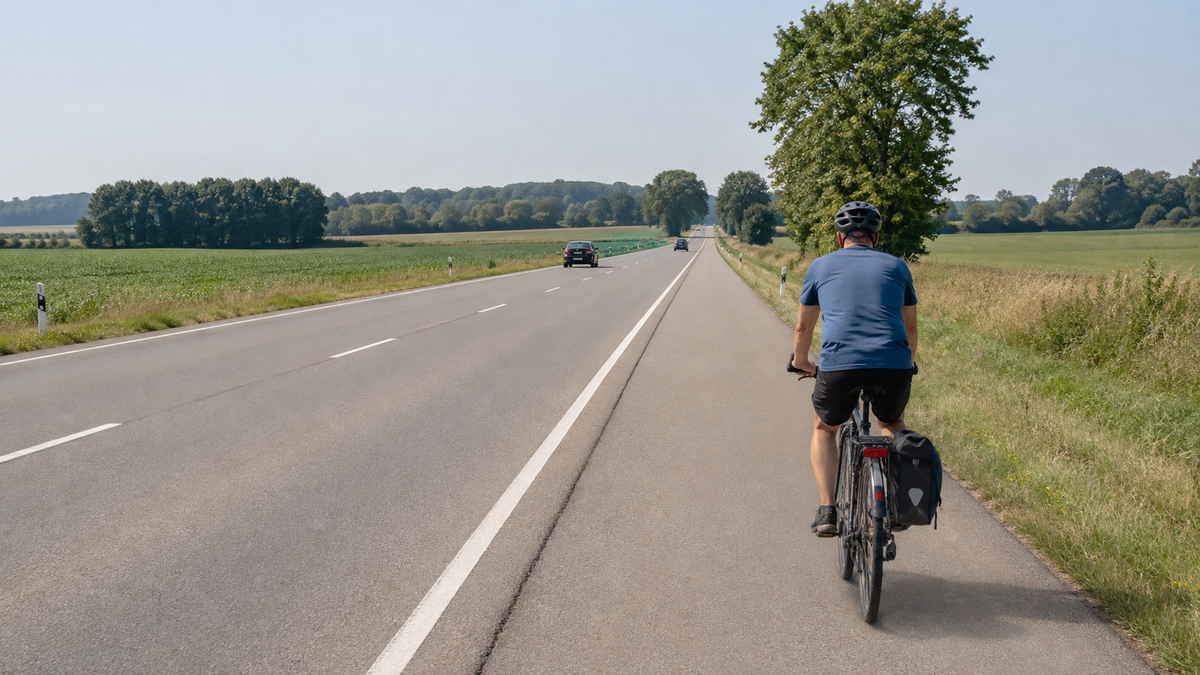
Can you ride a bicycle on a federal road? Often yes, but not on every section. “Federal road” initially refers to the road classification. A yellow number sign with a B is not in itself a no-cycling sign. What matters are the traffic signs on the specific section, whether it is a motor-vehicle road and whether use of a cycle path is mandatory where one is signposted.
A federal road is not automatically a motor-vehicle road
A federal road may pass through built-up areas, be built as an ordinary rural road or have special access rules on individual sections. Only sign 331.1 designates a motor-vehicle road. Under Section 18(1) of the German Road Traffic Regulations, motorways and motor-vehicle roads may only be used by motor vehicles whose design-related maximum speed exceeds 60 km/h. A bicycle does not meet this vehicle requirement and may not enter.
This applies to the specific section. A federal road may initially be open to bicycles and later become a motor-vehicle road with sign 331.1. Conversely, the road number alone says nothing about this traffic sign. Therefore, do not plan solely based on the colored road display on a map; check the signs at the planned entry point and at junctions.
Four steps for making the decision on site
- Check access signs: If sign 330.1 indicates a motorway or sign 331.1 a motor-vehicle road, you may not enter by bicycle.
- Look for a no-cycling sign: Sign 254 prohibits cycling even without motor-vehicle-road status.
- Identify a cycle path: Sign 237, 240 or 241 can make an existing path mandatory to use for the respective direction.
- Assess suitability: If the section is legally open, also check traffic, visibility, road width, the space at the side of the road, weather and a possible alternative route.
Which signs change the answer
| Sign or situation | Meaning for ordinary bicycles | Consequence |
|---|---|---|
| Only a yellow federal-road number | Not an independent bicycle restriction | Check other signs and routes |
| Sign 331.1: Motorway for motor vehicles | Bicycles may not enter | Take a legal alternative before the start |
| Sign 254: No cycling | Cycling prohibited | Choose a diversion or another permitted connection |
| Signs 237, 240 or 241 in the direction of travel | The signposted path is generally mandatory to use | Follow the marked cycle path or the shared or separate path |
| Use the right-hand hard shoulder if there is no cycle path | May be used in accordance with Section 2(4) | Do not obstruct pedestrian traffic |
The 60 km/h specification is not a minimum speed
The wording in Section 18 is often misunderstood. More than 60 km/h refers to the design-related maximum speed of the authorized motor vehicle. It does not require every vehicle on a limited-access road to travel at least 60 km/h at all times. The result for bicycles is nevertheless clear: they are not a vehicle type permitted there.
Therefore, do not try to derive an exception from your own speed. Even a very fast road cyclist, or a bicycle that briefly reaches a high speed downhill, does not thereby become an authorized motor vehicle. This access rule depends on the type and design of the vehicle, not its current speedometer reading.
When a cycle path must be used
Section 2(4) of the German Road Traffic Regulations (StVO) makes the mandatory use of a cycle path conditional on signs 237, 240, or 241. If such a sign for your direction of travel is located on a path alongside the road, it must generally be used. A structurally recognizable cycle path without these signs may be used on the right in the direction of travel, but is not automatically mandatory merely because of its appearance.
Roadworks, closures, or a route that is genuinely unusable may require a reassessment. However, this does not amount to a blanket permission to spontaneously go around every obstacle on the roadway. Read the temporary signs and the diversion, stop if the route is unclear, and change position only where it is legally and safely possible.
Hard shoulder: permitted, but not always present
Under Section 2(4), bicycles may use the right-hand hard shoulder if there is no cycle path and doing so does not obstruct pedestrians. A hard shoulder is part of the road, but not every narrow edge, verge, or dirty margin is a safely usable hard shoulder. Broken glass, drainage grates, potholes, and an area that ends abruptly may argue against using it in practice.

If the roadway is the only option, the general requirement to keep right applies. “As far to the right as possible” does not mean riding over unusable edges. Maintain a predictable line and sufficient space from obstacles. On a busy, fast-moving route, it is also important to wear clearly visible clothing and use functioning lights; however, these are no substitute for safe infrastructure or a legal right of access.
Legal does not automatically mean suitable for touring
A formally open federal road may be unsuitable for a recreational ride. Heavy goods traffic, a narrow roadway, numerous access roads, a lack of roadside space, or long stretches with poor visibility increase the strain. Assess the route before setting off and again on site. A parallel minor or municipal road, a signposted cycle path, or a rail connection may be the more pleasant choice.
Digital route planners are a starting point, but not a substitute for current signs. Maps may show construction work, a newly designated road for motor vehicles, or a closed cycle path with a delay. Do not load the route blindly onto your navigation device. Note critical entrances and an alternative before you reach an area where turning around safely is not possible.
Check current information before the trip
Do not look only at the start and destination, but at every planned section of federal road. Municipal construction notices, regional cycle-route signs, and current information from the road authority may indicate a closure or diversion. Plan resupply and exit points so that you do not have to remain on the critical section in strong winds, darkness, or unexpectedly heavy traffic. A saved offline alternative is helpful where mobile reception is weak.
The current signage on site still applies. If it differs from the plan, follow the signs rather than the old track. Stop to replan in a safe location away from the carriageway; glancing at the display while riding impairs your control.
Which vehicles this article applies to
This explanation applies to ordinary bicycles and Pedelecs that are legally classified as bicycles. Faster vehicle classes or those approved under different regulations may be subject to different access and cycle-path rules. Anyone using an S-Pedelec, moped, or other motor vehicle must check its approval status and the applicable signage separately.
Frequently asked questions
Are all federal roads prohibited for bicycles?
No. The road classification alone does not prohibit bicycles. Entry is prohibited in particular on a road for motor vehicles, a motorway, where sign 254 applies, or where another effective local restriction is in place.
May I ride on the road if there is a cycle path alongside it?
If sign 237, 240, or 241 applies in your direction, the signposted route must generally be used. Without one of these signs, the answer depends on the specific routing and other rules.
May I use the shoulder?
Yes, if no cycle path is available, a right-hand shoulder may be used by bicycle, provided you do not obstruct pedestrians there. Its actual suitability for cycling and the end of the shoulder must nevertheless be assessed safely.
Is a navigation app enough to authorize access?
No. Current traffic signs and barriers on site take precedence. Use the app for planning, but keep a legal alternative ready.
As of September 5, 2026. This article explains general rules in Germany and does not replace checking the current signage or obtaining legal advice for an individual case.
Share:
Read the “Cyclists Dismount” Sign Correctly
Turning left by bicycle: directly or indirectly?