

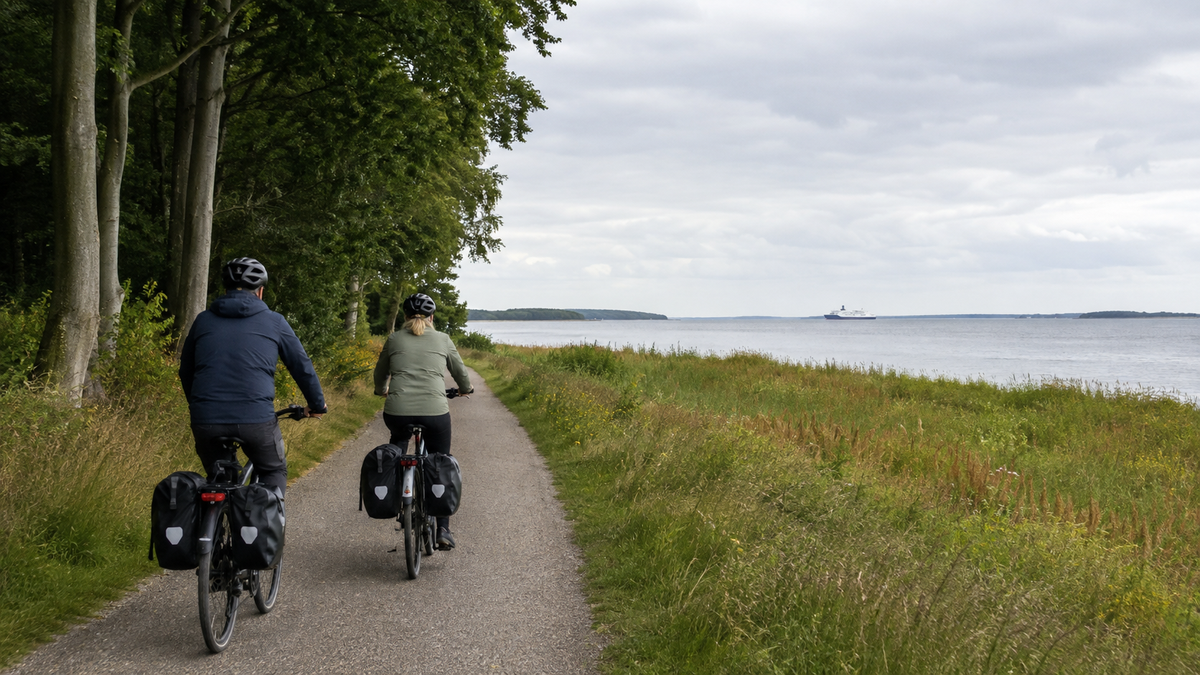
The Berlin–Copenhagen Cycle Route connects two capital cities, the lake landscapes of Brandenburg and Mecklenburg-Western Pomerania, and the Danish Baltic coast. VisitDenmark gives the international route as approximately 630 kilometers. For your booking, however, the current track is what matters: urban approaches, detours, and minor route changes can shift the actual distance. The following plan allows for 13 riding days plus one reserve day and is suitable for you if you can usually ride 40 to 70 kilometers a day with luggage.
Berlin–Copenhagen Cycle Route at a glance
| Point | Planning figure |
|---|---|
| Total length | around 630 km according to VisitDenmark; the selected GPX track is more authoritative than a rounded portal figure |
| Start and finish | Berlin and Copenhagen; the route can be ridden in both directions |
| Route networks | in Germany part of EuroVelo 7 and D-Route 11, in Denmark largely National Route 9 |
| Time required | at least 12 days according to VisitDenmark; here 13 riding days plus 1 buffer or city day |
| Ferries | Rostock–Gedser mandatory; Stubbekøbing–Bogø with the seasonal Ida ferry |
| Character | long flat stretches, but changing winds, varied surfaces, and some longer daily distances |
EuroVelo describes the German section from Berlin via Havel, Fürstenberg, Neustrelitz, Güstrow, and Rostock. The Danish route portal shows the N9/EV7 with individual GPX sections; its map page also includes the continuation north of Copenhagen. Therefore, explicitly select only the track between Gedser and Copenhagen. Before departure, download the current data from the EuroVelo portal and the Danish route portal. Use an offline copy; signs and the app do not replace one another.

A realistic 14-day plan
The distances are rounded planning figures, not surveyed measurements. Check each day’s route with your accommodation and current detours. If 70 kilometers with luggage is too much, split Day 2, 5, or 9 in particular and extend the trip.
| Day | Section | approx. km | Planning note |
|---|---|---|---|
| 1 | Berlin–Oranienburg | 45 | a relaxed start; do not underestimate city traffic and the exit route |
| 2 | Oranienburg–Fürstenberg/Havel | 70 | start early and bring provisions for rural sections |
| 3 | Fürstenberg/Havel–Neustrelitz | 45 | lake and forest sections; keep offline navigation available |
| 4 | Neustrelitz–Waren (Müritz) | 65 | plan extra time for nature trails and breaks |
| 5 | Waren–Güstrow | 60 | top up your water and snacks before departure |
| 6 | Güstrow–Rostock | 45 | check the ferry booking, port route, and check-in the evening before |
| 7 | Rostock–Gedser ferry, then Gedser–Nykøbing Falster | 29 | a short cycling day with a generous timetable buffer |
| 8 | Nykøbing Falster–Stubbekøbing | 35 | check the Ida ferry for the following day |
| 9 | Stubbekøbing–Bogø–Stege | 70 | only with Ida operating; without it, replan using the official alternative |
| 10 | Stege–Præstø | 40 | deliberately shorter for Møn and possible headwinds |
| 11 | Præstø–Rødvig | 40 | allow sufficient time for the coastal section and breaks |
| 12 | Rødvig–Køge | 38 | at Stevns Klint, dismount in protected areas and observe local rules |
| 13 | Køge–Copenhagen | 54 | allow time for the urban approach and secure bike parking |
| 14 | reserve or Copenhagen | – | leave room for wind, ferry cancellations, repairs, or a day off |
The two ferries are fixed planning constraints
According to the ferry company, the Scandlines crossing from Rostock to Gedser takes about two hours. A bicycle is not simply treated as regular pedestrian luggage: Scandlines charges a bicycle supplement in addition to the pedestrian ticket. The current information page states that check-in is required up to 30 minutes before departure in Rostock and up to 15 minutes before departure in Gedser. Prices, ticket types, and departures may change; check them directly with Scandlines and do not plan to take the last connection of the day.
Between Stubbekøbing and Bogø, the municipal ferry Ida replaces a motorway connection unsuitable for bicycles. For 2026, the operator lists sailings from May 1 to September 30 and during the Danish autumn holidays. This information is not a promise for future years. Shortly before your trip, check the current Ida timetable. Outside the season, you will need to fundamentally reroute the Danish section, not just add a few minutes.
Border, ferry, and return journey
Take a valid travel document with you. The German Federal Foreign Office notes that German nationals need a valid identity card or passport and that spot checks may take place at the German-Danish border. Different rules apply to other nationalities; check them before booking.
If you want to shorten a section by train or return from Copenhagen, book the bicycle and passenger together. On German long-distance trains, a bicycle ticket and bicycle-space reservation are required; on local trains, fares vary and carriage is not guaranteed if the train is full. In Denmark, the ticket and reservation requirements depend on the train type and operator. Check your specific connection with DB and DSB rather than applying general rules to every train.
Travel period, food, and accommodation
May to September is practical for the complete route because the Ida operates regularly then and the long days provide more leeway. Even during this period, wind, heavy rain, or heat can disrupt daily plans. Check warnings and local closures every day. During holiday periods, book Rostock, the nights on the ferry, Møn, and Copenhagen well in advance.
Plan accommodation in the stage locations mentioned, but check directly with each establishment that it offers secure bicycle storage, late arrival, and charging facilities. Do not rely on a café being open at all times in forest and coastal sections. Set out with water, a substantial snack, and a small emergency reserve; restock before shops close. Denmark uses Danish kroner, even though card payments are widely accepted.
Preparation checklist
- Save the current EuroVelo/N9 track offline and export the daily sections separately
- Confirm the Scandlines ticket, including the bicycle, and the Ida season before departure
- Check identification, insurance coverage, and emergency contacts for both countries
- Have the brakes, tires, chain, lights, and luggage attachment serviced before the trip
- Take a spare inner tube or suitable repair materials, a pump, tools, and a power bank
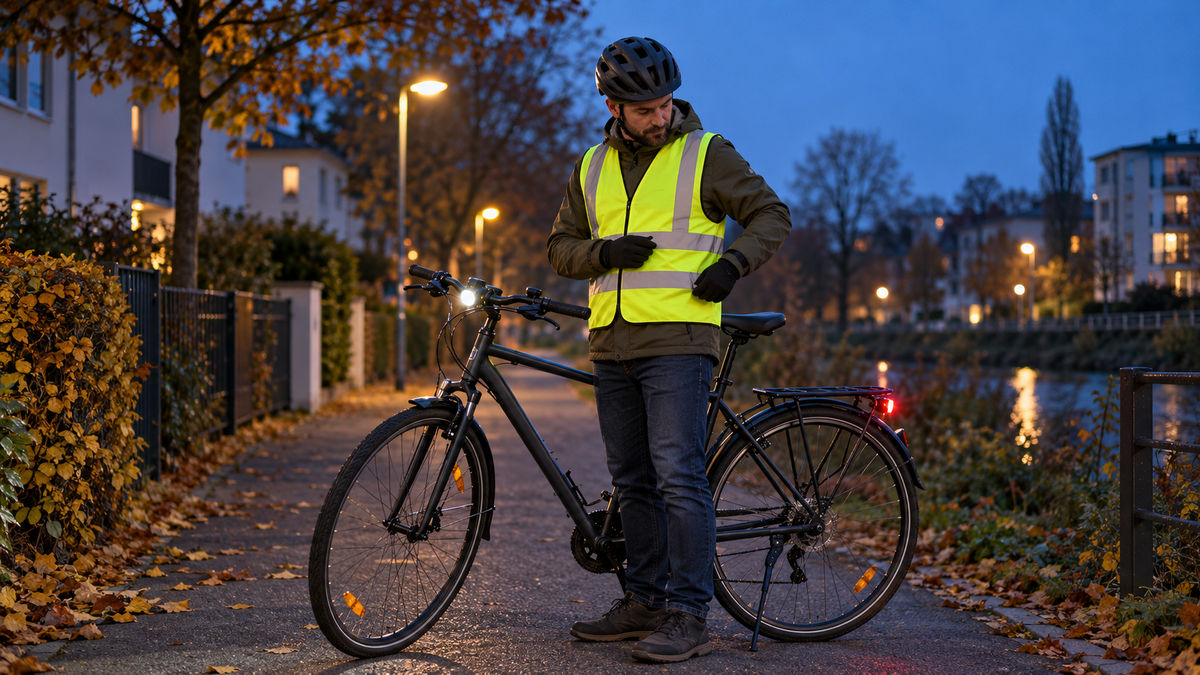
- Pack wind and rain protection, a warm layer, and high-visibility clothing
- Note train connections with confirmed bicycle carriage only as a backup plan
The short check before every day of riding
Each morning, compare the offline track with current closures and the weather forecast. On a ferry day, reconfirm the departure, terminal, and check-in. Check the tire pressure is within the tire’s permitted range, the brakes work, the lights function, and the bags are securely attached. Store your rain jacket, water, snack, and ID so you can reach them without completely unpacking. For an e-bike, include the charger and keys compatible with the system in the same check; a calculated remaining range is no substitute for a reserve. Send the next accommodation an arrival time only if you have allowed for the ferry, breaks, and wind. If the day is already clearly becoming too long in the morning, shorten it at a safe location or use the buffer day. A fixed hotel booking is no reason to continue riding in severe weather or with a technical problem.
Frequently asked questions
Is the Berlin–Copenhagen cycle route suitable for beginners?
Yes, if you divide the longer days and complete several rides beforehand with a loaded bike. The main challenges are not the climbs, but the distance, wind, navigation, and consecutive riding days.
Can I ride the route outside summer?
In principle, partial sections are possible. However, the Ida operates seasonally. Without a confirmed connection between Stubbekøbing and Bogø, you will need to take a different Danish route. Accommodation and dining options may also be limited.
Which direction is better?
Neither direction guarantees a tailwind. Decide based on your travel arrangements, ferry booking, and accommodation availability. Check the wind forecast only shortly before departure and keep the buffer day.
Can I ride only from Rostock to Berlin?
Yes. To do so, ride the German stages of this plan in reverse order and check the current EuroVelo track for the desired direction. You will not need a Baltic Sea ferry, but you will need a train connection with confirmed bicycle carriage to Rostock and from Berlin. Replan longer sections to suit your fitness, accommodation, and current route conditions.
Official planning: EuroVelo 7 Germany, National Route 9 in Denmark, and VisitDenmark’s overview of the full route.
Share:
Changing bicycle pedals: How to identify a left-hand thread safely
Kocher-Jagst Cycle Route in 6 Days: Circular Tour Starting in Aalen