

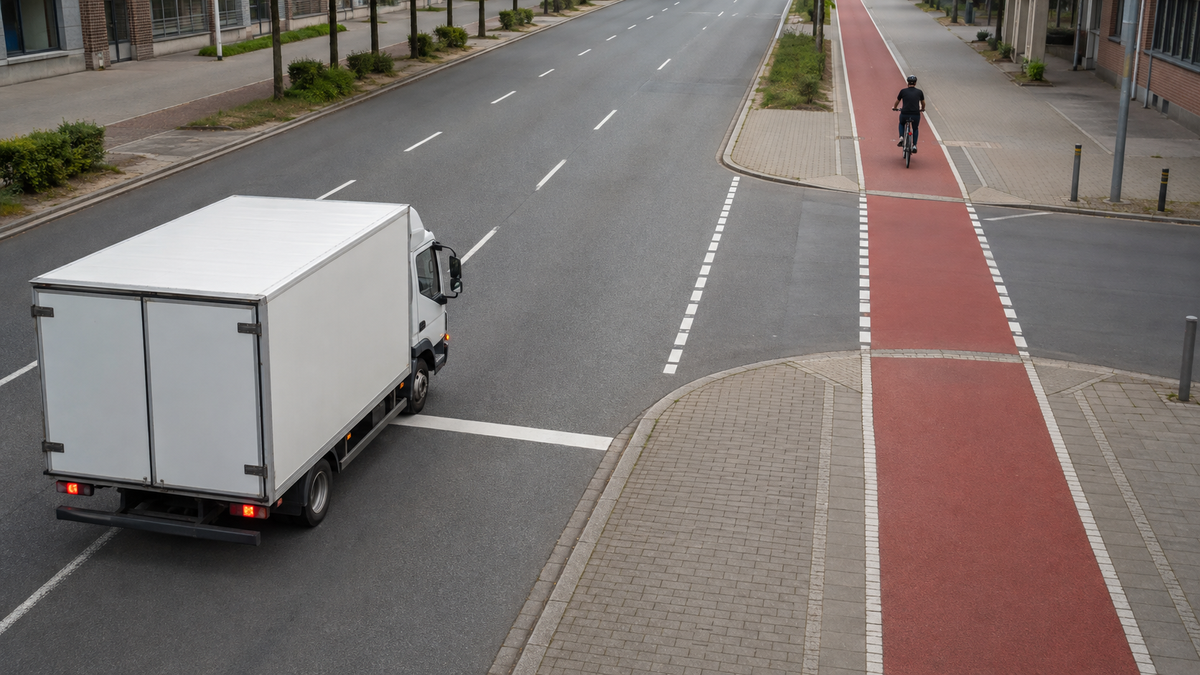
A typical conflict arises when a vehicle turns right and crosses a bicycle’s route going straight ahead. Under the law, the turning vehicle must give way to cyclists travelling in the same direction on or beside the carriageway. In practice, knowing who has right of way is not enough: Anyone riding a bicycle should identify early whether the driver of the turning vehicle has noticed their position and remain ready to brake at all times.
Who has to give way to whom?
Under Section 9(3) of the StVO, a turning vehicle must give way to bicycles, mopeds and motorised personal mobility devices travelling in the same direction when they are moving on or beside the carriageway. This covers the classic case: A bicycle is travelling straight ahead while a car or truck wants to turn right across its path. The obligation lies with the turning vehicle, regardless of whether the bicycle route runs on the carriageway, a cycle lane or a road-adjacent path.
This basic rule does not cover every conceivable intersection. Signals, right-of-way signs, permitted directions of travel and special traffic arrangements can determine the specific sequence of events. Anyone travelling against the permitted direction or ignoring a red signal cannot simply invoke the standard case. That is why traffic lights and traffic guidance are read first, followed by application of the general turning rule.
The special walking-speed rule for heavy vehicles
Within built-up areas, motor vehicles with a permissible maximum mass of more than 3.5 tonnes are subject to an additional rule. When turning right, they must drive at walking speed if cyclists travelling straight ahead can be expected on or beside the carriageway, or if pedestrians crossing are present in the immediate area where the vehicle is turning. This is set out in Section 9(6) of the German Road Traffic Regulations (StVO).
The distinction is important: Not every car turning right has to drive at walking speed solely because there is a bicycle nearby. The special rule applies to vehicles over 3.5 tonnes within built-up areas and to the conflict situations described there. For everyone else, the general duties when turning, yielding and exercising due care continue to apply. The law does not replace “walking speed” with a single fixed nationwide speed in kilometres per hour.
Five signals that cyclists can read early
- Vehicle position: Is a vehicle moving to the right before the intersection, or is it already close to your route?
- Turn signal: A turn signal that is activated is a warning. Conversely, the absence of a turn signal does not prove that the vehicle is going straight.
- Speed: Is the vehicle decelerating evenly, coming to a stop, or continuing to roll without any discernible reaction?
- Front wheels and vehicle angle: The initial steering movement can indicate that a turn is beginning before the entire vehicle turns.
- Driver's cab: Eye contact can be helpful, but it is not conclusive proof of awareness. Reflections, seating position, or an obstructed view are difficult to assess from outside.
None of these features transfer legal responsibility to cyclists. They serve as a defensive visual check. Slowing down despite having the right of way does not automatically mean giving up your rights; it creates time to react to an error.

Where the danger zone is
A position immediately beside the cab or front section of the vehicle is particularly unfavorable when the vehicle is already signaling right or rolling into the turn. With long vehicles, the rear wheels follow a tighter line than the front. As a result, the lateral space can become smaller during the turn. Do not try to pass through a shrinking gap at the last moment.
If you can safely stay behind the vehicle before the intersection, that is often the clearest evasive decision. If you are already clearly ahead of its front and the situation is under control, remain visible and predictable. There is no one maneuver for every position; distance, speed, and an open escape or braking zone are decisive.
Three-phase action plan
| Phase | Observation | Safe response |
|---|---|---|
| Before the intersection | Turn signal, vehicle position, signal, and cycling facility | Reduce speed, cover the brakes, and do not ride into a narrow gap at the side |
| Beside the vehicle | Front wheels, cab, remaining space | Do not rely on eye contact; if in doubt, stay behind the vehicle |
| Turning begins | Vehicle crosses the straight-ahead route | Brake in a controlled manner, increase your following distance, and do not force a risky pass |
| Vehicle is clearly waiting | Bicycles are stopped, the route is clear, and the signal permits travel | Continue observing and ride straight ahead at a manageable speed |
Which traffic light applies?
Traffic signals take precedence over the general right-of-way rules. Section 37 of the German Road Traffic Regulations (StVO) also governs special signals for bicycle traffic. If a dedicated bicycle signal is installed at a designated cycling facility, it applies to that facility. A green bicycle signal permits travel but does not guarantee that a turning vehicle has recognized the conflict. A red signal must not be disregarded by invoking the general right of way for straight-ahead traffic.
With separate signal phases, the potential conflict may be reduced, but movements in violation of the rules are still possible. Before entering the intersection, briefly look to the side and ahead. This is not a repetition of the entire traffic-light logic, but a specific safety check for the crossing vehicle turning right.
Increase your safety margin in darkness and rain
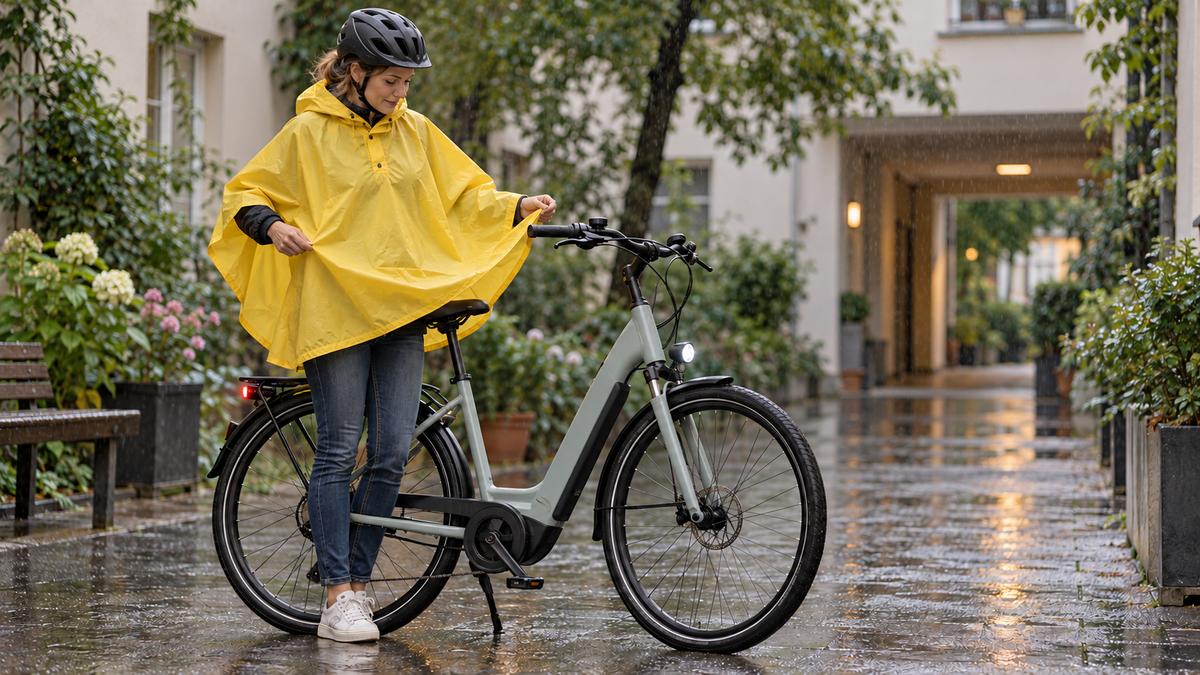
Depending on the bicycle, tyres, and road surface, wet conditions increase the controllable braking distance, while water on lenses and mirrors can reduce visibility. Therefore, slow down earlier and keep more distance from the possible turning line. Working lights and clearly visible clothing help others perceive you, but do not guarantee that you have been seen. Plan your speed so that, even if you have to steer late, you can still stop without swerving into other road users’ path.
Offset cycle paths and side roads
A cycle path running alongside the road may be set back several metres from the carriageway. As a result, the turning vehicle encounters the bicycle route only later. Whether a crossing, signal, or right-of-way sign is present must be checked directly at this crossing. Red surfaces or bicycle pictograms alone do not replace a complete assessment of the signal and signs.
Vehicles can also cross the straight-ahead route at property entrances and petrol station entrances. Maintain visual awareness of the entire area of movement there, not just the windshield. Parked cars, advertising structures, or plants can obstruct the view for both sides. In poor visibility, reducing your speed is a safety decision based on the general duty of care under Section 1 of the German Road Traffic Regulations (StVO).
Frequently Asked Questions
Does a bicycle traveling straight ahead always have priority over vehicles turning right?
In the typical same-direction situation, the turning vehicle must yield to bicycle traffic on or alongside the carriageway. However, signals, permitted direction of travel, right-of-way signs, and special traffic arrangements must still be checked.
Do all vehicles turning right have to travel at walking speed?
No. The specific duty in Section 9(6) applies within built-up areas to motor vehicles over 3.5 tonnes when the straight-ahead bicycle traffic or crossing pedestrian traffic referred to there can be expected.
Is eye contact with the driver a reliable sign?
No. You cannot reliably tell where the person is actually looking. At most, use eye contact as additional information, while also observing wheels, speed, distance, and the clear braking zone.
Should I be prepared to brake even when I have the right of way?
Yes. Being prepared to brake is a defensive precaution and does not automatically mean giving up the right of way. It helps prevent the consequences of overlooking a bicycle.
As of September 5, 2026. This article describes general rules for Germany and does not replace a legal assessment of a specific intersection or accident.
Share:
Read the “Cyclists Dismount” Sign Correctly
Turning left by bicycle: directly or indirectly?