

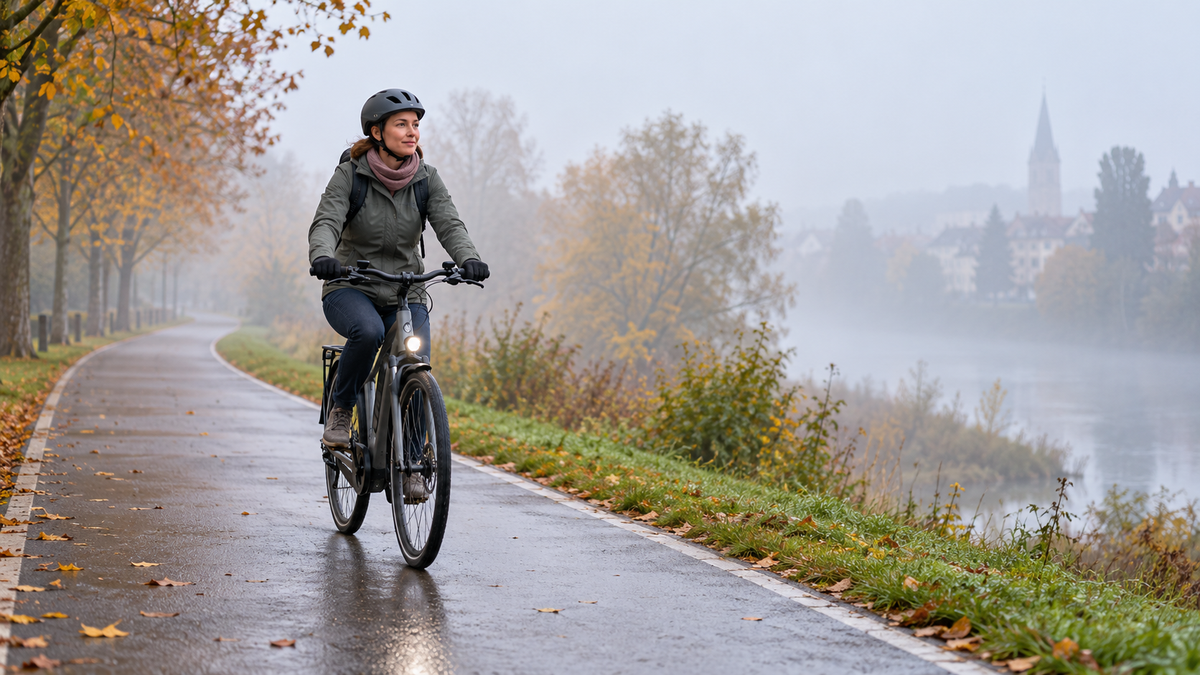
When riding an e-bike in fog, switch on the lights before setting off, adjust your speed significantly to the actual visibility, and ride only as fast as you can stop within the area you can see. Check that the front and rear lights are working properly and that your glasses or visor stay clear.
A reflective vest can make you more visible, but it never replaces the legally required bicycle lights. If the route becomes unclear, intersections or obstacles disappear into the fog, or you feel pressured by traffic, you have reached the right point to stop: pull over safely, change your route, or postpone your ride.
Before setting off: fog calls for a visibility check, not a test of courage
Fog is not equally dense everywhere. Visibility may still be adequate on an open hilltop, then deteriorate abruptly in a dip, by a river, or behind a line of trees. So don’t judge conditions only at your front door. Check weather warnings and your route, and plan an alternative along well-lit, easy-to-see roads. If you’re commuting, include the return journey in your decision.
Turn on the e-bike fully and check the lights, brakes, and battery charge before riding into traffic. Clean the headlight, rear light, and reflectors. Bags, coats, or luggage must not obscure any light. If the front headlight is loose or the rear light stays dark, don’t set off. A working display or motor does not automatically mean the lights are working properly.
Which bicycle lights are required in fog?
Section 17(1) of the StVO requires the use of the prescribed lighting equipment at dusk, in darkness, or whenever visibility conditions otherwise make it necessary. The lights must also not be obscured or dirty. This means fog may require you to use your lights even during the day.
Section 67 of the StVZO covers bicycle-specific equipment. This includes a white dipped-beam headlight at the front, a red rear light, and the required reflectors. The headlight must be adjusted so that it does not dazzle other road users. Flashing front and rear lights are not permitted as substitutes for the required bicycle lights.
If your approved bicycle headlight has a high-beam function, pay attention to its effect. ADFC Rhein-Berg advises against using high beams in fog because the fine water droplets can reflect the light and reduce your visibility. Use the compliant dipped-beam setting and adjust it appropriately instead of trying to “cut through” the fog with maximum brightness. Our article on bicycle lighting and required reflectors explains the equipment requirements in detail.
Adjust your speed to your visibility
Section 3(1) of the StVO requires drivers to remain in control of their vehicles at all times. Speed must be adjusted to factors including visibility, weather, road conditions, traffic, personal ability, and vehicle characteristics. You must be able to stop within the distance you can see; on very narrow roads, even half of the visible distance may be the relevant limit.
The same section states that if visibility due to fog, snowfall, or rain is less than 50 meters, you must not drive faster than 50 km/h unless a lower speed is required. These figures are expressly not a recommendation to ride an e-bike in fog at 50 km/h—or anywhere near that speed. 50 km/h is a maximum limit, not a safe speed. For a bicycle, the actual speed is determined by a much stricter practical test: can you stop within the distance in which you can recognize hazards in time?
Consider three distances, not one estimated figure
- Detection distance: How far away can you actually see a bollard, branch, pedestrian, or the next junction?
- Stopping distance: Are your reaction time and braking distance on the wet surface enough to stop before you reach that point?
- Decision distance: Is there also enough room to choose a safe line without swerving abruptly?
Your safety margin is determined by the shortest of these distances. General figures for distance or speed would be misleading because lighting, road surface, tires, brakes, gradients, and your reaction time all affect the result. Don’t test your brakes in the middle of traffic. If you can’t confidently judge how the bike will handle in wet conditions, choose a quieter route or don’t ride.
Set a clear point to stop before you set off
Your stopping point should be based on something you can observe. “I’ll ride as long as I can somehow manage” is not a plan. Before setting off, decide where you’ll stop to reassess—for example, at the last well-lit intersection, before an obscured stretch of forest, or before the cycle path leads onto a fast main road.
| Observation | Decision |
|---|---|
| The route, obstacles, and intersections are visible in good time; lights and glasses stay clear | Continue only at an appropriate speed and with a generous safety margin |
| Fog gets denser in dips or visibility fluctuates sharply | Reassess at a safe spot before entering the dense fog and turn back if necessary |
| The headlight or rear light fails, is obscured, or is very dirty | Do not continue until the required lights are working |
| Bollards, pedestrians, the edge of the road, or junctions appear only at the last moment | Stop safely and switch to a clearer route or another means of transport |
| Your glasses repeatedly fog up or water obscures your vision | Don’t wipe them while riding; stop in a safe place and deal with the problem |
Don’t stop suddenly in the traffic lane or just behind a bend. If possible, find a driveway, a spot off to the side, or another place outside the path of traffic. Walk your e-bike only if it’s also safe to do so on foot. Dense fog can coincide with wet roads, leaves, or the first signs of ice; in these sections, reduce your speed further or change your route.
Stay visible and predictable to others
Minimize distractions. Set your navigation and assistance level before entering a section with limited visibility. Keep both hands on the handlebars, ready to brake, and increase your following distance. Assume that other people will have more difficulty judging your speed and distance in fog.
Don’t overtake if you can’t see the full route ahead. At junctions and driveways, expect vehicles to become visible only at the last moment. A mirror cannot replace a shoulder check, but when correctly adjusted it can provide additional information.
If you’re riding in a group, increase the gaps between riders and agree on stops in advance. Don’t rely solely on people calling out. Every rider needs their own working lights and must be able to assess the route they can see.
Reflective clothing: useful, but only as an extra
ADFC recommends bright or reflective clothing for autumn rides because it can improve visibility in rain, fog, or backlighting. However, reflective surfaces only work when light hits them. They don’t light up the road and do not automatically meet the requirements for a headlight, rear light, and bicycle reflectors.
A high-visibility vest is therefore an additional aid to visibility, not a replacement for bicycle lights. The same applies to reflective bands, reflective backpacks, and additional lights worn on the body. First check that your bicycle has the required equipment, then add useful extras. If visibility is so poor that others can’t see you in time despite these measures, or you can’t judge the route yourself, stopping is still the right decision.
Frequently asked questions about riding an e-bike in fog
Do bicycle lights need to be switched on in fog during the day?
Yes, if visibility conditions make it necessary. Section 17(1) of the StVO then requires the use of the prescribed lights. Check the front and rear lights before setting off, and keep lights and reflectors clean and unobstructed.
Does visibility under 50 meters mean that 50 km/h is safe?
No. The StVO sets 50 km/h as the upper limit when visibility is less than 50 meters and expressly adds that a lower speed may be necessary. When riding an e-bike, what matters is whether you can control it and stop within the distance you can see. In dense fog, the safe choice may also be to get off and walk or change your plans.
Can a high-visibility vest replace a broken rear light?
No. Reflective clothing can improve your visibility, but it does not replace a red rear light or the required reflectors. If the required lights fail, you should not continue riding in fog.
What should I do if my glasses fog up in the fog?
Slow down in a controlled manner and stop in a safe place outside the path of traffic. Clean or ventilate your glasses only when stationary. If the problem immediately returns and affects your visibility, choosing another route or another means of transport is the sensible option.
Conclusion: visibility margin matters more than your schedule
Safe e-bike riding in fog starts with a working dipped-beam headlight, a clean rear light, and a realistic choice of route. Ride only as fast as you can stop safely within the area you can see. The StVO’s figures of 50 meters and 50 km/h are not a target speed. As soon as the route, obstacles, or other road users become visible too late, stop safely and change your plans.
Share:
EU Battery Passport 2027 for E-Bikes: What Buyers Really Need to Know
E-bike fall check: Check the lights, brakes, tires, and battery in 15 minutes