

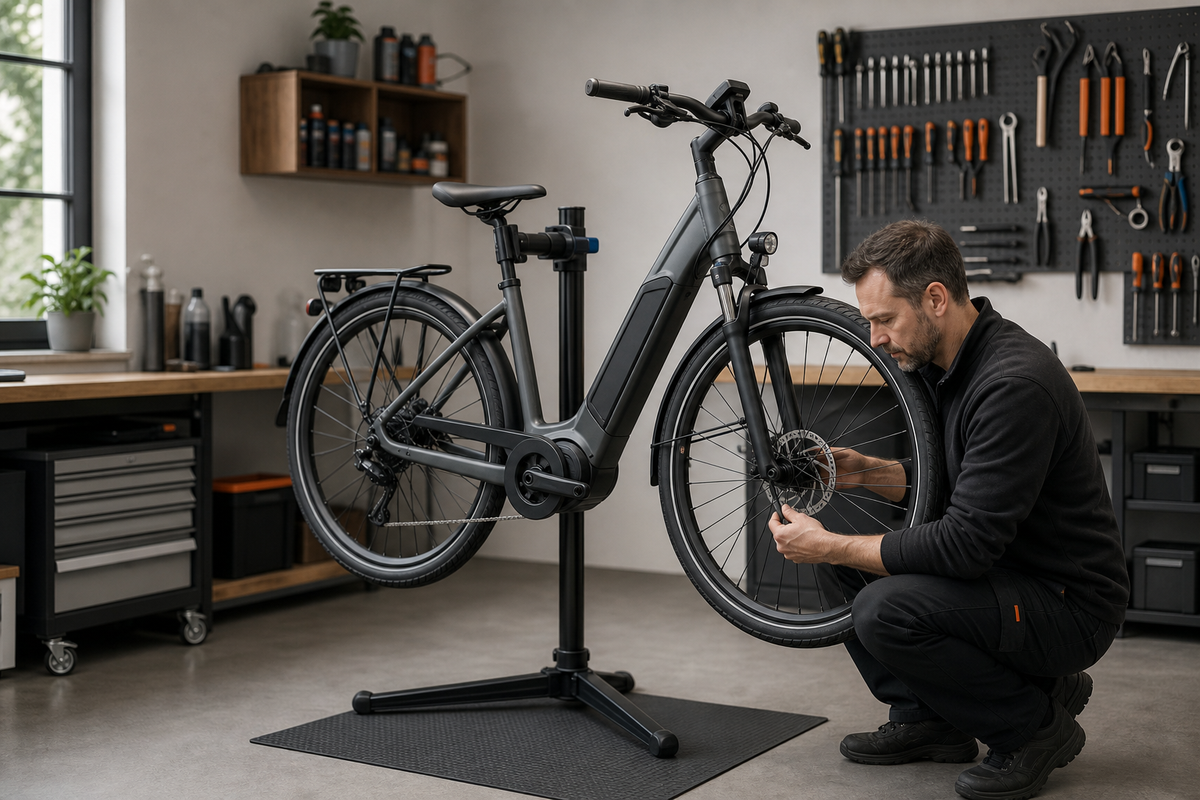
An e-bike inspection is advisable when the manufacturer’s documentation calls for one, and at a minimum when there are unusual braking issues, play in the handlebars or wheels, unusual noises, shifting problems, error messages, or visible damage. For many regularly used bikes, an annual workshop appointment is a practical guideline. However, the decisive factors are the specific model, mileage, operating conditions, and owner's manual—not a rigid deadline found online.
Short answer: What you should know
- An inspection checks the bicycle as a complete system: frame, fasteners, wheels, tires, brakes, drivetrain, lighting, and—where technically possible—the electrical system.
- An annual inspection is a common recommendation, but it does not replace the specifications of the bicycle and component manufacturers.
- Current price examples from major German workshop chains range from €120.00 to €139.99 for a basic e-bike inspection; spare parts and additional work may cost extra.
- Before the appointment, the scope of services, brand compatibility, spare-part costs, and approval for any additional work should be clarified.
- For a Cyseekin e-bike, any problem covered by the warranty should first be coordinated with Cyseekin Support.
The term “inspection” sounds clear, but it is not defined the same way everywhere. One workshop may offer only a safety check, while another may add system diagnostics, a software check, or a detailed inspection report. The price alone is therefore not the only deciding factor. It makes sense to choose an offer that suits the specific e-bike and its components and clearly states the scope of services in advance.
When should an e-bike be inspected?
Shimano describes a complete annual service as a useful guideline and points out that more frequent appointments may be advisable with heavy use or unfavorable conditions. At the same time, Shimano recommends observing the service intervals specified by the respective e-bike manufacturer. It follows that the owner's manual and the instructions for the installed components take precedence over any general rule of thumb.
According to the manufacturer's service interval
If the manual, service booklet, or component documentation specifies an inspection time, this should be followed first. Documented maintenance may also be relevant for warranty or leasing matters.
Before the season or a major tour
After a longer period of storage or before a trip, it is worth booking an appointment well in advance. This leaves time for questions, spare parts, and a subsequent test ride.
After heavy use
High mileage, frequent riding in rain and dirt, heavy loads, or poor roads can increase the need for inspections. A fixed mileage figure therefore does not suit every usage profile.
Immediately if there are warning signs
Declining braking performance, play in the steering or wheels, cracks, loose components, a skipping chain, recurring error messages, or unusual heat generation should not be ignored until the scheduled date.
Do not continue riding if the inspection is inconclusive
If braking performance is significantly reduced, the frame is damaged, the handlebars are loose, the wheel is not securely attached, the rim is severely deformed, cables are exposed, or the battery appears abnormal, do not continue using the e-bike. Do not open the battery or motor yourself.
Inspection, maintenance, and repair: What is the difference?
| Service | Goal | Typical examples | Clarify beforehand |
|---|---|---|---|
| Inspection | Check condition and safety | Visual and functional inspection, identify wear, and check fasteners and adjustments | Which inspection points and documentation are included? |
| Maintenance | Maintain functionality and limit wear | Clean, lubricate, adjust, or maintain according to the manufacturer's specifications | Which materials and labor time are included in the price? |
| Repair | Fix a detected fault | Replace a defective or worn part, repair a cable or connection | Is there a cost estimate and an authorization limit? |
| System diagnostics | Electronically check a compatible e-bike system | Read out the error memory, check for available updates, and create a report | Does the workshop support the installed system exactly? |
What is checked during an e-bike inspection?
The exact scope depends on the workshop, model, and package booked. Shimano names brakes, gears, the chain, and tires among the regular inspection points. Workshop descriptions typically also include fasteners, wheels, motor mounting, connectors, and—if available—system diagnostics or software checks.
Frame and contact points
The frame and fork are checked for visible damage. The handlebars, stem, seat post, pedals, folding joints, and relevant fasteners are checked for secure fit and permissible play.
Wheels and tires
Tire pressure, tread, sidewalls, rims, spokes, and wheel attachment are checked. Cracks, deformation, or noticeable wheel runout must be clarified before continuing the ride.
Brakes
Braking performance, lever feel, lines or cables, pads, and brake discs are checked. Safety-related work should be entrusted to a qualified professional if there is any uncertainty.
Chain and gears
The chain, sprockets, chainring, and shifting function are considered as a system. Measuring wear is more informative than assessing it based solely on color or noise.
Electrical system and drivetrain
The external condition of the battery, mount, cables, connectors, display, sensors, and motor mount is checked. Diagnostics and updates are only possible if the workshop and system are technically compatible.
Lights and functional test
Lighting, controls, and the assistance function are checked. After adjustments or repairs, an appropriate functional check is carried out according to the workshop's specifications.

How much does an e-bike inspection cost?
There is no uniform price nationwide. For orientation, the following market snapshot shows publicly stated prices from three German workshop providers. It was checked on September 2, 2026, and is not a price guarantee for your bike or location.
| Provider | Published price | Important note |
|---|---|---|
| Decathlon | from 120.00 euros | Branch prices may vary; replacement parts are not included. Additional work may be required for bikes outside their own range. |
| Lucky Bike | 129.99 euros | Described as an e-bike inspection including system diagnostics; wear parts and further work are charged separately after consultation. |
| Fahrrad XXL | 139.99 euros | Listed as an annual inspection; replacement parts and additional work may be added after consultation. |
The basic package price therefore answers only part of the cost question. Before handing over the bike, ask whether diagnostics, software checks, cleaning, small parts, and a test ride are included. Also set an authorization limit: If additional work exceeds this amount, the workshop will call you beforehand.
How to prepare for your workshop appointment
- Note the model and documents: Have the manufacturer, model, frame number, purchase date, and relevant manual or service information ready.
- Describe the symptoms specifically: When did the problem start, in which gear or assist mode, in wet conditions or under load?
- Document error messages: Photograph the display, code, and situation instead of describing the error only from memory.
- Confirm compatibility: Ask whether the workshop can diagnose the specific drive system and source suitable replacement parts.
- Clarify the scope of work and costs: Record the package, additional work, parts, appointment, estimated pickup time, and authorization limit in writing.
- Clarify the warranty first: In a potential warranty case, contact the seller or manufacturer before commissioning chargeable work.
What can you check yourself—and what belongs in the workshop?
| Can be checked yourself | Contact a workshop or support |
|---|---|
| Check the tire pressure according to the tire and manufacturer's specifications | Cracks, visible casing, deformed rim, or loose wheel |
| Check the lights, bell, and any obviously loose accessories | Play in the handlebars, fork, folding joint, or bearings |
| Visually inspect the chain for dirt, rust, and damage | Jumping chain, unintended gear changes, or bent parts |
| Carefully check that the brakes function before riding | Reduced braking performance, a leak, an unusually soft lever, or a damaged disc |
| Visually inspect the battery housing and contacts without opening them | Swelling, a severe dent, unusual heat, odor, damaged contacts, or a recurring error message |
For more detailed self-checks, see the Cyseekin guides on chain wear and checking the correct e-bike tire pressure. These tips do not replace a professional diagnosis if a safety-relevant component appears abnormal.
What applies to a Cyseekin e-bike?
Cyseekin asks customers to contact Support first if there is a problem, before visiting a workshop. The team can assess the issue and provide guidance on the next steps or required parts. Especially during the warranty period, inspection and repair should be agreed in advance, as unapproved work may not be reimbursed.
The Cyseekin service and repair page can be used to find a suitable service point. Before the visit, confirm the appointment, availability, brand and system compatibility, scope of services, and any potential costs directly with the workshop. Model-specific documents are available on the user manuals and assembly videos page.
Check the documents first, then arrange an appointment
Have the model, purchase details, symptoms, and photos ready. This allows Support to identify the appropriate service route more quickly and helps the workshop estimate the scope of work more realistically.
FAQ about e-bike inspections
Does an e-bike have to be inspected every year?
Not solely based on a general rule of thumb. An annual comprehensive service is a common recommendation. The intervals specified in the manual, contractual requirements such as those for leasing, and the bike's actual condition take precedence.
How much does an e-bike inspection cost?
The price examples from Decathlon, Lucky Bike, and Fahrrad XXL checked on September 2, 2026, range from €120.00 to €139.99 for the respective inspection service. The store, scope of services, system diagnosis, spare parts, and additional work may change the final price.
What is done during an e-bike inspection?
Typical checks include the frame and fasteners, wheels, tires, brakes, chain, gears, lighting, and electrical connections. A system diagnosis or software update is included only if it is offered and compatible with the installed system.
How long does an e-bike inspection take?
The actual working time may be several hours, depending on the scope. The actual pickup time also depends on workload, diagnostics, follow-up questions, and the required spare parts. It should therefore be confirmed specifically when booking the appointment.
Can any bike workshop service every e-bike?
Not every workshop has diagnostic access, training, or spare parts for every system. Before the appointment, provide the bike model, drive system, requested service, and parts availability, and explicitly confirm acceptance.
Is battery diagnostics always included in the inspection price?
No. The scope of services and technical capabilities vary. Ask whether the service includes only an external inspection or also compatible electronic diagnostics and a report. A battery is not opened without authorization.
Sources and test criteria
- Shimano: Caring for your e-bike at home and at the dealer – annual maintenance as a guide, more frequent checks with heavy or unfavorable use, plus information on brakes, gears, battery, and firmware; checked on September 2, 2026.
- Shimano: Service checklist – brakes, wheels, gears, chain, tires, and electrical system; checked on September 2, 2026.
- Cyseekin: Service and repairs – support coordination, service points, warranty information, and clarification of costs; checked on September 2, 2026.
- Cyseekin: User manuals and assembly videos – model-specific documents; checked on September 2, 2026.
- Decathlon: E-bike inspection – 120.00 euros, branch and spare-parts information; checked on September 2, 2026.
- Lucky Bike: Specialist workshop and e-bike inspection – 129.99 euros including system diagnostics, service description and note on additional costs; checked on September 2, 2026.
- Fahrrad XXL: Workshop and annual inspection – 139.99 euros, service description and note on additional costs; checked on September 2, 2026.
Editorial note: This article is based on the linked information from manufacturers, brands, and workshops. No independent workshop or product test was conducted. Prices and services may change; the current offer from the selected workshop and the documents for the specific e-bike are authoritative.

Share:
E-bike tire puncture on the go: Repair it or call for help?
Danube Cycle Path in 12 stages: from Donaueschingen to Passau