

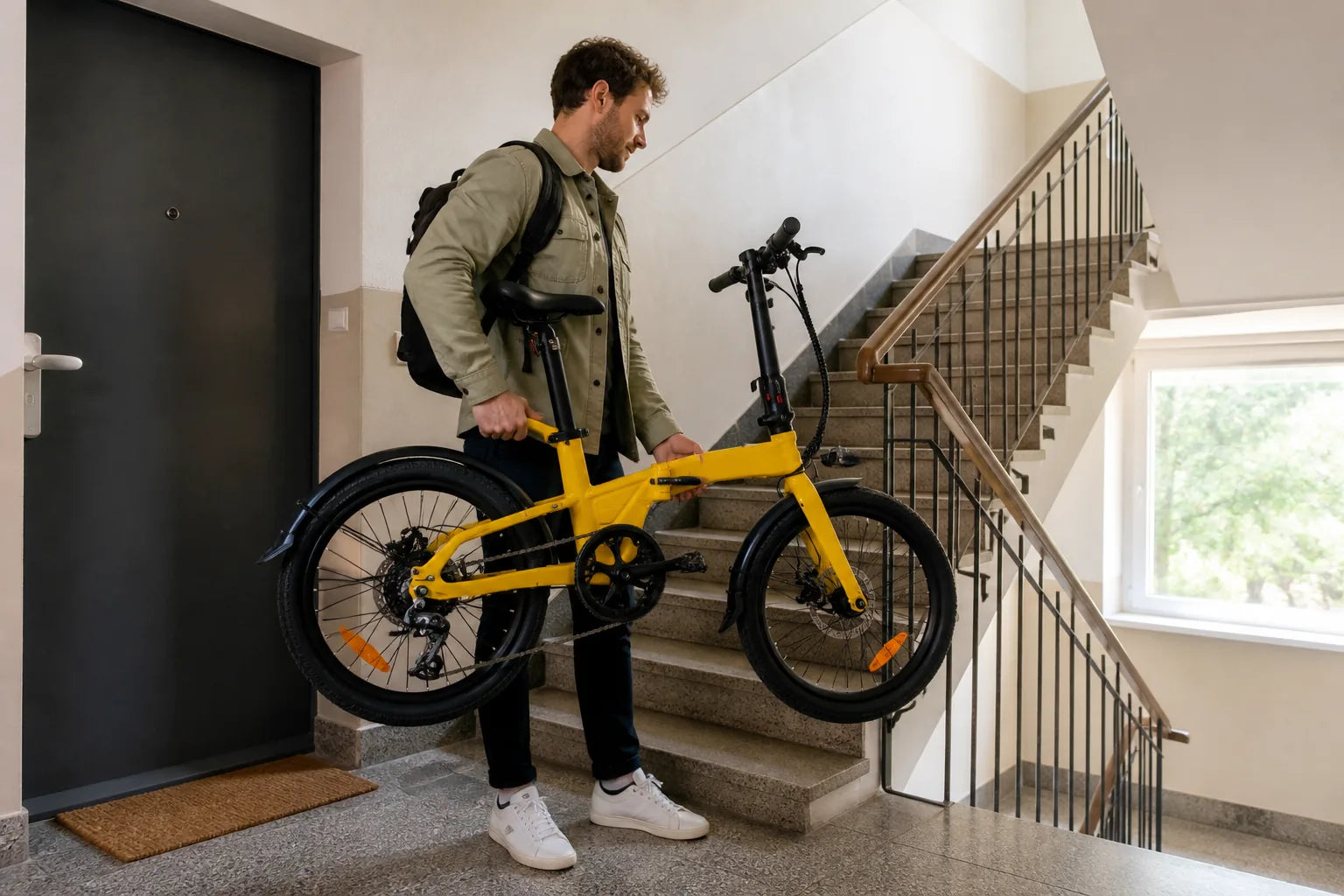
Before using it every day, it is therefore worth doing a dry run: remove the luggage, switch off the bike, clear the route and check whether you can lift the complete bike close to your body without losing sight of the steps or your field of vision.
In brief
Which staircase situation is realistic in everyday use?
A single wide basement staircase is different from four floors in an older building with a narrow turning landing. That’s why you should consider not only the bike, but the entire route.
| Situation | What matters | A sensible decision |
|---|---|---|
| Several floors every day | Repeated exertion, a secure gripping position, clear visibility and sufficient space to set the bike down | Be sure to test with the complete bike; if in doubt, choose ground-level storage or an elevator. |
| Occasional use on a few steps | Dry, well-lit steps and a short, unobstructed route | Remove luggage and calmly test the process with a second person. |
| Narrow or winding staircase | Handlebar width, bike length, center of gravity and available platform space | Measure beforehand; folding can reduce the length, but does not automatically improve the grip. |
| Elevator available | Cabin dimensions, door width and turning space | Pushing or folding the bike in a controlled manner is usually the better solution than carrying it. |
Weight, grip and center of gravity go hand in hand
When lifting, it’s not just the number on the scale that matters. A long or bulky bike can be significantly harder to control when it remains far from your body. The German Federal Institute for Occupational Safety and Health recommends, among other things, avoiding unnecessary handling when manually moving loads, keeping the load close to your body, and maintaining a safe position with a clear view.
- Consider the ride-ready weight: The battery, lock, basket, bags, and other accessories are part of the real everyday situation.
- Grip only solid frame parts: Do not lift it by the cables, display, mudguard, seat-post quick release, or moving folding parts.
- Control the center of gravity: When lifted, the bike should not suddenly tip or hit your legs or the railing with the pedals or handlebars.
- Keep the steps in view: As soon as the frame or handlebars obscure your feet, the process can no longer be planned safely.

Folding makes an e-bike more compact—not automatically lighter
With a folding e-bike, the smaller folded dimensions can be helpful in an elevator, car trunk, or on a wide landing. On a narrow staircase, however, the folded bike may become more awkward to handle if the two wheels swing against each other or there is no comfortable grip position.
According to the current product page, the Cyseekin C10 weighs 18.6 kg including the battery and measures 815 × 400 × 690 mm when folded. The battery is removable and lockable. These specifications are helpful for planning but do not replace a lifting test: even a compact bike must be capable of being lifted and set down steadily on your own staircase.
Carry it folded or unfolded?
The better position depends on the route. When unfolded, the frame and wheels are clearly secured; when folded, the bike is shorter. Before using it for the first time, both configurations should be tested on level ground. The folding mechanism must be fully locked, and loose parts must not move when lifting.
A safe seven-step trial run
- Clear the route: Remove shoes, parcels, and other obstacles; ensure good lighting and dry steps.
- Switch off the bike: Deactivate the drive system and remove the key if the model uses one.
- Remove everything loose: Carry bags, shopping, bottles, and any accessories that are not firmly attached separately.
- Remove the battery only as instructed: A removable battery can make the bike lighter. Protect the contacts and carry the battery separately and safely; follow the model-specific instructions in the manual.
- Lift it on level ground: From a straight, stable stance, check whether the bike stays close to your body and can be set down again in a controlled manner.
- Make the first attempt with two people: A second person should secure the route but must not stand below the bike.
- Take the stop criterion seriously: If your grip slips, visibility is obstructed, or the bike hits the railing, do not improvise.
A walk-assist function is intended for level paths or suitable ramps. On ordinary stairs, it does not replace safe carrying technique and should not be used there as a general solution.
When carrying it every day is not practical
At that point, more practice is not automatically the best answer. A safe ground-level storage option, a sufficiently large elevator, an approved ramp, or a different bike concept may be more suitable. Before buying, the ADAC also recommends lifting a pedelec if it will later need to be carried up and down stairs regularly.
Anyone still weighing up weight, folded dimensions, and intended use can find a cross-model overview in the Cyseekin C10/S10/C20 buying guide. The latest technical specifications and variants are always listed on the respective product page.
FAQ: Carrying an e-bike up the stairs
Is a folding e-bike automatically easier to carry?
No. The folded dimensions can reduce the length and space required, but do not change the actual weight. In addition, the handle position and center of gravity may be less favorable when folded. Both positions should therefore be tested on level ground.
Should the battery be removed before carrying?
If the bike is designed with a removable battery, removing it can make the bike lighter. The instructions in the relevant manual are decisive. The switched-off battery must be carried separately and securely and protected from impacts, moisture, and damaged contacts.
Is 18.6 kg easy to carry on stairs?
There is no blanket answer. The figure describes the C10 including the battery, but the shape of the stairs, handle height, center of gravity, body size, and frequency determine whether the bike remains controllable. A realistic trial run is more informative than the weight specification alone.
Can the push-assist function move the e-bike over steps?
It is not a general solution for stairs. Depending on the model, a push-assist function can provide support on suitable level paths or ramps. On steps, there is a risk of uncontrolled drive movement or slipping; the model-specific manufacturer's instructions apply exclusively here.
Does a carrying strap help with an e-bike?
Only if the strap is expressly designed for the specific weight and suitable fixed attachment points. It must not place stress on moving parts or cables, and must not create a tripping or snagging hazard. Without appropriate manufacturer approval, no improvised strap should be used.
What is the best solution if I cannot lift the bike safely?
Do not continue trying alone. A secure ground-level storage location, an elevator, an approved ramp, or a different bike concept is then the more sensible solution. A trial run with a specialist retailer or a second person can also help confirm the decision.
Sources and Test Bench
Technical specifications and safety information were reviewed on August 21, 2026. Availability and product configuration may change; the current product page is decisive.
Share:
Metal Bike Phone Mount: What Really Matters
Riding an E-Bike in the Rain: Protection for the Battery, Display, and Brakes